Wedding Centerpiece Ideas for Round Tables (3-2-1 Formula)
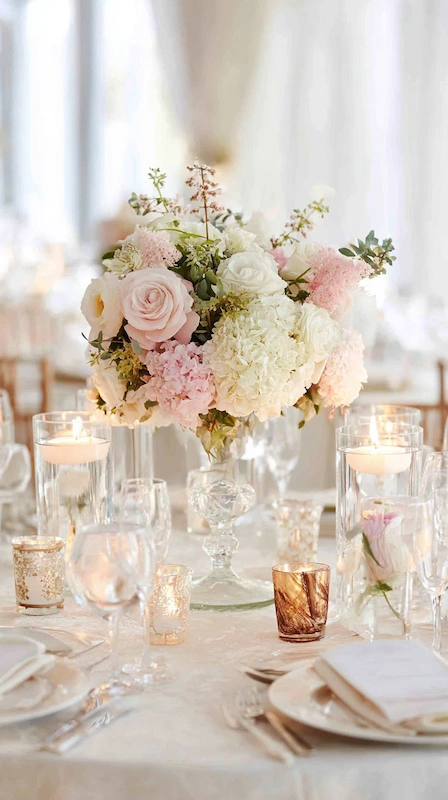
The difference between a centerpiece that looks styled and one that looks like a last‑minute pile of pretty things is rarely the flowers. It’s structure.
Light-and-airy tables need structure even more than bold palettes do—because when everything is soft (ivory linen, clear glass, pale blooms), the design can disappear in photos… or swing the other way and look cluttered.
That’s where the 3‑2‑1 formula comes in: a simple method that works for floral centerpieces, candle-forward designs, and even nonfloral tables—especially on one of the most common reception setups: the 60‑inch round.
- 1 focal point (the hero)
- 2 textures (soft + reflective)
- 3 heights (low + medium + a tall accent)
Want the centerpiece to feel cohesive with the rest of the place setting? Start with a complete wedding tablescape first.
What The 3-2-1 Wedding Centerpiece Formula Means
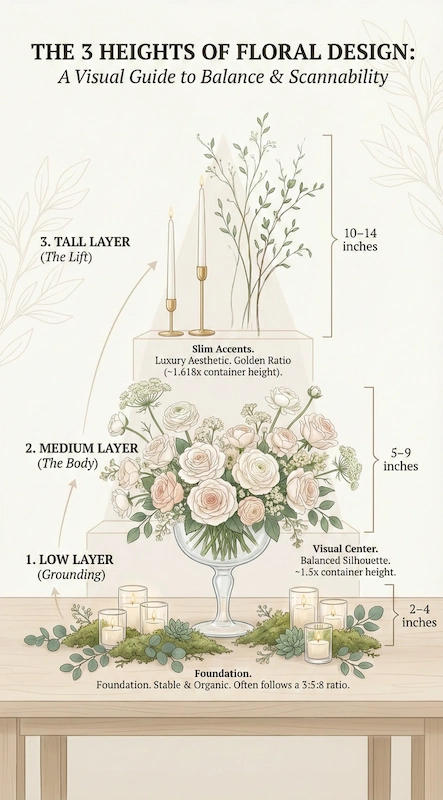
The 3: three heights
When designing a wedding centerpiece, you are adding dimension on purpose, not by accident.
- Low layer (about 2 to 4 inches), grounding elements that spread the design outward and make the table feel full without blocking conversation.
- Medium layer (about 5 to 9 inches), the body of the centerpiece, this is where the eye wants to rest.
- Tall layer (about 10 to 14 inches, used sparingly), a thin vertical accent that breaks the pancake look and gives the table a little lift.
Light & airy tip: Keep tall elements slim. Tapers and airy branches read elegant. Bulky tall vases read heavy.
The 2: two textures
Texture is a fundamental pillar of floral design architecture; it is what makes a soft palette show up in photos rather than looking flat
Pick:
- One soft organic texture, petals, airy greenery, loose floral movement, even ribbon.
- One hard or reflective texture, glass, metal, ceramic glaze, stone, crystal.
Two textures are the sweet spot: enough contrast to feel curated, not so many materials that the table looks busy.
The 1: one focal point
Your focal point is the element with the most visual weight. It is the main character.
Good focal-point options:
- a low compote arrangement
- one premium bloom type repeated, ranunculus, roses, sweet peas
- a statement vessel
- a sculptural candle cluster
Rule: If you have two focal points, you actually have none. The wedding centerpiece will simply read as noise
Why this formula works so well for light and airy round tables
Light and airy tables are usually built from white or ivory linens, clear glassware, soft blooms, and delicate candlelight.
That is gorgeous, but it is also low contrast. The 3‑2‑1 method forces you to add height variation to give the design shape, a controlled second texture to prevent it from photographing flat, and one hero to tell the table’s story clearly.
These wedding centerpiece ideas are designed specifically for round tables (especially 60-inch rounds).
Step by step, build a 3-2-1 Wedding centerpiece for a 60-inch round table

A 60‑inch round typically seats 8–10 guests, depending on chair size and the formality of your place settings. Keep your centerpiece contained to a comfortable center zone so it doesn’t creep into plates, glassware, or elbows.
If you’re mapping guest groups too, these wedding seating arrangements tips make round tables much easier.
Step 1: Choose the focal point (the 1)
Before you pick extras, decide what the wedding centerpiece is really about.
Light and airy focal options that always work:
- Low compote arrangement in whites and soft greens
- Bud vase cluster where the focal is one flower variety repeated
- Candle cluster focal where florals are minimal and the glow is the hero
Budget vs. luxury mindset
Budget: Make the focal point about the shape. A simple vessel or one flower type repeated looks designed.
Luxury: Make the focal point about the material. Use premium blooms, heavy glass, custom ceramics, or refined mechanics.
Step 2: lock in your two textures, the 2
For light and airy centerpieces, the easiest pairing is soft florals or greenery plus clear glass candleholders or glossy ceramic.
Good texture pairs:
- petals, clear glass votives
- airy greenery, glazed ceramic bud vases
- soft ribbon detail, glass and wax candlelight
Practical rule: Keep your hard texture consistent. If you choose clear glass votives, don’t add silver mercury glass, gold candlesticks, and mirrored bases on the same table unless you have a very controlled plan.
Step 3: build the three heights, the 3
Now you assemble the layers.
Low layer (2–4 inches):
- votives
- low bud vases
- tiny clusters of greenery
- small fruit accents, if you are doing a market vibe
Medium layer (5–9 inches):
- a low compote centerpiece
- a clustered group of bud vases
- a short candleholder set
Tall layer (10–14 inches):
Keep tall elements slim and airy so the table still feels open for conversation.
- 2 to 3 taper candles
- one slightly taller bud vase
- one airy branch element
On a 60-inch round, tall accents should be few. Two to three tapers is usually enough to create lift without turning the centerpiece into a forest.
Step 4: place it on the table, the spacing map
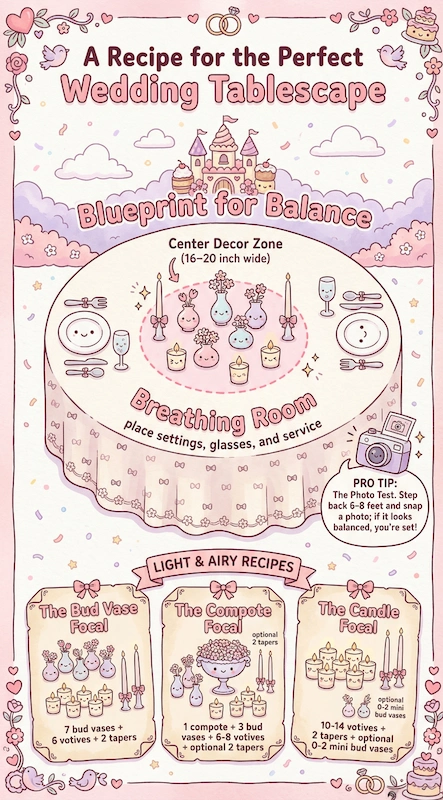
Use these boundaries and your tables will look styled and feel comfortable.
- Create a defined center decor zone (roughly 16–20 inches wide for most 60‑inch rounds).
- Leave breathing room near the edge so place settings, glasses, and service stay effortless.
Quick light-and-airy counts that work for most weddings:
- Bud vase focal, 7 bud vases, 6 votives, 2 tapers
- Compote focal, 1 compote, 3 bud vases, 6 to 8 votives, optional 2 tapers
- Candle focal, 10 to 14 votives, 2 tapers, optional 0 to 2 mini buds
Photo test: Step back 6–8 feet and take a quick photo with your phone. If it looks balanced there, it will look balanced in professional images.
Five light and airy Wedding centerpiece recipes using the 3-2-1 method, built for 60-inch rounds
Each wedding centerpiece recipe below follows the same structure: one focal point, two textures, three heights, plus simple counts and a budget and luxury way to execute it.
Recipe 1, The Bud Vase Garden
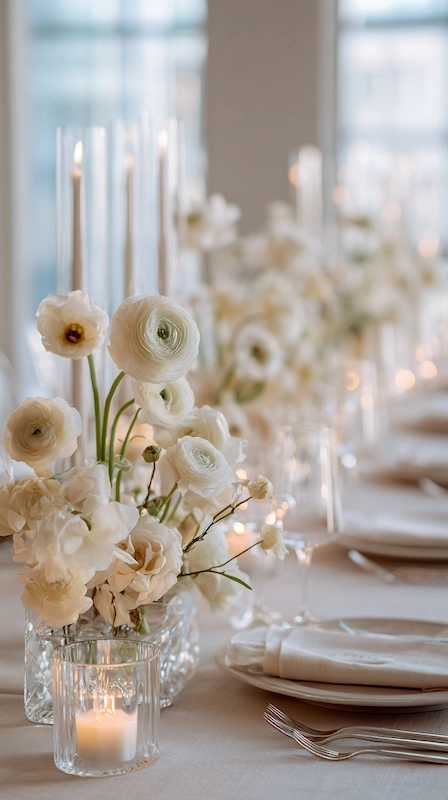
This is the easiest way to get that editorial scattered but intentional look without a giant centerpiece.
1 focal point: one premium bloom type repeated, like roses or ranunculus, the repetition becomes the hero.
2 textures: soft petals, clear glass bud vases and clear votives.
3 heights: low, 6 votives. Medium, 7 bud vases, 1 to 2 stems each. Tall, 2 tapers in slim holders.
Budget version: Identical bud vases bought in bulk. Grocery florals in one color family. Keep it simple and consistent.
Luxury version: Curated vintage bud vases in one family. Premium stems with movement (sweet peas, butterfly ranunculus). Upgraded heavy-glass votives.
Recipe 2, Low Compote plus a Glow Ring
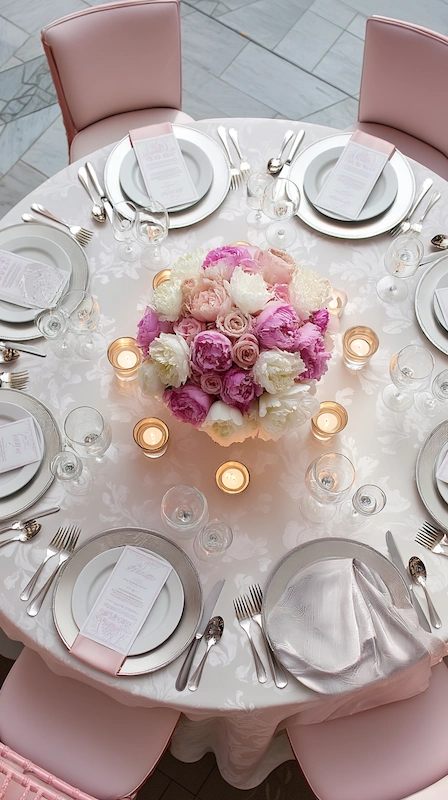
This is classic wedding centerpiece energy, refined, low, and conversation‑friendly.
1 focal point: one low compote arrangement, 8 to 12 inches wide.
2 textures: soft florals, glass or subtle metallic candleholders.
3 heights: low, 8 votives to create the ring around the compote. Medium, the compote itself. Tall, 2 thin tapers, optional, only if you want lift.
Budget version: keep the compote slightly smaller and let candles widen the footprint, candles are your volume.
Luxury version: a fuller compote with refined mechanics and premium blooms, plus coordinated candleholders in a single finish.
Recipe 3, The Candle Focal, Flowers as an Accent

This is for couples who want the table to feel romantic and airy without spending heavily on florals.
1 focal point: a clustered candle moment, not a flower arrangement.
2 textures: wax and flame glow, clear glass, votives, hurricanes, or holders.
3 heights: low, 10 to 14 votives, this recipe needs density in the low layer. Medium, 2 to 4 slightly taller glass holders. Tall, 2 tapers to create lift.
Budget version: LED votives if needed, mixed with a few real flames where allowed, keep all holders clear so it reads light.
Luxury version: real flame everywhere, premium holders, and one tiny floral accent, like two bud vases, to soften the look.
Recipe 4, Airy Greenery Base with Bud Accents

This gives you the garden feeling while staying light and not over floral.
1 focal point: a low greenery island in the center, about 18 to 22 inches across, kept flat and soft.
2 textures: airy greenery, clear glass candles or glazed ceramic buds.
3 heights: low, 6 votives tucked along the greenery edge. Medium, 3 bud vases nested into the island. Tall, 2 tapers or one airy branch element.
Budget version: greenery does most of the work, add only a few blooms for softness.
Luxury version: more nuanced greenery mix, not just one leaf, plus premium white blooms tucked into the base for dimension.
Recipe 5, The Single Statement Vessel, supported not crowded

This is the cleanest path to high end, because it is edited.
1 focal point: one beautiful vessel with a simple arrangement, the vessel is part of the design, not an afterthought.
2 textures: soft florals, ceramic or stone, plus clear glass votives.
3 heights: low, 4 to 6 votives. Medium, 1 statement vessel arrangement. Tall, 2 tapers if you want height, otherwise keep it all low and let negative space do the luxury work.
Budget version: choose one affordable but substantial vessel per table, or rent a set, keep the floral recipe minimal and consistent.
Luxury version: designer ceramics or heavy stoneware, fewer stems but better stems, intentional asymmetry, and pristine candleholder styling.
Common mistakes with 3-2-1, and the quick fix

Mistake, everything is medium height
The table feels flat and undecided. Fix: Add two thin tapers. Or remove items and commit to low-only with a stronger candle layer.
Mistake, you used three or four textures
The table starts to feel decorated, not designed. Fix: Remove the odd material out, often it is an extra metal finish, glitter, acrylic, or mirrored pieces that do not match the rest.
Mistake, no true focal point
It looks like a collection of equally important items. Fix, choose one hero, then downgrade the rest, fewer stems per bud vase, simpler holders, fewer competing objects.
Mistake, tall elements are bulky
Guests cannot see each other and the table feels crowded. Fix, make tall accents thin, tapers and airy branches are your friend.
Mistake, the Wedding centerpiece footprint is too small
It gets lost in the table. Fix, widen it with a low layer, more votives, an extra two bud vases, or a greenery base.
Budget vs luxury upgrade map, what changes the look the most

If you want the centerpiece to look more expensive, prioritize upgrades that show up in photos and repeat across every table.
High impact upgrades for light and airy tables:
- a matching set of clear glass votive holders
- upgraded linen napkins or a better tablecloth texture
- fewer, better stems instead of many varieties mixed together
- one statement vessel used consistently
What to keep simple:
- table numbers, keep them clean and readable
- menus, consider one per table if your place settings are already detailed
- extra tabletop signage, most tables do not need it
Choose one splurge: Premium blooms or upgraded linens or upgraded glassware or premium candleholders. Trying to splurge on all of them usually pushes you into clutter.
Quick checklist, build your centerpiece using 3-2-1
- 1 focal point chosen
- 2 textures selected and repeated
- 3 heights present, low, medium, tall
- centerpiece stays within a 16 to 20 inch center zone on a 60-inch round
- nothing blocks guest sightlines
- phone photo test looks balanced from 6 to 8 feet away
FAQ
Can I use the 3-2-1 method if I want all low centerpieces
Yes. For a low wedding centerpiece, treat ‘tall’ as a thin taper candle or one slightly taller bud vase.
How many candles is too many on a 60-inch round
When guests start losing space for water glasses and service feels cramped. As a rule of thumb, once you’re above ~14 votives on a 60‑inch round, it can start to feel crowded unless the rest of the centerpiece is very minimal.
Does this work for non floral centerpieces
Yes. Swap the soft texture for something organic like fruit, fabric, or paper, keep the hard texture as glass or ceramic, and still build low, medium, tall.