Popular Engagement Rings That Will Still Turn Heads in 20 Years
Some engagement ring styles rise fast and fade just as quickly. The ones worth focusing on are the designs that remain elegant, wearable, and genuinely beautiful decades after the wedding day.
That’s what this guide is about. We’ve rounded up the most popular engagement ring styles right now, what makes each one special, and which styles are most likely to look beautiful long after current trends fade.
Whether you’re drawn to classic engagement rings with clean, understated lines or something bold and unique that makes a statement, the best engagement rings are always the ones that feel completely and unmistakably you.
Trend Alert: Lab-grown diamonds are among the fastest-growing engagement ring choices, offering the same brilliance as mined stones at a significantly lower price point. If you’re looking for affordable engagement rings without sacrificing quality, this is worth exploring with your jeweler.
Quick Comparison: Popular Engagement Ring Styles at a Glance
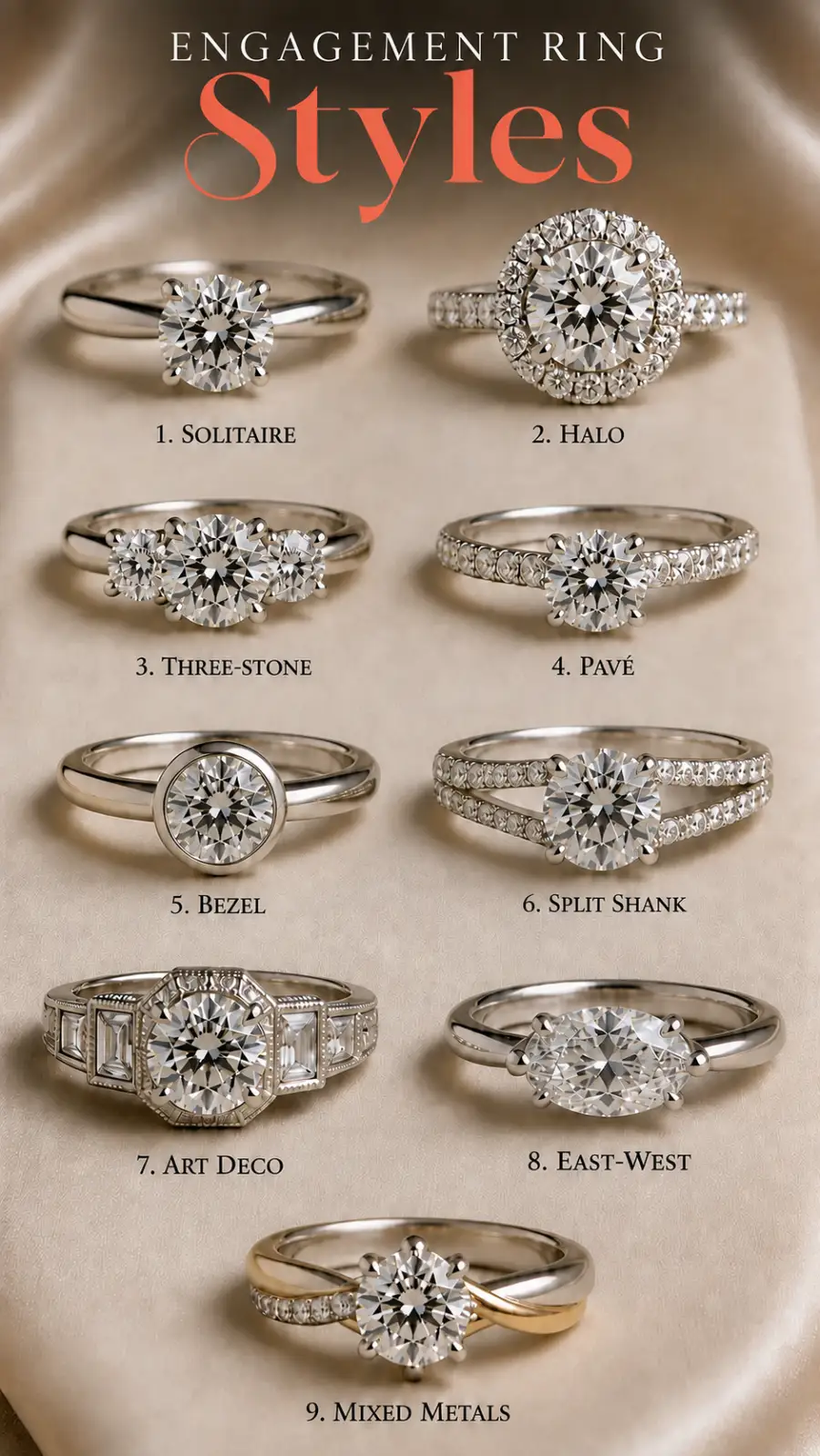
Not sure where to start? Use this table to compare the most popular styles before diving into the full breakdown below.
| Style | Best For | Timelessness | Maintenance | Overall Look |
|---|---|---|---|---|
| Solitaire | Classic taste, minimal style | Extremely timeless | Low | Clean, elegant |
| Halo | Maximum sparkle, budget-conscious on stone size | Very timeless (when refined) | Moderate | Brilliant, romantic |
| Three-Stone | Symbolism lovers, balanced design | Very timeless | Low to moderate | Balanced, meaningful |
| Pavé | Sparkle seekers, detail-oriented | Timeless | Moderate | Glittering, refined |
| Bezel | Active lifestyles, minimalist aesthetic | Very timeless | Low | Sleek, modern |
| Split Shank | Statement-seekers, larger center stones | Style-dependent | Moderate | Dramatic, architectural |
| Art Deco / Vintage | History lovers, one-of-a-kind seekers | Very timeless | Moderate to high | Distinctive, romantic |
| East-West | Non-traditional, contemporary taste | Trend-forward | Low to moderate | Modern, unexpected |
| Mixed Metals | Style-forward, decisive on metal mix | Trend-forward | Low to moderate | Distinctive, modern |
Current Engagement Ring Trends With Staying Power
The engagement ring trends shaping the market right now lean in two directions: timeless elegance and bold individuality. Couples are gravitating toward classic silhouettes with unexpected twists, mixing metals, experimenting with diamond shape, and choosing colored gemstones as their engagement ring center stone.
But here’s the deal: the most important ring trend right now isn’t a specific style. It’s personalization. More couples than ever are working with custom engagement rings that reflect their unique story rather than defaulting to whatever appears most popular on social media.
Here are the top engagement ring trends gaining traction right now:
- Hidden halo settings are having a serious moment, adding subtle sparkle from below without changing the ring’s silhouette from above.
- East-west settings are increasingly popular, especially for oval, marquise, and emerald cut stones.
- Lab-grown diamonds have become a mainstream choice, no longer just a budget alternative but a preferred option for many couples.
- Mixed metals continue to rise in popularity, particularly white gold paired with yellow gold or rose gold accents.
- Colored diamonds and sapphires as center stones are growing fast, with couples looking for something genuinely one-of-a-kind.
Classic Solitaire: The Diamond Solitaire That Never Goes Out of Style
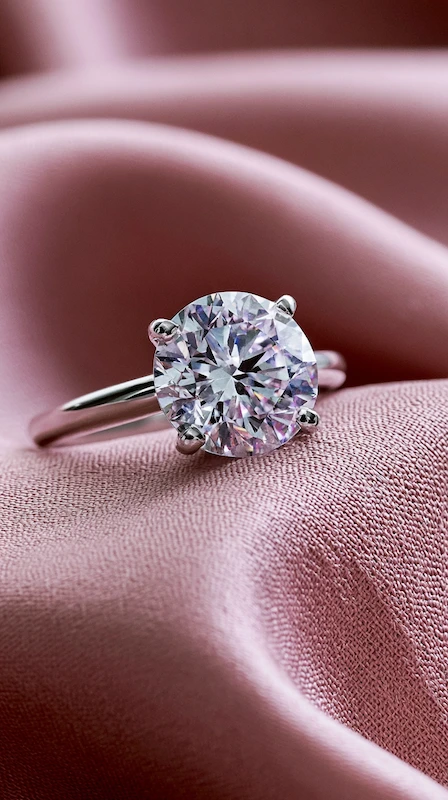
When it comes to timeless engagement rings, nothing beats the classic solitaire. A diamond solitaire features a single diamond in a clean, understated setting that puts all the focus on the stone itself.
That’s the whole point. The solitaire engagement ring isn’t trying to compete with anything. It’s confident, elegant, and completely versatile when it comes to pairing with a wedding band or wedding ring down the line.
A classic solitaire is typically available in prong or bezel settings. The prong setting lifts the diamond higher to maximize light return and brilliance. The bezel setting wraps the center stone in a slim metal rim for a sleeker, more modern look.
Why it lasts: The solitaire has one defining strength: it is never dependent on a trend. Because the design removes everything except the diamond, it has no period-specific details that can feel dated. A well-chosen solitaire from any decade looks just as relevant today.
Key Takeaway: The round diamond is still the most popular engagement ring shape for a solitaire, but cushion, oval, and emerald cuts all work beautifully in a simple setting. If you love classic engagement rings with zero fuss, a diamond solitaire is where to start.
Best for: Couples who value timelessness above all else, those who prefer understated elegance, and anyone who wants maximum flexibility when pairing with a wedding band.
- Single center stone with no side stones or surrounding diamonds
- Available in white gold, yellow gold, rose gold, or platinum
- Works across every diamond cut, from round to princess to asscher. Our guide to popular diamond cuts for engagement rings is worth reading alongside this one.
- One of the most affordable engagement rings to build on with a pavé or diamond wedding band
- A solitaire engagement ring is one of the least likely styles to ever feel dated. It is as close to a guaranteed choice as fine jewelry gets.
Halo Rings: Maximum Sparkle Around Your Center Stone
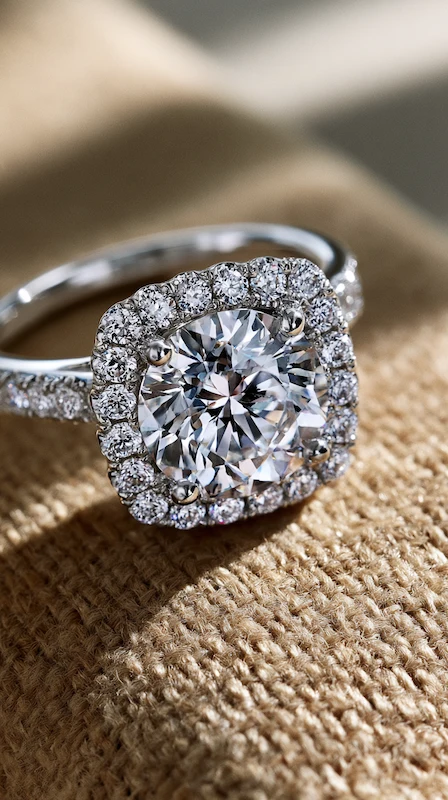
The halo engagement ring has long been one of the most popular engagement ring designs, with origins tracing back to at least the 1920s, and it shows no sign of fading. The design features an engagement ring center stone surrounded by a ring of smaller diamonds, creating the illusion of a much larger diamond while adding serious sparkle.
Halo rings are available in round, cushion, oval, pear, and marquise shapes. The hidden halo is a variation worth knowing about: instead of framing the top of the stone, the smaller diamonds are set underneath, adding brilliant light that catches as the wearer moves.
Why it lasts: A refined, proportional halo is genuinely timeless because it enhances the center stone without overpowering it. Where halo rings can feel more trend-specific is when the halo is very heavy or stacked in a double layer. A scaled halo that complements the stone rather than competing with it tends to age far better.
Expert Insight: Halo or pavé combinations are among the most popular engagement ring designs for couples who want maximum visual impact. If carat weight is a concern, a well-designed halo can make a 0.75ct center stone look significantly larger without changing the diamond itself.
Best for: Couples who want maximum sparkle, anyone looking to make a smaller center stone appear larger, and those drawn to romantic, brilliant-looking fine jewelry.
- A halo framing a cushion or oval center stone creates a lush, romantic look
- Hidden halo rings offer sparkle from below without changing the ring’s silhouette from above
- The halo or pavé combination is a top choice for unique, classy engagement rings
- Available in white gold, yellow gold, and platinum settings
- Choose a proportional halo over an oversized one for the best long-term wearability
Three-Stone Rings: Balanced Design, Lasting Meaning
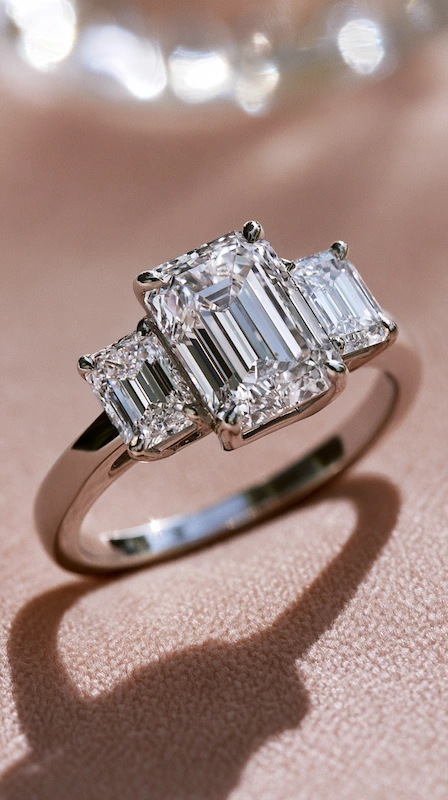
Three stone engagement rings carry a meaning most couples find immediately compelling. The two smaller stones on either side represent the past and future of the relationship, while the center diamond represents the present.
It’s a design that makes a ring feel like more than a piece of jewelry. Three-stone rings are available in a wide range of diamond shapes. A round diamond flanked by pear side stones is one of the most popular center stone combinations. Cushion and emerald cut centers with matching side stones are also a strong choice.
Why it lasts: The three-stone ring endures for two reasons: its symbolism and its visual balance. The symmetrical structure of two smaller stones flanking a larger center stone is one of the most harmonious ring designs available, and that structural elegance does not go out of fashion.
Pro Tip: Three-stone rings work especially well when the side stones are a different shape than the center diamond. A round center stone flanked by two tapered baguettes gives a completely different feel than a cushion flanked by two round diamonds. Talk to your jeweler about what works best for your chosen carat weight.
Best for: Couples who want a ring with emotional significance, those who love a balanced and structured look, and anyone who wants side stones without going full pavé.
- Three-stone rings symbolize past, present, and future
- Two smaller stones frame the center stone on either side
- Popular in white gold, yellow gold, and platinum settings
- Available across a wide range of center stone sizes
- Three-stone rings with colored gemstone side stones, like sapphire, are increasingly popular for couples who want special engagement rings with a personal touch
Pavé Settings: The Band That Adds Sparkle Without Changing the Stone
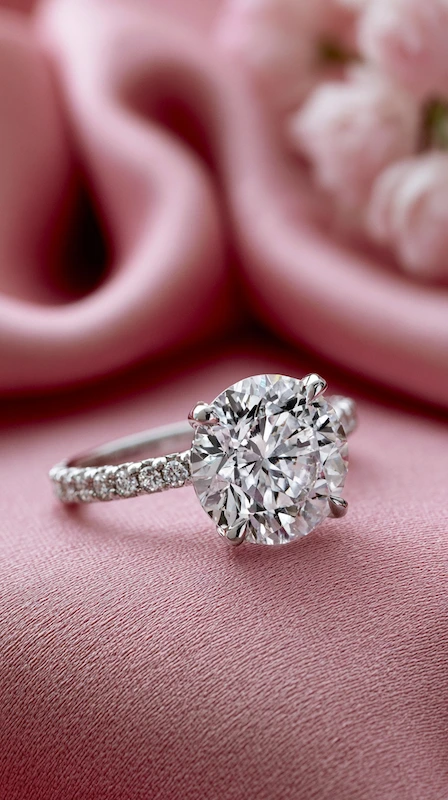
Pavé, from the French word for “paved,” describes a setting where small diamonds are set closely together along the band, creating a continuous surface of glittering light. It’s one of the most popular styles for adding brilliance and dimension to a diamond engagement ring without increasing the size of the center stone.
Pavé settings come in several variations: standard pavé, micro-pavé (even smaller stones set more tightly together), and pavé applied to both sides of the band. Side stones in a pavé arrangement are also commonly used to draw the eye toward the center diamond.
Why it lasts: Pavé has been used in fine jewelry for well over a century. The reason is simple: it adds sparkle and perceived value without requiring a larger center stone, and its visual effect is universally flattering. A clean micro-pavé band, in particular, tends to photograph beautifully across every era.
Styling Hack: Pavé settings pair beautifully with almost any center stone style. They work particularly well with solitaires, halo rings, and split-shank designs. Just know that pavé diamonds require a bit more maintenance than a plain band, so ask your jeweler about the recommended care schedule.
Best for: Couples who want extra sparkle without a larger center stone, anyone who loves detail-oriented fine jewelry, and those pairing a pavé band with a solitaire center.
- Pavé diamonds are held in place by tiny metal beads or prongs
- Standard pavé and micro-pavé are the two most common pavé settings
- A pavé band adds visual weight and sparkle without affecting carat weight
- Popular for both engagement rings and matching wedding bands
- Pavé settings are especially popular in white gold and platinum
Bezel Setting: Clean Lines, Modern Feel, and Maximum Protection
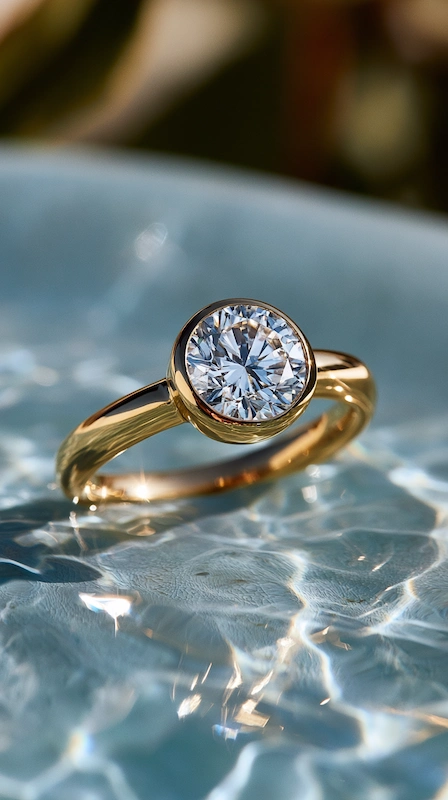
The bezel setting is one of the most underrated engagement ring settings out there. Instead of prongs, the bezel wraps a thin rim of metal around the girdle of the diamond, securing the center stone from all sides.
Here’s what I’ve learned: couples who work with their hands or live active lifestyles consistently gravitate toward bezels. There are no prongs to catch on anything, no sharp edges, and the diamond sits closer to the finger for a sleek, low-profile look.
Bezels are available as full bezels (enclosing the entire diamond) or partial bezels (leaving the sides open to let in more light). A bezel setting in white gold versus yellow gold gives the ring a completely different personality, so it’s worth exploring both options with your jeweler.
Why it lasts: Clean lines age extraordinarily well in design. The bezel setting is essentially minimalism applied to jewelry: strip everything back to its purest form. That restraint is exactly what makes it feel as current today as it did decades ago.
Actionable Tip: If you love clean lines and a minimal profile, pair a bezel setting with an east-west oriented stone. East-west settings with bezels are one of the most elegant, unique engagement ring combinations gaining momentum right now.
Best for: Active lifestyles, minimalist aesthetics, low-maintenance everyday wear, and couples who want a modern look that won’t feel dated.
- Full bezel and partial bezel setting options are available
- No prongs means no snagging and no worry about prong wear over time
- Bezels are ideal for oval, cushion, and marquise center stones
- A bezel setting pairs well with simple gold bands for a modern, minimalist look
- Available in white gold, yellow gold, rose gold, and platinum
Split Shank: A Popular Engagement Ring Setting That Makes a Statement
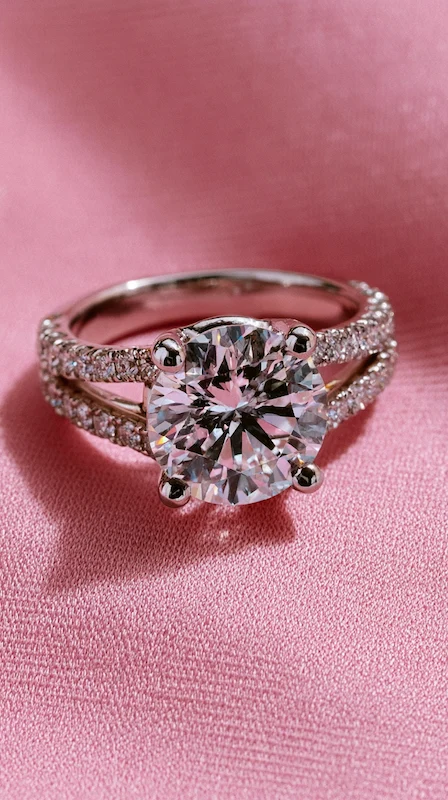
The split shank engagement ring features a band that divides into two as it approaches the center stone, creating a V-shape or open-frame effect around the setting. It’s dramatic, architectural, and unmistakably bold.
This ring style tends to suit larger center stones particularly well, since the open split draws the eye directly to the diamond. It’s also one of the most popular styles for custom engagement rings because there are so many ways to personalize the split: plain metal, diamond-set, twisted, or tapered.
Why it lasts: A split shank with clean lines and restrained detailing can be genuinely timeless. The key is proportion. A subtle, elegant split that frames the center stone tends to age well. More ornate versions with heavy diamond coverage and complex metalwork can feel more trend-specific over time, so keeping the design as refined as possible is the smarter long-term call.
Add Some Flair: The split shank is one of the best design elements to combine with a halo or pavé center stone arrangement. The result is layered and genuinely impressive without feeling overdone. Think of it as engagement ring inspiration that stacks multiple popular ideas into one cohesive piece.
Best for: Couples who want a statement ring, those with larger center stones, and anyone drawn to architectural, structural jewelry design.
- The shank splits into two at the shoulders, framing the center stone
- Popular in white gold and platinum for a modern, architectural feel
- Can be set with diamonds along the band for extra sparkle
- Works with round, cushion, pear, and marquise center stones
- For the best long-term wearability, opt for a refined split over a heavily embellished version
Art Deco and Vintage-Inspired: The Engagement Ring Style That Outlasts Every Trend
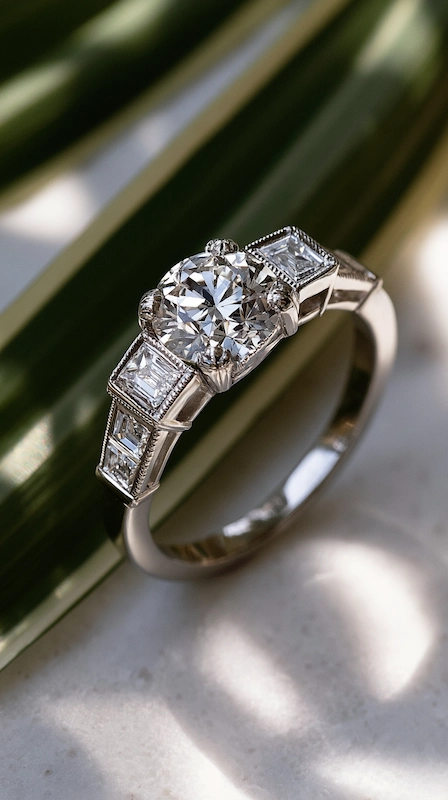
Art deco and vintage-inspired engagement rings have experienced a real rise in popularity in recent years, and it’s easy to understand why. These rings carry design elements that mass-produced styles simply cannot replicate: hand-cut filigree, milgrain edging, intricate geometric patterns, and craftsmanship that reflects a distinct era.
Art deco rings tend to feature geometric shapes, bold gold settings, and colorful gemstones like sapphires or rubies alongside the center diamond. Vintage engagement rings, spanning Edwardian through Retro periods, lean toward soft curves, floral motifs, and diamond halos with delicate engraving.
Why it lasts: Vintage-inspired rings are already rooted in enduring historical design. When a ring draws on a century of jewelry history, its longevity is already proven. Art deco geometric styles, in particular, have a structural elegance that feels equally at home in any decade. That’s exactly why so many vintage-inspired designs are among the most sought-after rings at estate sales and antique dealers.
Trend Alert: Vintage-inspired engagement rings are increasingly popular with couples who want something that feels genuinely one-of-a-kind without going fully custom. Many fine jewelry brands now offer vintage-inspired collections set in white gold or yellow gold with authentic period details.
Best for: Couples who love history, those who want a ring that feels unique and personal, and anyone drawn to rings with exceptional craftsmanship and detail work.
- Art deco rings often feature emerald cut and asscher cut diamonds for a sophisticated, geometric look
- Milgrain, filigree, and enamel are signature design elements that give vintage rings their distinctive character
- Popular in yellow gold settings for an authentic period feel
- A vintage-inspired ring set in white gold gives a contemporary edge to a classic style
- These rings are a natural fit for couples drawn to unique timeless engagement rings that tell a story
- Restrained vintage details age better than maximalist interpretations
East-West Settings: A Fresh Ring Trend Worth Knowing
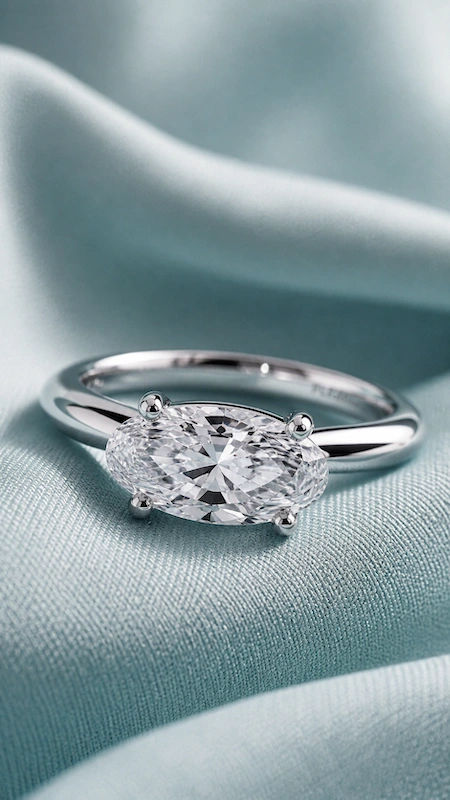
East-west settings flip the traditional orientation of the stone 90 degrees, so the long axis of the diamond runs horizontally rather than vertically. It sounds like a small change, but the visual impact is significant.
An east-west setting makes a diamond ring feel contemporary and unexpected without requiring an unusual stone or elaborate metalwork. It’s a particularly strong choice with oval, marquise, emerald cut, and cushion diamonds, where the horizontal orientation really shows off the stone’s character.
Why it lasts (with a caveat): East-west settings are more trend-forward than solitaires or three-stone rings. That doesn’t mean they won’t hold up, but it’s worth noting. A simple east-west bezel in white gold or yellow gold with a clean band and minimal embellishment has a strong chance of aging gracefully. More decorated east-west versions feel more of-the-moment by comparison.
Trending Now: East-west settings are one of the most talked-about ring styles right now, especially as simple solitaires set in white gold or yellow gold for a refined, modern look.
Best for: Couples who want something contemporary and non-traditional, those drawn to clean modern design, and anyone who wants a conversation-starter ring without an oversized stone.
- The center stone is rotated 90 degrees from its traditional vertical orientation
- Most popular with oval, marquise, and emerald cut diamonds
- Works in solitaire, bezel, and prong settings
- Available in white gold, yellow gold, or platinum
- For the best long-term wear, keep the surrounding band simple and the setting refined
Mixed Metals and White Gold: The Ring Trend That Keeps Growing
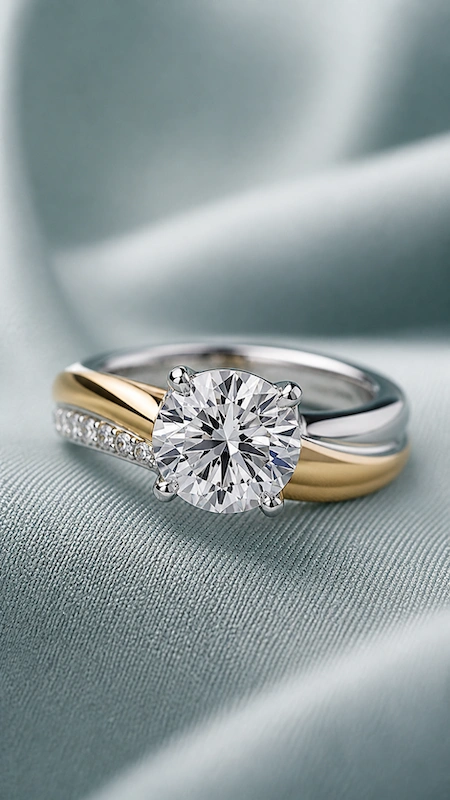
Mixed metal engagement rings combine two or more precious metals in the band and setting, typically white gold with yellow gold, or platinum with rose gold. It’s a ring trend that has moved from niche to mainstream and shows no signs of slowing.
But here’s the catch: mixed metal rings require a bit more thought when pairing with a wedding band. That’s why it’s worth settling on your metal combination early and confirming your jeweler can craft a matching band to go with it.
Why it lasts (with a caveat): Mixed metals are rising in popularity right now, but they are more trend-influenced than a classic platinum solitaire or a yellow gold bezel. That said, a well-executed two-tone ring with a restrained design can absolutely stand the test of time. Gold designs combining white and yellow gold have appeared in fine jewelry for decades, so it’s not without precedent.
Perfect Pairing: A white gold band with yellow gold settings, or vice versa, is the classic mixed metal combination. Gold designs in a two-tone style tend to photograph beautifully and age well. For a warmer feel, rose gold accents on a platinum or white gold base are a beautiful choice.
Best for: Style-forward couples, those who genuinely can’t choose between two metals, and anyone who wants a distinctive engagement ring that stands out without being overly ornate.
- Two-tone rings combine white gold and yellow gold for a balanced, versatile look
- Three-tone combinations are available for a bolder ring style
- Mixed metal gold bands pair well with almost every diamond shape
- Consider your preferred karat (14k vs. 18k) when mixing metals, since karat affects both color and durability
- 14-karat gold is the most durable everyday option; 18-karat gold has a richer, deeper tone
Lab-Grown Diamonds and Gemstones: Stone Choices Worth Knowing
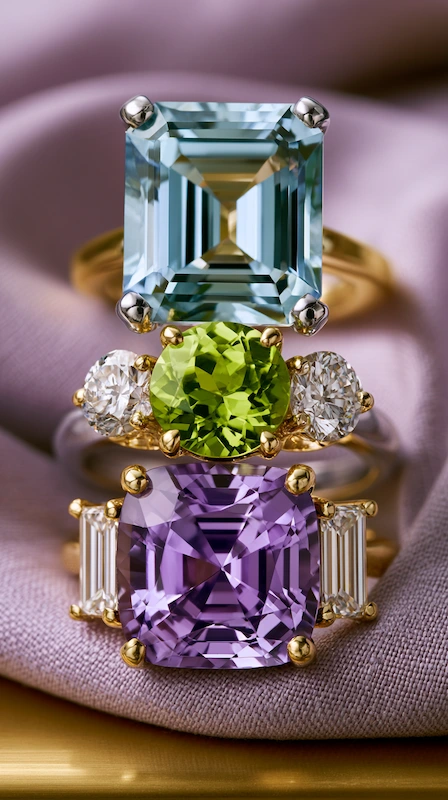
While ring style gets most of the attention, the stone itself plays a major role in the overall look of an engagement ring. Two choices worth knowing about right now are lab-grown diamonds and colored gemstones, both of which have become increasingly popular center stone options.
Lab-grown diamonds are chemically, physically, and optically identical to mined diamonds, delivering the same diamond cut quality and brilliance at a fraction of the price. They are not synthetic stones or imitations. They are real diamonds grown in a controlled environment. Many couples choose lab-grown specifically because it allows them to get a larger carat weight and higher clarity for the same budget as a smaller mined stone.
Colored diamonds and gemstones are also seeing a rise in popularity as center stone choices. Sapphires, emeralds, and other precious gemstones are all popular options for couples who want something beyond the traditional diamond engagement ring. Couples looking beyond the classic diamond will find plenty of inspiration in our guide to non-traditional engagement rings.
Expert Insight: If you’re considering a colored gemstone as your center stone, discuss hardness and durability with your jeweler. Sapphires are an excellent everyday choice (9 on the Mohs scale). Some other gemstones require considerably more care for daily wear.
Best for: Couples looking for more carat weight for their budget (lab-grown), those who want a unique or colorful center stone, and anyone who wants their ring to feel truly personal.
- Lab-grown diamonds are available in all popular shapes: round, cushion, oval, pear, marquise, emerald, and asscher
- A lab-grown diamond set in white gold, yellow gold, or platinum is indistinguishable from a mined stone to the naked eye
- Colored diamonds offer a truly unique alternative to the traditional white diamond engagement ring
- Sapphire and emerald center stones are popular choices for elegant engagement rings with a unique, classy feel
- Carat weight and clarity grades apply to lab-grown diamonds exactly as they do to mined stones
Beyond Ring Style: Karat, Prong Count, and Customization
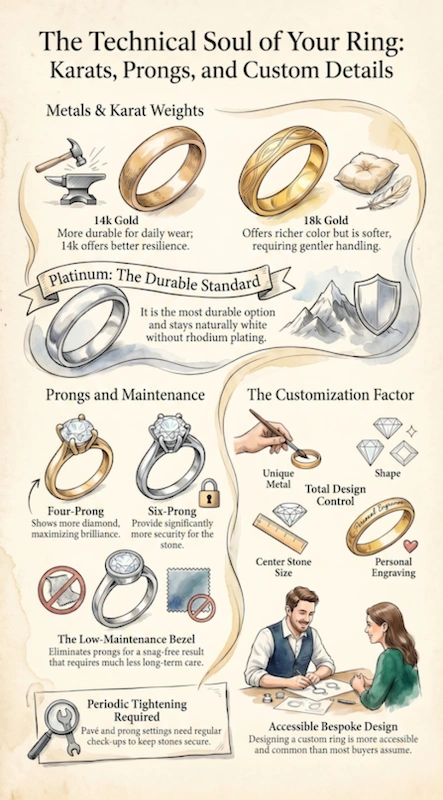
Choosing the right engagement ring style is only part of the equation. Several practical decisions will affect how the ring looks, wears, and holds up over time.
Metal and Karat
For gold rings, 14 karat is the most popular choice for everyday wear. It’s durable, affordable, and available across white gold, yellow gold, and rose gold. 18 karat gold has a richer color and slightly softer feel, making it better suited for lower-wear engagement ring settings like bezels. Platinum is the most durable option and stays naturally white without requiring rhodium plating. For a full breakdown of each metal, our guide to engagement ring metals: pros and cons covers everything you need to know.
Prong Count and Setting
A four-prong setting shows more of the diamond, while a six-prong setting provides extra security. A bezel setting eliminates prongs entirely for a clean, snag-free result. The prong count and engagement ring setting you choose affect both the look of the ring and the maintenance it will need over the years.
Custom Engagement Rings
Custom engagement rings allow you to choose every element: metal, karat, diamond shape, center stone size, side stones, engraving, and more. If you can’t find exactly what you want in a ready-to-wear collection, working with a jeweler to design a custom ring is absolutely worth considering, and more accessible than most people assume.
Actionable Tip: Always ask about long-term care when choosing your engagement ring setting. Pavé and prong settings need periodic tightening. Bezel settings are much lower maintenance. Knowing this upfront helps you choose a ring that actually fits your lifestyle, not just your Pinterest board.
Frequently Asked Questions About Popular Engagement Ring Styles
What engagement ring style is the most timeless?
The solitaire is widely considered the most timeless engagement ring style. Because it features a single diamond with no trend-dependent design elements, it has remained consistently popular across decades. Three-stone rings and bezel settings are also among the most enduring choices.
Are halo engagement rings still popular?
Yes. Halo rings have been one of the most popular engagement ring designs for nearly a century and remain a top choice today. A refined, proportional halo tends to age well. Oversized or heavily layered halo designs can feel more trend-specific over time.
What is the best engagement ring setting for everyday wear?
The bezel setting is consistently recommended for everyday wear because it has no exposed prongs, sits low on the finger, and protects the diamond on all sides. Solitaires with six-prong settings are also a solid everyday choice when the prongs are checked and maintained regularly.
Are bezel settings more secure than prong settings?
Generally yes. A full bezel encloses the diamond entirely, making it significantly harder for the stone to loosen or fall out. Prong settings expose more of the diamond, which is beautiful, but the prongs can catch on fabrics and wear down over time without regular maintenance.
Is a three-stone engagement ring classic or trendy?
Three-stone engagement rings are genuinely classic. The design has been used in fine jewelry for well over a century, and the symbolism of past, present, and future gives it a meaning that transcends any particular trend cycle.
Are lab-grown diamonds a good choice for engagement rings?
For many couples, yes. Lab-grown diamonds are physically and chemically identical to mined diamonds and offer excellent value, allowing you to choose a larger carat weight or higher clarity for the same budget. The main consideration is resale value, which is currently lower for lab-grown stones than for mined ones.
What is the difference between a pavé setting and a halo setting?
A pavé setting refers to small diamonds set closely together along the band itself. A halo setting refers to small diamonds arranged in a circle around the center stone. The two are often combined: a ring can feature a halo around the center stone and pavé along the band, which is one of the most popular engagement ring combinations available right now.
Finding the Best Engagement Rings for Your Personal Style
The best engagement rings are not the most expensive or the most elaborate. They are the ones that feel right every single time you look at your hand, and that will still feel right 10, 20, and 30 years from now.
You’re better off taking your time with this decision than rushing into a popular ring style that doesn’t actually fit your aesthetic or your day-to-day life. The most popular engagement ring styles are popular for good reason, but the right choice is always personal.
The bottom line is this: whether you’re drawn to a timeless diamond solitaire, a sparkling halo, a bold split shank, or a vintage-inspired ring with custom design elements, there is a ring out there that is exactly right for you. Use the comparison table near the top of this guide to narrow your options, focus on the two or three styles that feel most like you, and bring those to a jeweler as your starting point.
Bonus: Still narrowing it down? Start by identifying the one feature that matters most to you: timelessness, sparkle, low maintenance, or individuality. Then compare just two or three styles from that lens instead of trying to evaluate everything at once. That focused approach makes the decision far easier, and far more likely to lead to a ring you’ll love for a lifetime.
Looking for more? Check out our related guides: