Alternatives to a Traditional Wedding Ring: 23 Meaningful Ideas for Modern Couples
Not every couple wants a classic wedding band, and honestly, not every lifestyle works for one either.
Maybe you work with your hands and a metal ring is a safety hazard. Maybe you are allergic to certain metals, or you want something that reflects your personality instead of a jewelry store default. Maybe the price tag just does not align with your priorities. Or maybe you simply want your ring to mean something more specific to your story.
That’s why alternatives to the traditional wedding ring have become one of the biggest shifts in modern wedding jewelry. Couples today are choosing silicone, wood, tattoos, fingerprint engravings, birthstones, and even skipping rings altogether in favor of necklaces, bracelets, or meaningful ceremony rituals.
This guide covers all 23 options, organized by what they do best. Whether you want a ring that looks nontraditional, a ring built for a more active life, or something that is not a ring at all, you will find your answer here.
Find Your Fit: Quick Comparison Guide
Before you dive in, here is a fast reference to match the right option to your situation.
- Best for active lifestyles or physical jobs: Silicone rings, tungsten carbide, titanium, ceramic, bezel-set gemstone rings
- Best for symbolism and personal meaning: Tattoo rings, Claddagh rings, fingerprint rings, handfasting cords, birthstone rings
- Best for personalization: Custom-made rings, engraved bands, signet rings, initial rings, handmade rings
- Best budget-friendly options: Silicone rings, stainless steel, simple engraved bands, resin rings, tattoos
- Best non-jewelry alternatives: Handfasting, matching necklaces or bracelets, watches, meaningful gift exchange
- Best if you still want a ring but not a diamond: Gemstone rings, eternity bands, knot rings, wooden rings, non-metal rings
Section 1: Practical Wedding Ring Alternatives
These are for couples who want the symbolism of a ring but need something more wearable for their real, daily life.
1. Silicone Wedding Rings
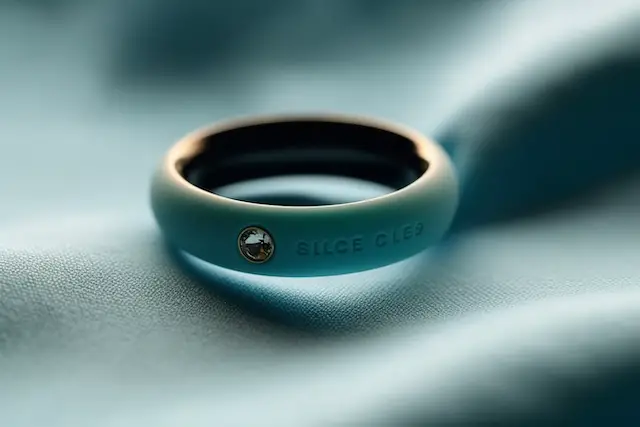
Here’s the deal: silicone rings have gone from a niche workaround to a genuinely mainstream wedding ring category. They are affordable (usually under $50), flexible, lightweight, and hypoallergenic. And because they are not made of precious metal, you are not stressed about losing one at the gym or on a hiking trail.
For people who work in healthcare, construction, or any hands-on field where metal rings can pose a safety risk, silicone is often the most practical choice available. Popular brands worth knowing:
- Groove Life: Their Thin Solid Ring sits close to the finger, resists stretching, and has a groove underneath for breathability.
- QALO: Wide variety of styles, colors, and collections, including sports-themed designs for active couples.
- Enso Rings: More refined designs that lean closer to fine jewelry aesthetics in silicone form.
Pro Tip: Many couples buy a silicone ring for daily wear and reserve their traditional band for special occasions. You get the best of both worlds without risking your nicer ring at the gym or in the ocean.
2. Alternative Metals
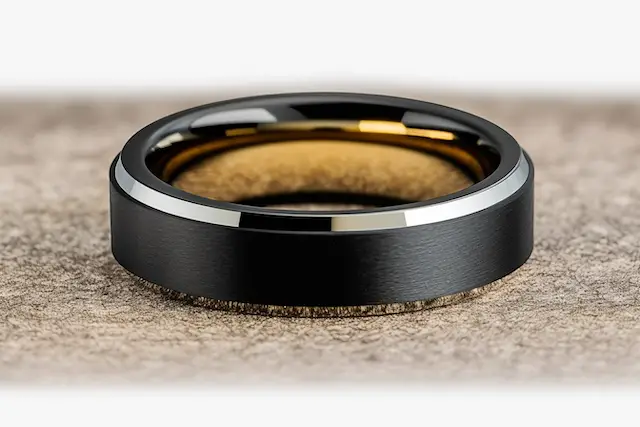
Gold and platinum are not the only metals worth wearing. Alternative metals offer durability, distinctive aesthetics, and significantly lower price points, making them one of the most popular shifts in wedding band choices today.
Tungsten Carbide
One of the hardest metals used in jewelry. Highly scratch-resistant, maintains its polished look for years, and has a distinctive gunmetal color. Note: tungsten carbide rings are very difficult to resize, so confirm your size before purchasing.
Titanium
Lightweight and strong, titanium is ideal for anyone who finds traditional rings uncomfortable or heavy. Hypoallergenic, corrosion-resistant, and available in a wide range of finishes. Resizing is more limited than with gold, but possible with some styles.
Stainless Steel
The most budget-friendly of the alternative metals. Hypoallergenic and resistant to tarnish and corrosion. It scratches more easily than tungsten or titanium, so occasional polishing keeps it looking sharp.
Ceramic
Made from high-tech zirconium ceramics, ceramic rings offer a contemporary matte look, most often in black or white. Hypoallergenic and highly scratch-resistant, though they can be brittle under sharp impact, so avoid dropping them on hard surfaces.
Key Takeaway: If budget and durability are your top priorities, tungsten or titanium give you the most ring for your money. If lightweight comfort is the priority, titanium wins by a wide margin.
3. Wooden Wedding Rings

Wooden rings are the choice for couples who want something genuinely different. No two are identical. The grain, tone, and texture of the wood make every piece one of a kind, and many makers use reclaimed or sustainably sourced timber, which makes them one of the more eco-conscious options available. Brands like Rustic and Main and Wooden Wedding Rings Co. have built their entire catalogs around this approach.
Care is straightforward: remove it during prolonged water exposure, and apply a conditioning oil or wax regularly to keep the wood from drying out.
Expert Insight: Many wooden rings incorporate an inner liner of metal or resin for structural support. Ask specifically about liner options when shopping, especially if you have an active lifestyle.
4. Non-Metal Rings: Resin and Quartz
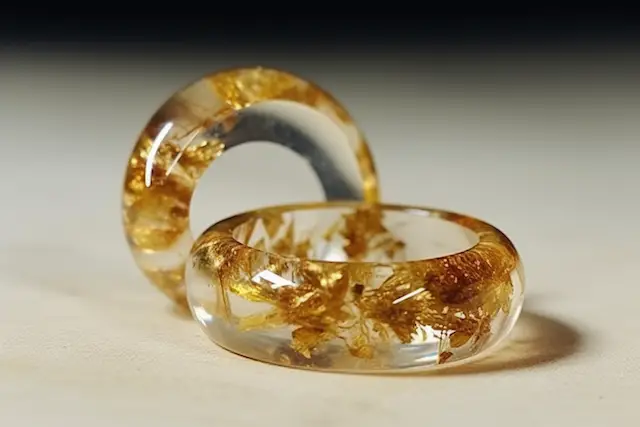
Resin rings start as a liquid mixture of resin and pigments or natural elements, which gets poured into a mold and cured into a finished ring. Pressed flowers, leaves, or small meaningful materials can be suspended inside. The results can be genuinely stunning.
Quartz rings are shaped from natural crystal: clear rock crystal, purple amethyst, yellow citrine, pink rose quartz, and more. Both options are lightweight, affordable, and highly customizable.
Actionable Tip: Search Etsy for resin ring makers who specialize in pressed florals. Many will embed dried flowers from your actual bouquet directly into the ring. That level of personalization is simply not available anywhere else.
Section 2: Personalized and Symbolic Ring Styles
These options keep the tradition of wearing a ring, but make it unmistakably yours.
5. Tattoo Wedding Rings

A tattoo wedding ring is as permanent as it gets. No resizing, no losing it, no taking it off at airport security. Common design directions include initials, significant dates, geometric patterns, symbols like infinity signs or hearts, or matching designs chosen together. Costs typically run between $50 and $300 for a clean, simple design, which is generally less than a traditional band.
But here’s the catch: ring tattoos fade faster than tattoos elsewhere because hands are constantly exposed to sun, water, and friction. Look specifically for an artist with fine-line or hand-poke experience, and ask to see healed photos of their finger tattoo work, not just fresh shots from the day of the session.
How-To: Book consultations with at least two or three artists before committing. Healed work tells the real story about what the design will look like in year two and beyond.
6. Fingerprint Rings
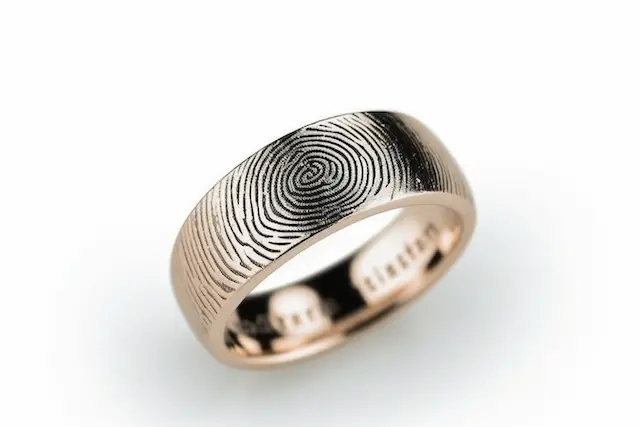
A fingerprint ring captures your partner’s actual print and engraves it into the band. Every time you look at your ring, you are looking at something that belongs only to them.
Two engraving methods exist. Laser engraving produces a precise, wear-resistant result. Hand engraving gives a more organic, artisan look but may show wear more quickly over time. Pricing ranges from around $50 for simpler designs to $1,200 or more for 14k gold bands.
Customization options to consider:
- Inner vs. outer engraving: Inner placement feels private; outer placement makes it visible to the world.
- Metal choice: Gold, silver, platinum, or titanium each carry different costs and durability levels.
- Finish: Polished, matte, or hammered textures all pair differently with the organic fingerprint design.
7. Birthstone Rings

Replacing a diamond with a birthstone connects your ring to something personal rather than conventional. Your birthstone, your partner’s birthstone, or both incorporated into one design creates a piece with real narrative behind it. January is garnet. May is emerald. September is sapphire. December is blue topaz or tanzanite.
Trend Alert: Sapphires have seen a major surge in popularity as center stones in wedding jewelry. They are also one of the more durable gemstone choices, rating 9 on the Mohs hardness scale, making them a strong pick for a band worn every day.
8. Claddagh Rings
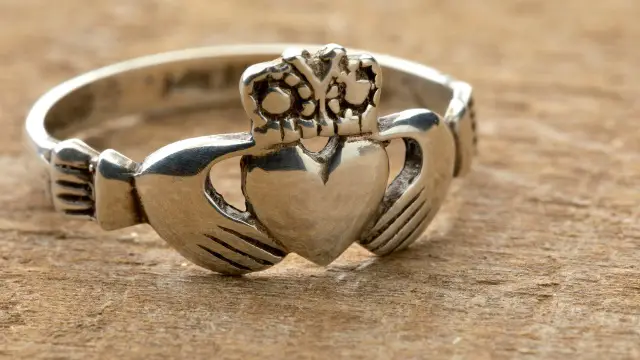
The Claddagh ring originates from the Irish fishing village of Claddagh, with roots tracing back to the 17th century. Its design features two hands holding a heart topped with a crown: friendship, love, and loyalty. As a wedding ring, wear it on your left hand with the heart pointing inward toward you.
You’re better off thinking of a Claddagh ring as a genuine cultural symbol rather than a trend pick. If you have Irish heritage or a personal connection to the tradition, it carries real weight. If neither applies, other personalized options on this list may feel more authentically yours.
9. Knot Rings
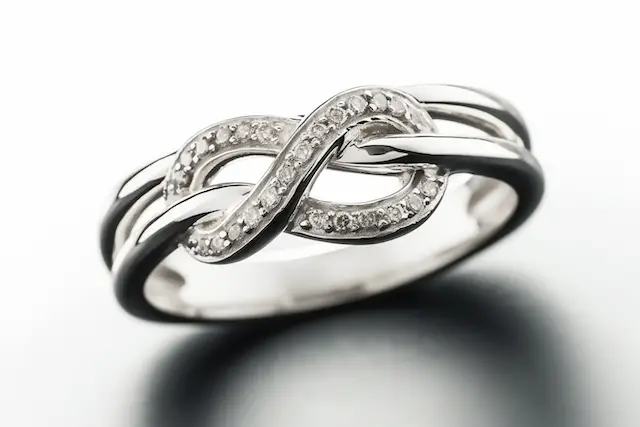
Knot rings come in two main styles, both rooted in the idea of an unbroken connection.
Celtic Knot rings feature intricate interlocking patterns with no visible beginning or end, a direct visual metaphor for eternal commitment. Classic designs include the trinity knot and variations on traditional Celtic knotwork, available across a wide range of metals and price points.
Infinity Knot rings use the familiar figure-eight symbol as their central motif, often featuring two bands woven together into a single unbroken loop. Two lives, one bond.
10. Signet Rings
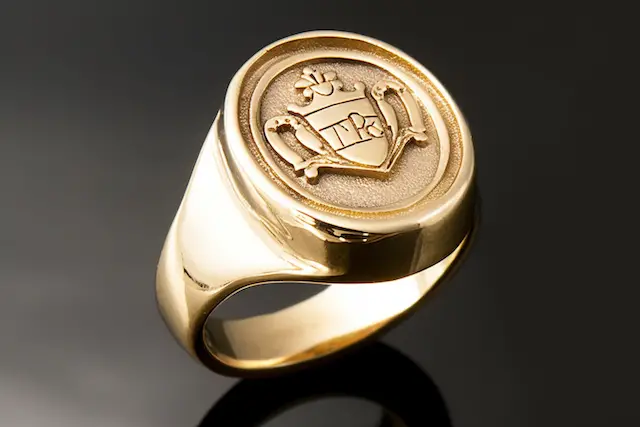
Signet rings have been reimagined as personalized statement pieces that do not require noble lineage to feel meaningful. Modern options include engraved initials, a custom symbol, a meaningful date, or a small piece of artwork. Some couples design matching signet rings as an alternative to traditional bands, giving them a coordinated aesthetic without looking like conventional wedding jewelry.
If family heritage matters to you, researching your ancestry and working with a jeweler to engrave a coat of arms creates a ring that connects your marriage to something much larger than the two of you.
11. Initial and Name Rings
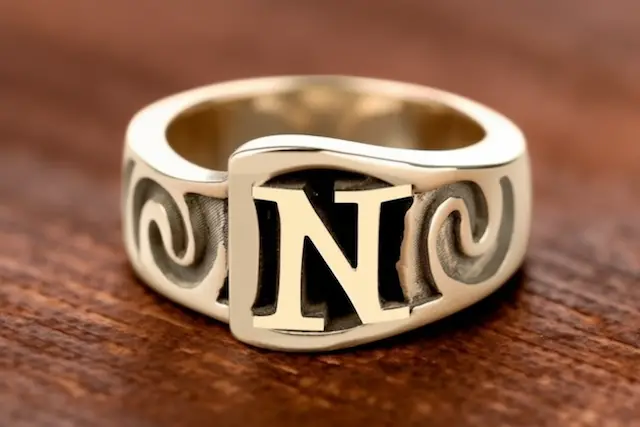
Initial rings and name rings are exactly what they sound like, but the variation in execution makes a significant difference in how they feel.
Monogram styles:
- Traditional: Both initials intertwined in a classic interlocking style.
- Modern: A minimalist single-initial approach for a cleaner look.
- Script: Calligraphic lettering for a more romantic presentation.
- Vintage: Designs that echo the aesthetic of heirloom jewelry.
Name ring configurations:
- Stacked: Two separate bands, each bearing the other person’s name.
- Connected: Both names on a single band, side by side.
- Split: Each partner wears half the other’s name.
- Birthstone accents: Gemstones added alongside the name for extra personalization.
Bonus: Initial rings double as everyday jewelry that reads as stylish without being overtly bridal. Many people wear them long before and after the wedding itself.
12. Engraved Plain Band
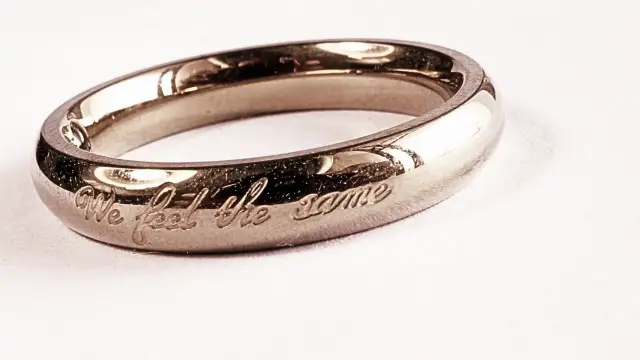
Do not underestimate the simplicity of a clean metal band with a meaningful inscription inside. This is one of the most timeless choices on this list, and it has never gone out of style for a reason. The engraving can be anything: a date, a line from your vows, coordinates of where you met, initials, or a symbol that holds private meaning between the two of you.
Extra Touch: Ask your jeweler about engraving each other’s actual handwriting rather than a standard font. Jewelers can work from a scanned image of real handwriting, and the result is unlike anything machine-generated. It is the detail that makes a simple ring feel completely irreplaceable.
13. Handmade and Custom Rings
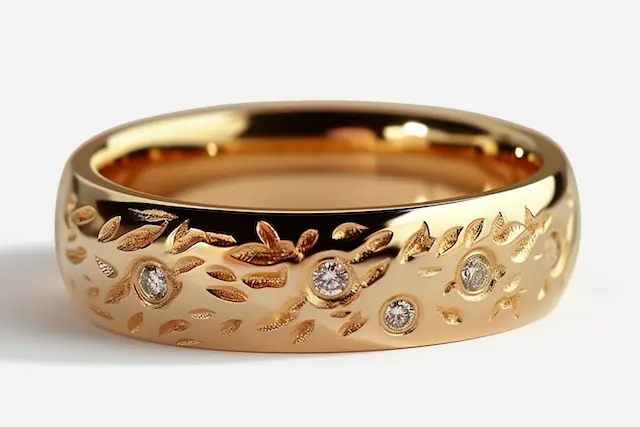
If you want something nobody else has, working with an artisan jeweler or custom designer is the path. Etsy hosts thousands of independent jewelers who specialize in custom work. Browsing their shops before reaching out gives you a strong sense of their aesthetic and craftsmanship. For local options, look for jewelers who specifically list custom design as a core service.
What to bring to a consultation:
- Inspiration images showing styles you are drawn to
- A clear and honest budget range
- Any materials, stones, or symbols you want incorporated
- A realistic sense of your lifestyle and how much work the ring will need to handle day to day
14. Gemstone Wedding Bands
Swapping a diamond for a colored gemstone has become one of the most popular moves in wedding jewelry, and the options extend far beyond sapphire and ruby.
- Sapphire: Available in blue, pink, yellow, and green. Rates 9 on the Mohs scale, one of the most durable gemstone choices for daily wear.
- Ruby: Deep red, highly durable at 9 on the Mohs scale, and holds up well over time.
- Emerald: Gorgeous green option, but softer than sapphire or ruby and more prone to chipping. Discuss care expectations with your jeweler before committing.
- Moissanite: A lab-created stone with diamond-level brilliance at a fraction of the price. A legitimate, beautiful option for budget-conscious couples who still want serious sparkle.
Expert Insight: Before choosing any gemstone, ask about its Mohs hardness rating. Stones rated below 7 will scratch more easily with daily wear. Sapphires, rubies, and moissanite all rate 9 or above, making them the most practical colored stone choices for a ring worn every single day.
15. Eternity Bands
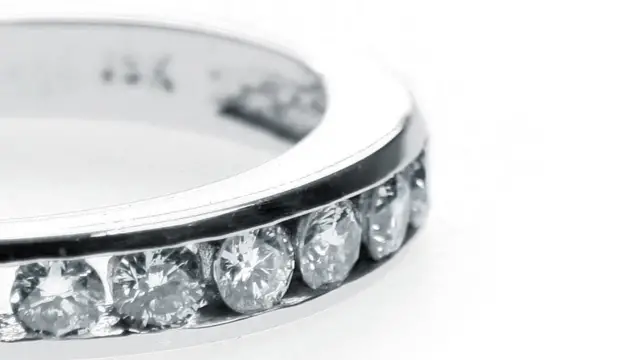
An eternity band features stones set continuously around the entire circumference of the band, representing love with no beginning and no end. Stone setting options include channel (streamlined and protected), prong (maximum brilliance), and bezel (most secure hold with a clean, modern look).
Styling Hack: An eternity band does not have to stand alone. Many couples use one as a wedding band, stacking it with other simple bands for a layered look that evolves over time.
Section 3: Nontraditional Ring Designs
These are still rings, but they break from the conventions of what a wedding band is supposed to look like.
16. Stackable Rings
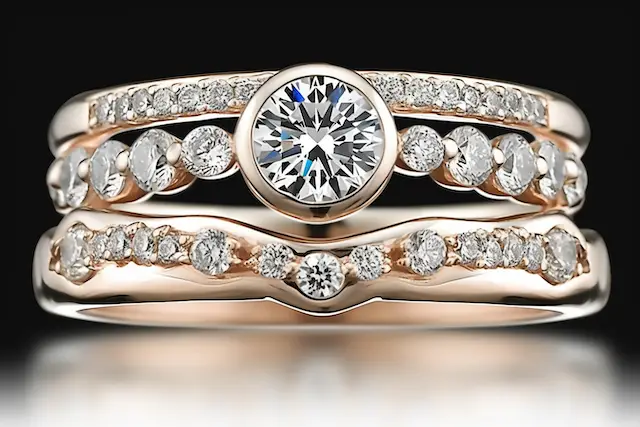
Wearing multiple rings on one finger has shifted from a fashion statement into a legitimate approach to wedding jewelry. The appeal is flexibility: you can build, edit, and evolve your stack over time, adding a ring for anniversaries or milestones. For a cohesive look without being matchy-matchy, keep individual bands thin and delicate, leave small gaps between rings, and choose a unifying element like a shared metal tone or finish.
Mixing metals in a stack is fully acceptable and often looks more interesting than a single-metal approach. The key is balance across the stack rather than clustering one metal on one side.
17. Coordinated Wedding Sets
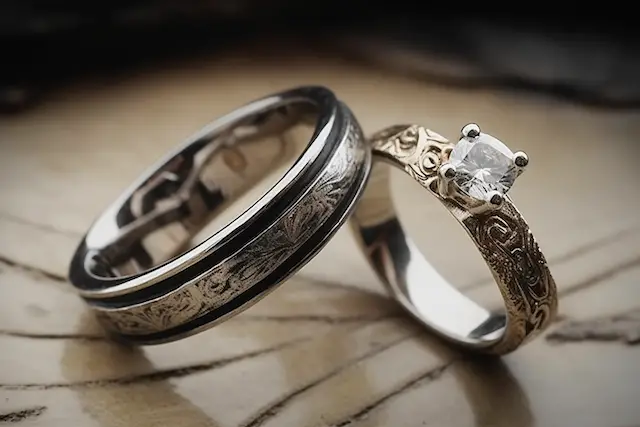
Coordinated pairs create a visual connection between two rings without requiring them to be identical. Matching means sharing a design element: the same metal, a complementary gemstone, a shared engraving, or a motif that appears on both. Some couples incorporate each other’s fingerprints. Others use the same stone in different cuts.
Here’s what I’ve learned: the most successful coordinated sets are the ones where both partners genuinely love their individual ring, not the ones where someone compromised to achieve the matching effect.
18. Unusual Diamond Settings
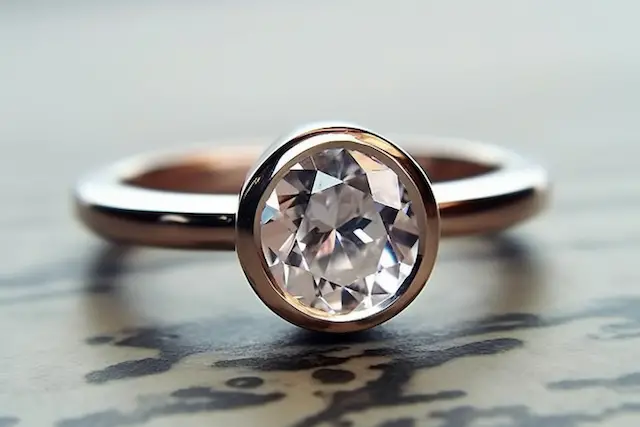
If you love diamonds but want to move past the classic solitaire, the setting makes a dramatic difference.
East-West settings rotate the stone 90 degrees so it sits horizontally across the finger. This works particularly well with elongated shapes like oval, marquise, or emerald cuts and gives the ring a modern, architectural feel.
Bezel settings wrap the diamond in a thin metal rim rather than holding it with prongs. The result is cleaner, more contemporary, and significantly more protective of the stone. For active lifestyles, it is one of the smartest choices available.
Actionable Tip: An east-west bezel setting gives you a traditional diamond with a distinctly modern presentation. It is one of the smartest upgrades available without changing the stone.
19. Themed Rings
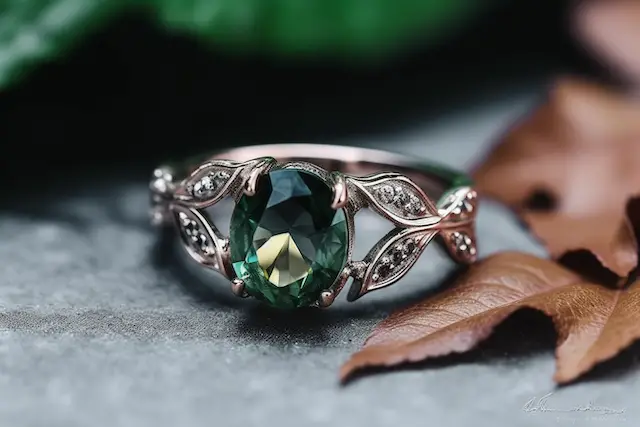
For couples who bond over a shared passion, a themed ring turns that passion into daily wearable art.
Fandom-inspired options exist for Star Wars, Lord of the Rings, Harry Potter, and Marvel, with dedicated jewelers crafting rings with recognizable symbols and design elements. When choosing, look for craftsmanship first. A poorly made ring with a beloved symbol still does not wear well.
Nature-inspired options feature motifs like vines, waves, mountain ridges, or animal tracks carved or cast into the band. Rose gold pairs naturally with botanical designs. Silver tends to complement coastal or wave-inspired themes.
20. Chain Rings
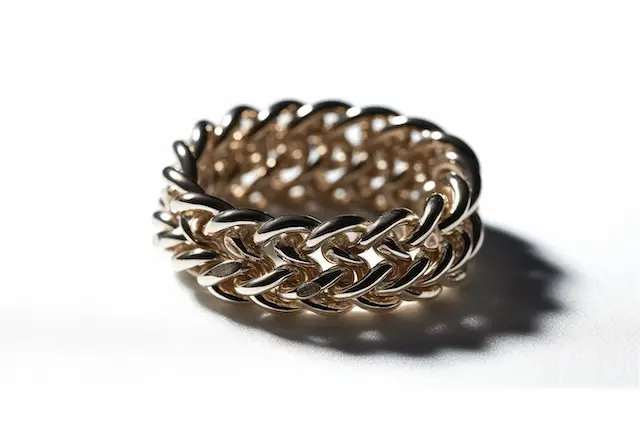
Chain rings feature interlocking links rather than a solid band, creating movement and visual texture that flat bands cannot achieve. Available in gold, silver, platinum, and stainless steel. Solid links hold up better over time than hollow ones, so ask specifically about construction quality. Clean regularly with a gentle solution and a soft brush, as links can trap oils and debris more easily than a solid band.
Section 4: Non-Ring Alternatives
These options step entirely outside the category of rings. For couples who do not want to exchange rings at all, or who want to replace the ring with something more personal, these are the most meaningful paths available.
21. Handfasting
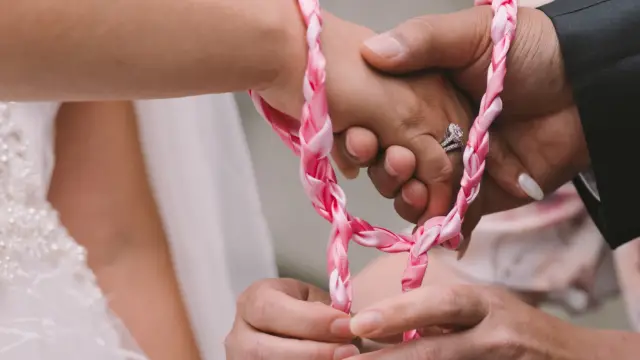
Handfasting is one of the oldest wedding rituals in existence, rooted in Celtic and Northern European tradition. During the ceremony, the couple’s hands are bound together with cords or ribbons while vows are exchanged. “Tying the knot” is not just a figure of speech. This is where it comes from.
Cords can be simple or elaborate, and their colors carry meaning:
- Red: Passion and love
- Blue: Loyalty and trust
- Green: Growth and new beginnings
- White: Purity and clarity
Some couples invite close family members to add their own cords as a gesture of community support. What is tied during the ceremony is often preserved as a keepsake afterward.
Trend Alert: Handfasting has moved well beyond Celtic-heritage weddings. It is now a common feature at bohemian, outdoor, and nondenominational ceremonies as a visually striking alternative to the ring exchange moment.
22. Alternative Jewelry: Necklaces, Bracelets, and Watches
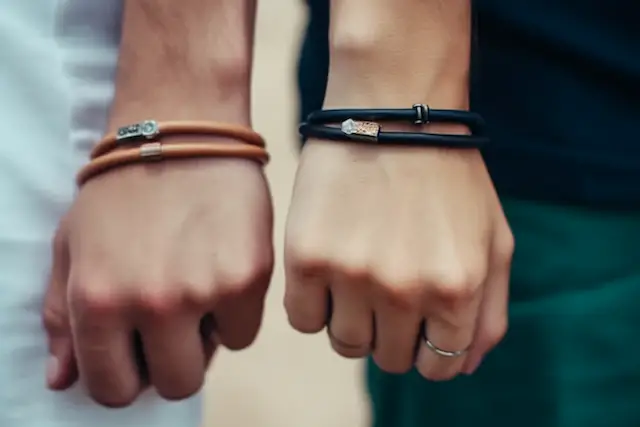
Swapping rings for another piece of jewelry keeps the gift-giving tradition intact while opening up more customization options. Matching necklaces work particularly well when they hold something symbolic: a shared initial, a locket, or two pieces of a pendant that only complete each other when worn together. Matching bracelets offer the same versatility across a wide range of materials and styles, from fine gold to leather cord.
Watches are one of the most overlooked alternatives on this list. Exchanging watches, whether identical or coordinated, gives each partner a sentimental object that is also genuinely practical. For couples who appreciate craftsmanship and functional design over traditional jewelry, this may be the most fitting choice.
Perfect Pairing: Whatever alternative jewelry you choose, have it engraved with your wedding date or a short phrase. It is the detail that transforms a beautiful piece into an irreplaceable one.
23. The Meaningful Gift Exchange
Some couples skip the ring entirely and exchange a different gift during the ceremony itself. Options that work well in a ceremony context:
- A piece of art created specifically for the occasion
- An engraved wallet card, money clip, or compact
- A journal with a handwritten entry inside
- A piece of heirloom jewelry passed down through the family
- A book with annotated passages meaningful to the relationship
Here’s what I’ve learned: the couples who make this work most beautifully are the ones who make the exchange feel as ceremonially significant as a ring. It is not about skipping tradition. It is about replacing it with something that means more.
How to Choose Your Wedding Ring Alternative
With 23 options in front of you, the question is where to start. Here is a simple framework.
Start with your lifestyle. If you work with your hands, in medical settings, or around machinery, silicone, titanium, or ceramic should be your starting point. They hold up in ways gold and platinum simply do not.
Think about permanence. Tattoo rings and handfasting cords exist on opposite ends of the spectrum. Tattoos are forever. Cords are a ceremony moment. Alternative metals and silicone sit in the middle as the most durable everyday options. Resin and quartz require more careful handling. Be honest about how much maintenance you are genuinely willing to do long-term.
Set your budget before you browse. Silicone and stainless steel work well under $100. Engraved bands and alternative metals sit comfortably in the $100 to $500 range. Custom, gemstone, or fine metal options typically start at $500 and go up from there.
Consider what you want the ring to communicate. Birthstone rings, Claddagh rings, fingerprint rings, and handfasting cords are built for symbolism. Engraved plain bands, alternative metal rings, and simple gemstone bands serve couples who want something beautiful but understated. Neither is more valid than the other.
Key Takeaway: The best alternative to a traditional wedding ring is the one that fits your actual life, not your idealized version of it. Choose something you will want to wear in ten years, not just on the wedding day.
Frequently Asked Questions
What materials can be used instead of gold for wedding rings?
Silver, platinum, palladium, titanium, tungsten carbide, stainless steel, ceramic, wood, resin, and quartz are all established alternatives to gold. Titanium and tungsten tend to be the most durable of the non-precious metal options. Wood and resin offer the most distinctive visual character.
What are the most affordable alternatives to traditional wedding rings?
Silicone rings are typically the most budget-friendly, usually under $50. Stainless steel, simple engraved bands in sterling silver, and tattoo rings (generally $50 to $300 for a simple design) are all strong, affordable options that still feel meaningful.
Which non-diamond gemstones are most popular for wedding bands?
Sapphire leads the category, partly due to cultural visibility and partly because its durability at 9 on the Mohs scale makes it genuinely practical for daily wear. Ruby, emerald, and moissanite are all popular choices. For budget-conscious couples, moissanite offers diamond-level brilliance at a fraction of the price.
Are there meaningful wedding ceremonies that do not involve ring exchange?
Yes. Handfasting is the most established ceremonial alternative, with roots going back centuries. Unity candle ceremonies, sand ceremonies, tree planting rituals, and meaningful gift exchanges are all recognized alternatives. Any of these can be incorporated into a modern ceremony with the right officiant.
Is a silicone ring a legitimate wedding ring?
Absolutely. The material does not determine the meaning. Many couples wear silicone rings as their primary wedding bands for practical reasons and find them completely satisfying as a symbol of their commitment. The tradition is the commitment, not the metal.
The Bottom Line
The traditional wedding band is a beautiful choice for many couples. But it is not the only meaningful option, and it is not the right fit for everyone.
If you want the most practical choice for an active lifestyle, start with silicone, titanium, or tungsten. If you want the most personalized approach, fingerprint rings, custom designs, or engraved bands are hard to beat. If you want something deeply symbolic, Claddagh rings, tattoo rings, birthstones, or handfasting bring layers of meaning that a plain band simply cannot match. And if you do not want a ring at all, matching necklaces, bracelets, watches, or a meaningful gift exchange can create a ceremony moment that feels just as significant.
The right choice is the one that reflects who you actually are as a couple, not who you feel you should be.
Not sure where to start? If you are still exploring ring options, our guide to engagement ring metals pros and cons breaks down every material in detail. If you are leaning toward something completely nontraditional, our piece on how to personalize your wedding ceremony has ideas for making the whole day feel more like you.