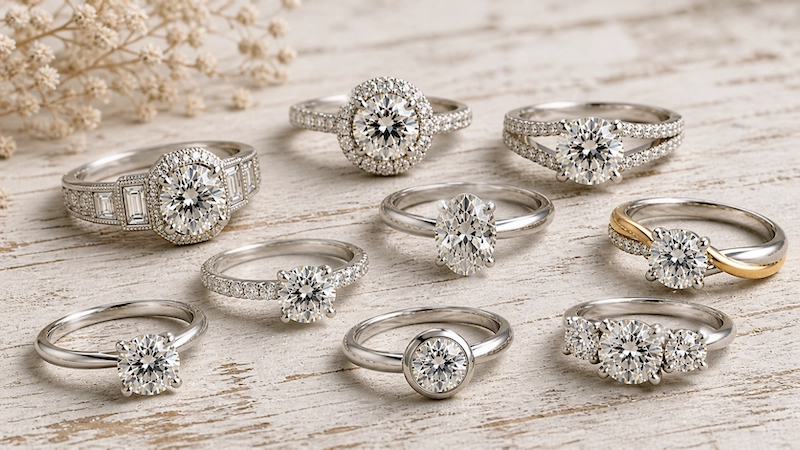
Engagement Ring Guide
Lab Grown Diamond Engagement Rings: Pros, Cons, Cost, and What to Know
The planner-level truth about lab grown diamonds: what they are, what they really cost couples, how grading changed in 2025, and when a natural stone is still the better call.
Lab grown diamond engagement rings are now the most common choice in the U.S.: in The Knot’s 2026 Real Weddings Study of couples married in 2025, 61% of engagement rings featured a lab grown center stone. You get a real diamond, often a bigger one, for noticeably less money. It’s also one of the most loaded decisions in the whole planning process, because it touches your values, your budget, and what “real” means to the two of you.
Let’s clear one thing up first: choosing lab grown isn’t settling, and choosing natural isn’t old-fashioned. They’re different trade-offs, and the right one depends on what you want the ring to do for you. The market has changed fast, and a lot of the advice still floating around is out of date, including how the biggest grading lab now treats these stones.
This guide covers everything in one place: the pros and cons, real costs, what changed with certification, and how to shop without getting burned.
Key Takeaway: If sparkle, size, and budget matter most, lab grown is a strong choice. If resale value or the rarity of an earth-formed stone matters deeply, natural is the better fit. Neither choice is wrong.
In this guide
- What Is a Lab Grown Diamond?
- How Lab Grown Diamonds Are Made
- Lab Grown vs. Natural Diamonds
- Lab Grown Diamond Pros and Cons
- Should You Choose Lab Grown or Natural?
- How Lab Grown Diamonds Are Graded in 2026
- Do Lab Grown Diamonds Pass a Diamond Tester?
- Lab Grown Diamond Cost: What Couples Actually Spent
- What Your Savings Can Actually Pay For
- Do Lab Grown Diamonds Hold Their Value?
- The Ethics and Environment Behind Your Choice
- How to Buy Lab Grown Diamond Engagement Rings
- Caring for Your Lab Grown Diamond
- Lab Grown Diamond FAQ
What Is a Lab Grown Diamond?
A lab grown diamond, also called a lab created diamond, man-made diamond, or synthetic diamond, is a real diamond. Full stop.
It’s pure carbon with the same crystal structure as a mined stone. GIA describes lab grown diamonds as having essentially the same chemical composition, crystal structure and physical properties as natural diamonds. The difference is origin: instead of forming deep in the earth over billions of years, it grows in a controlled lab in a matter of weeks.
That’s why “lab grown” and “fake” don’t belong in the same sentence. Simulants like cubic zirconia and moissanite look similar but are completely different materials. A lab grown diamond is the same material as the diamond in your grandmother’s ring.
Expert Insight: Reputable sellers clearly disclose a stone as lab grown. Independent grading reports say so on the document, and the stone itself usually carries a microscopic laser inscription on its edge.
How Lab Grown Diamonds Are Made
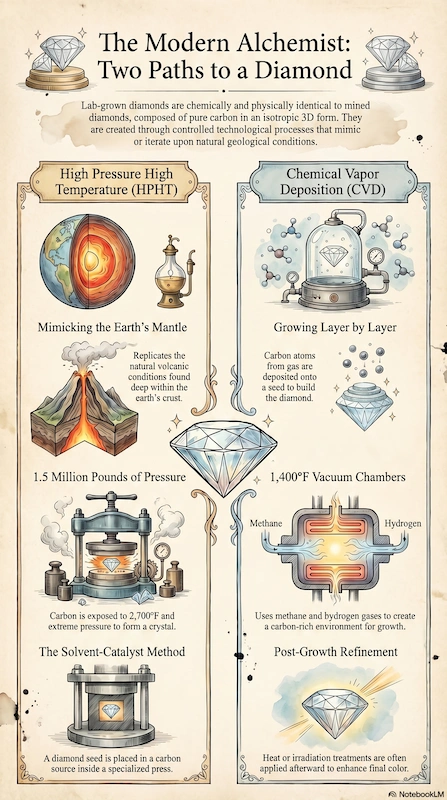
There are two main production methods. You don’t need a chemistry degree, but knowing which one made your stone helps you read a grading report and ask better questions.
Method 1
HPHT: High Pressure, High Temperature
HPHT recreates the conditions deep in the earth. A tiny diamond seed sits in a carbon source inside a press. According to GIA, the chamber is heated to roughly 1,300 to 1,600°C (about 2,400 to 2,900°F) at pressures above 870,000 pounds per square inch. Metal catalysts help the carbon crystallize, which is why some HPHT stones contain tiny metallic inclusions.
Method 2
CVD: Chemical Vapor Deposition
CVD builds the diamond layer by layer. A seed sits in a sealed chamber of carbon-rich gas (usually methane and hydrogen). GIA notes the chamber runs at about 900 to 1,200°C, lower heat and pressure than HPHT, and carbon atoms settle onto the seed. Many CVD stones get a post-growth heat treatment to improve color.
Not a diamond
Simulants: CZ and Moissanite
Cubic zirconia and moissanite are diamond look-alikes made of different materials. They can be lovely and budget-friendly, but they are not lab grown diamonds. If a price looks too good to be true, check that the report says laboratory-grown diamond.
Pro Tip: Ask your jeweler which method grew the stone and whether it was treated after growth. Check what your particular report discloses, and ask for growth and treatment details if they aren’t listed (IGI, for example, adds them on request). Neither method is “better” on its own: judge the individual diamond, not the process.
Lab Grown vs. Natural Diamonds
To the naked eye, you can’t tell them apart. Even trained gemologists need lab equipment to confirm origin. But here’s the deal: the differences that matter are about money, meaning, and the long game.
| Feature | Lab grown | Natural |
|---|---|---|
| Material | Real diamond (carbon) | Real diamond (carbon) |
| Price for similar quality | Typically much lower | Typically much higher |
| Resale value | Weak in today’s market | Stronger, though rarely full price |
| Origin | Grown in a lab in weeks | Formed in the earth over billions of years |
| Traceability | Depends on the producer; ask for documentation | Depends on the source; ask for documentation |
| Inclusions | Often fewer; HPHT may show metallic traces | Natural mineral inclusions vary |
| Rarity | Not rare | Geologically rare |
| Hardness | 10 on the Mohs scale | 10 on the Mohs scale |
- Price: lab grown stones often cost far less than natural stones of similar size and quality, and the gap has widened as production has scaled.
- Resale: natural diamonds tend to hold value better. The secondhand market for lab grown is still thin.
- Environment: lab growth avoids mining, but it uses a lot of energy, so the footprint depends on the producer’s power source.
- Ethics: lab grown stones sidestep mining-related labor and conflict concerns. Transparency still varies by brand, so ask who produced the stone rather than assuming.
- Inclusions: the controlled environment often means cleaner stones at lower prices.
Trend Alert: Lab grown is officially mainstream. Among couples married in 2025, 61% of engagement rings featured a lab grown center stone, according to The Knot, a 239% jump since 2020.
Lab Grown Diamond Pros and Cons
The upside
Pros
- Typically far more affordable than a comparable natural diamond
- Chemically and physically a real diamond
- Sidesteps mining-related labor and conflict concerns
- Often fewer inclusions at a given price
- Available in a wide range of shapes, cuts, and sizes
- Frees up budget for a bigger stone, a better setting, or the wedding itself
- As durable as a natural diamond for everyday wear
The trade-offs
Cons
- Weak resale value, with prices still falling
- No geological rarity, which some people value deeply
- GIA no longer gives lab stones full 4Cs grades, so comparing reports takes more care
- “Eco-friendly” claims vary by producer and energy source
Still weighing other center stones? Our guide to non-traditional engagement rings compares colored gems, unique cuts, and other options side by side.
Should You Choose Lab Grown or Natural?
Both are great choices for different reasons. The quickest way to decide is to be honest about what you want the ring to do for you.
Choose lab grown if you want
- A larger stone for the same budget
- Higher clarity and color at a lower price
- A diamond without mining-related concerns
- To move savings toward the wedding, a honeymoon, or a home
Choose natural if you want
- Better long-term resale potential
- The rarity and origin story of an earth-formed stone
- A stone with traditional significance in your family or community
- An antique or vintage engagement ring with its own history
The bottom line is that this is a personal decision, not a right-or-wrong one. If a stone formed by nature over billions of years means something to you, that matters. If you would rather put the difference toward a honeymoon or a down payment, that matters too. And either one can become a family heirloom: what makes a ring worth passing down is the story attached to it.
How Lab Grown Diamonds Are Graded in 2026
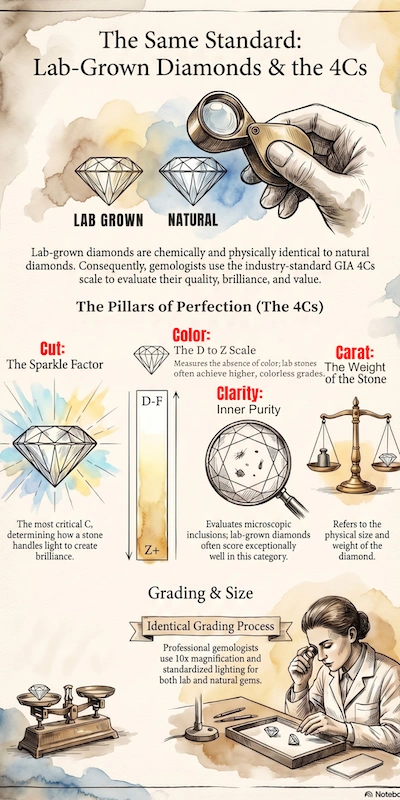
Most lab grown diamonds are still described with the classic 4Cs. Here’s what each one means for your ring.
1
Cut
Controls sparkle. This is the most important C: a well-cut stone outshines a poorly cut one, whatever its color or clarity.
2
Color
Graded D (colorless) to Z. Lab grown stones often land in the near-colorless range, so a top color grade rarely costs a fortune.
3
Clarity
Measures inclusions. Lab grown diamonds often grade well here. Look for a stone that’s eye-clean rather than paying for flawless.
4
Carat
Weight, not size. Shape and proportions decide how big a stone looks from above, so compare the millimeter measurements on the report too. Among 2025 couples, lab grown center stones averaged about 2 carats vs. about 1.6 for natural.
How-To: Prioritize cut above everything. A beautifully cut 1.5 carat stone will often look more impressive than a poorly cut 2 carat. Don’t chase size at the expense of sparkle.
What changed with GIA (and why it matters)
Here’s the update most guides miss. In October 2025, GIA stopped assigning 4Cs grades to lab grown diamonds. GIA’s quality assessment for D-to-Z laboratory-grown diamonds (0.15 carat and up) now classifies each stone as either Premium or Standard, and laser-inscribes it “Laboratory-Grown” with the report number.
- Premium: D color, VVS clarity or better, Excellent polish and symmetry, and an Excellent cut grade (cut is graded on round brilliants only).
- Standard: at least E to J color, VS clarity, Very Good polish, and Very Good symmetry (Good is allowed on fancy shapes), plus a Very Good cut grade on round brilliants. A stone that meets these levels but misses Premium anywhere, such as a D color with VS clarity, is Standard.
- Stones below the Standard thresholds don’t receive either classification. GIA publishes the full criteria chart.
Meanwhile, IGI, one of the most widely used labs for lab grown stones, still uses full cut, color, clarity, and carat grades. On request, it also notes the growth method and any treatments.
Actionable Tip: Ask for a report from an independent lab, and compare like with like. An IGI 4Cs report and a GIA Premium or Standard report describe a stone differently, so don’t line them up on price alone. Also check that the report number matches the laser inscription, and look it up on GIA Report Check or IGI’s report verification.
A quick word on fluorescence
Some diamonds glow under UV light, and lab grown stones often fluoresce differently from natural ones, which is one clue labs use to identify them. It rarely changes the choice, but view the stone in daylight before you buy.
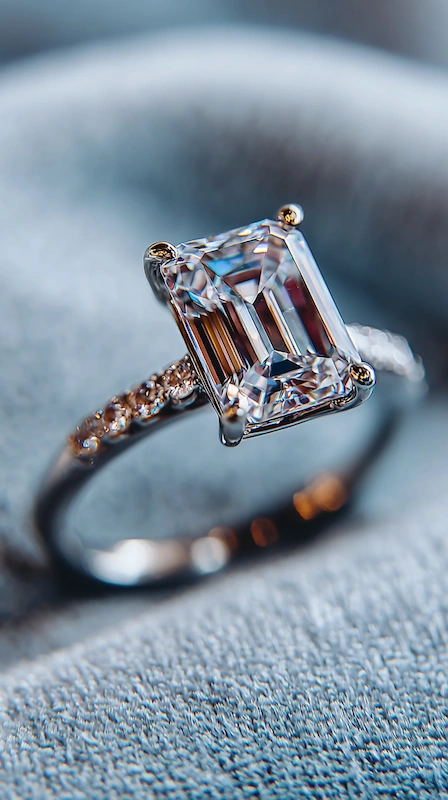
What carat size is right for you?
It depends on your partner’s style, hand, and the setting. The upside of lab grown is that size is more within reach, so you can choose based on what looks right instead of what you can afford.
Do Lab Grown Diamonds Pass a Diamond Tester?
Usually, but handheld testers have blind spots, so an odd reading isn’t automatically a red flag.
- Thermal testers measure how fast a stone moves heat. Lab grown diamonds read as diamond just like mined ones. The catch: IGI notes that thermal testers can also read moissanite as diamond.
- Electrical conductivity testers are meant to separate diamond from moissanite, but IGI warns they can mistake certain lab grown diamonds for moissanite, for example some HPHT stones or stones containing boron.
- Magnets can sometimes give HPHT stones away: GIA notes that some contain enough metallic flux inclusions to be attracted to a magnet. CVD stones don’t have these.
But here’s the catch: a basic tester can’t reliably establish origin, and some readings need further gemological testing. GIA says only a gemological lab with advanced testing equipment can authoritatively determine whether a stone is natural or lab grown. If a tester gives a surprising result, have the stone checked by a lab before assuming anything.
Pro Tip: This is exactly why the report and the laser inscription matter. If you ever need to prove what your stone is, for an appraisal, an insurance claim, or a resale, the paperwork does the talking.
Lab Grown Diamond Cost: What Couples Actually Spent
Lab grown prices have dropped so fast that any per-carat price chart is out of date within months. So instead, here’s what couples actually spent on finished rings, from The Knot’s 2026 Real Weddings Study of 10,474 couples married in 2025.
What Couples Spent on Engagement Rings
| Ring type | Average spend | Average center stone |
|---|---|---|
| Lab grown center stone | $4,300 | About 2 carats |
| Natural diamond center stone | $7,000 | About 1.6 carats |
| All engagement rings | $4,600 | About 1.9 carats |
Sources: overall figures from The Knot Worldwide; the lab grown and natural breakdown as reported by Rapaport (September 29, 2026).
Keep in mind what these numbers are: averages for whole rings, setting included, across very different budgets. The roughly $2,700 gap between the lab grown and natural averages is a difference between survey averages, not the savings you should expect on a like-for-like stone. Still, it’s telling that the lab grown group spent less and ended up with bigger stones.
Loose stone vs. finished ring
Many retailers price the center stone and the setting separately. A “from” price on a loose diamond doesn’t include the metal, side stones, labor, or sizing, so compare finished-ring totals.
How to compare quotes
- Match stone specs: shape, carat, measurements in millimeters, color, clarity, cut, and which lab issued the report
- Match the setting: metal type and karat, side stones, and band width
- Add tax, shipping, and insurance to every total
- Note what’s included: resizing, a written appraisal, cleanings, and prong checks
Prices are still sliding at the wholesale level. Diamond analyst Edahn Golan’s wholesale price index is down 96% since he began tracking in 2018, though JCK reported in July 2026 that declines are starting to slow. Meanwhile, analyst Paul Zimnisky’s data shows retail markups above 80% that have barely moved between 2025 and 2026. That gap is worth knowing when you compare quotes, though how much room any single retailer has will vary.
Actionable Tip: Get written quotes from at least three retailers for stones with matching specs. Compare the grading documents, not just the sticker, and ask about return and upgrade policies in writing.
What Your Savings Can Actually Pay For
The useful next question is what you want the difference to pay for.
Option 1
Better food and drinks
Put it toward catering or an upgraded bar package, usually one of the biggest lines in the whole budget.
Option 2
Photo and video
Add a videographer or extend your photographer’s coverage so you get the getting-ready moments and the last dance.
Option 3
The honeymoon
Upgrade the room, add a few nights, or cover the flights outright.
None of this is a knock on natural diamonds, and the ring is the one piece of the wedding you’ll wear every day for decades. The point is to decide on purpose: list your top three priorities together, then see where the ring falls.
If the diamond matters most, spend there and don’t apologize for it. If the celebration matters more, lab grown gives you the same look on your hand and more of the wedding you pictured. Our wedding budget breakdown shows where that money can go furthest.
Do Lab Grown Diamonds Hold Their Value?
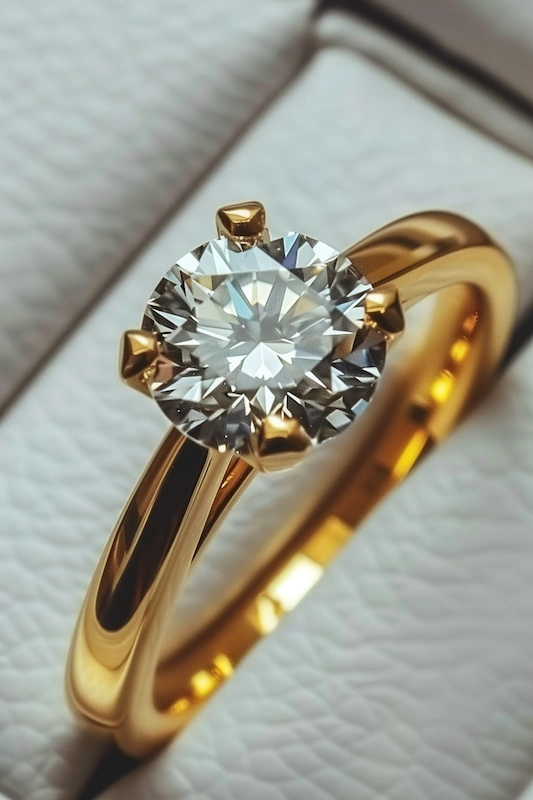
Not well, at least right now. Lab grown prices keep falling as production grows, and few buyers on the secondhand market will pay much for a used lab stone. Natural diamonds hold value better, though they rarely resell for anything close to what you paid either.
That said, most engagement rings are kept, not sold. If this is a ring you plan to wear for life, the bigger question is whether you love it.
If resale truly matters, consider a natural stone, a vintage piece, or an alternative to a traditional ring.
The Ethics and Environment Behind Your Choice
Diamond mining has a complicated history. At its worst it has been linked to conflict financing, unsafe labor, environmental damage, and murky supply chains. The Kimberley Process was created to stop conflict diamonds, but critics point out it doesn’t cover every labor or environmental issue.
Lab grown diamonds avoid many of those concerns. There’s no mine, and production happens in a controlled setting. Many producers can tell you exactly where and how a stone was grown, so ask for that documentation rather than assuming it. If ethical sourcing is your top priority, read our guide to conflict-free diamond engagement rings.
Expert Insight: “Eco-friendly” isn’t a blanket label for every lab grown diamond. Growing diamonds takes a lot of energy, and some producers run on renewables while others don’t. If the environment is a priority, ask your retailer who grew the stone and how it’s powered.
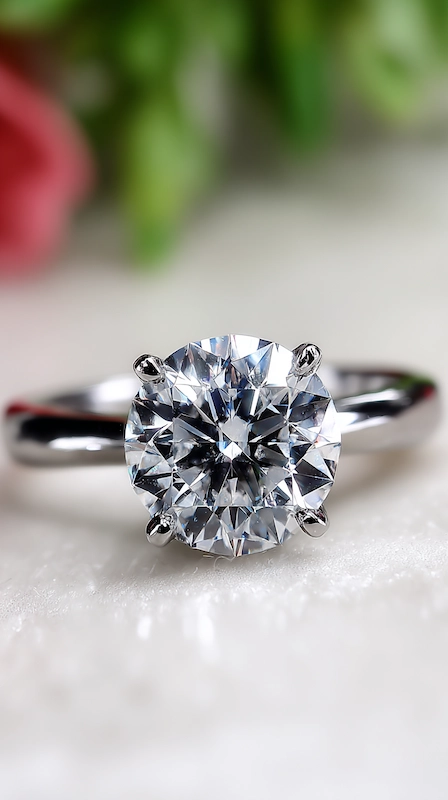
How to Buy Lab Grown Diamond Engagement Rings
Your planner-approved shopping checklist
1
Insist on an independent report
IGI or GIA are the names you’ll see most. The report should state that the stone is laboratory grown.
2
Verify the report number
Look it up on GIA Report Check or IGI’s verification tool, then ask to see the matching laser inscription under magnification.
3
Ask about growth, treatment, and producer
HPHT or CVD, any post-growth color treatment, and who grew the stone. A good retailer answers without hesitation.
4
See the actual stone
Ask for photos or video of that exact diamond, not stock images, and compare its millimeter measurements alongside the carat weight.
5
Check the wedding band fit
Make sure the band you want can sit comfortably next to the engagement ring. Some settings need a curved or notched band.
6
Confirm the timeline
Ask how long setting, resizing, and delivery take, and work back from your proposal date with a buffer.
7
Get the policies in writing
Returns, warranty, resizing, and any trade-in or upgrade program. Walk away from anyone who pushes you to skip the report to “save” money.
8
Know report vs. appraisal
A grading report describes the stone’s quality. An appraisal puts a replacement value on the finished ring for insurance. You’ll want both.
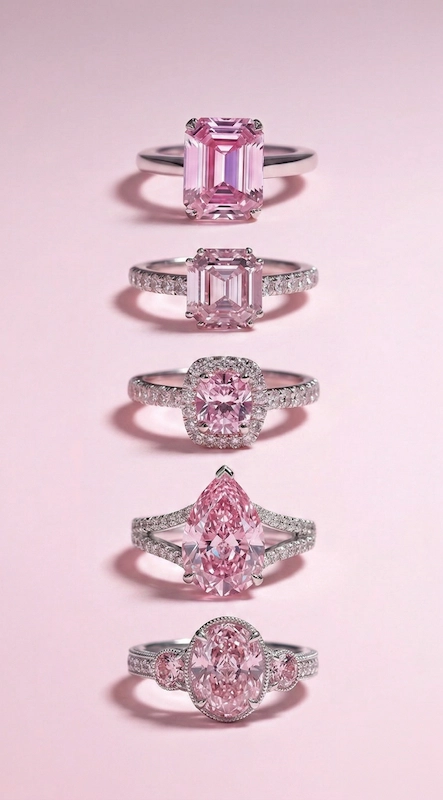
Choosing your setting and style
The setting matters as much as the stone. A well-chosen setting can make a modest diamond look breathtaking.
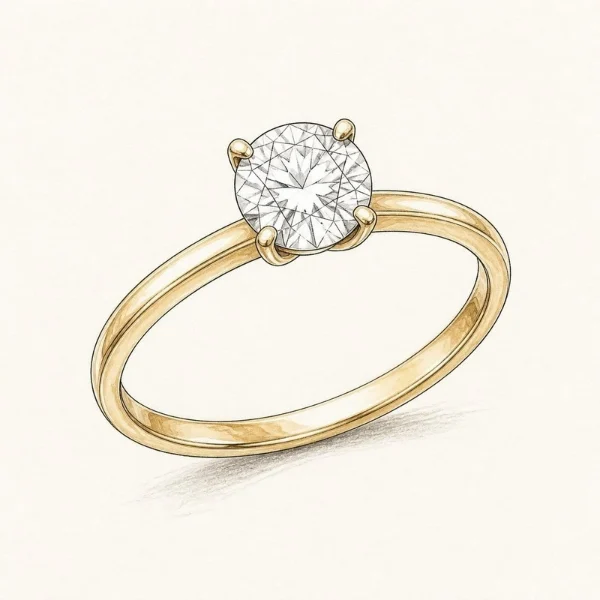
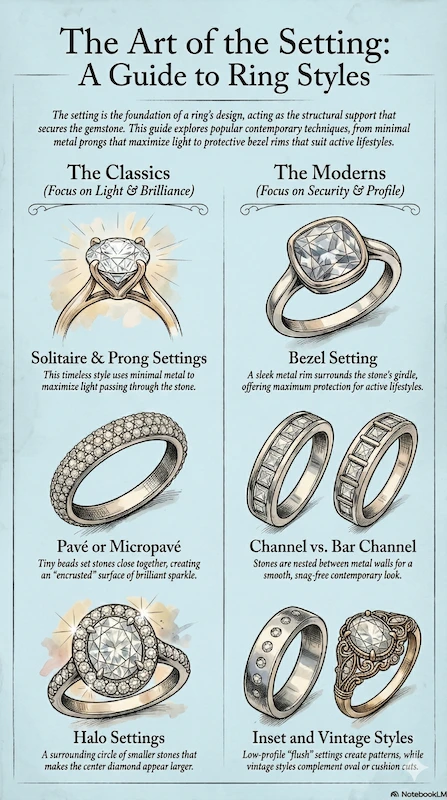
Solitaire
Timeless and clean. Puts the stone front and center.
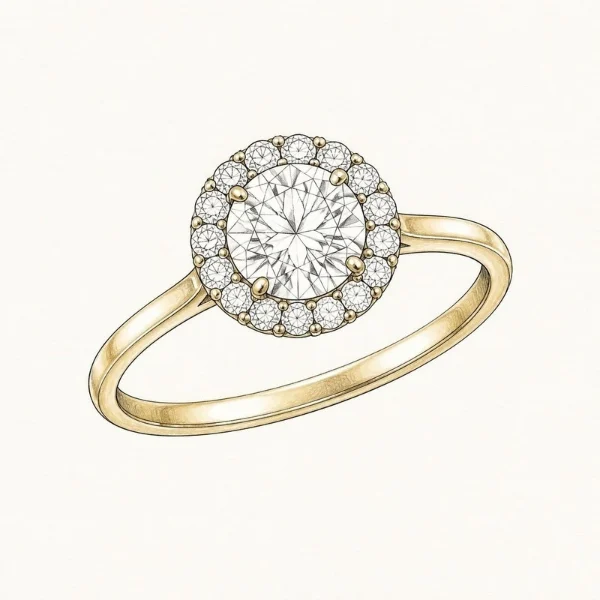
Halo
A ring of small stones that makes the center diamond look larger.
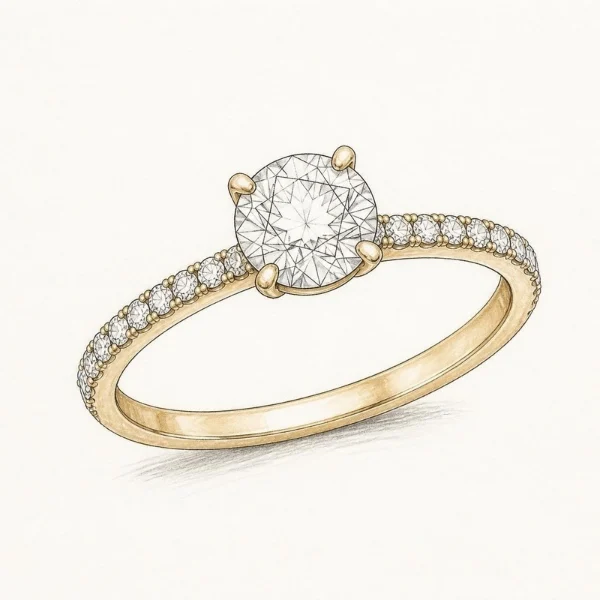
Pavé
Tiny diamonds along the band for extra sparkle.
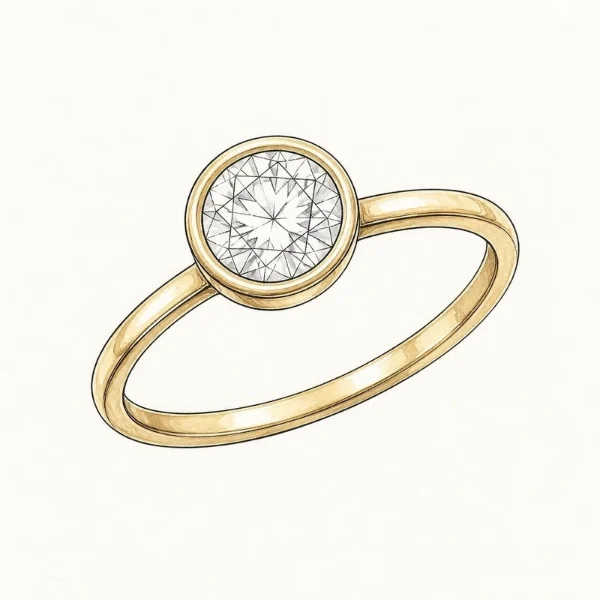
Bezel
Sleek, modern, and great for active lifestyles.
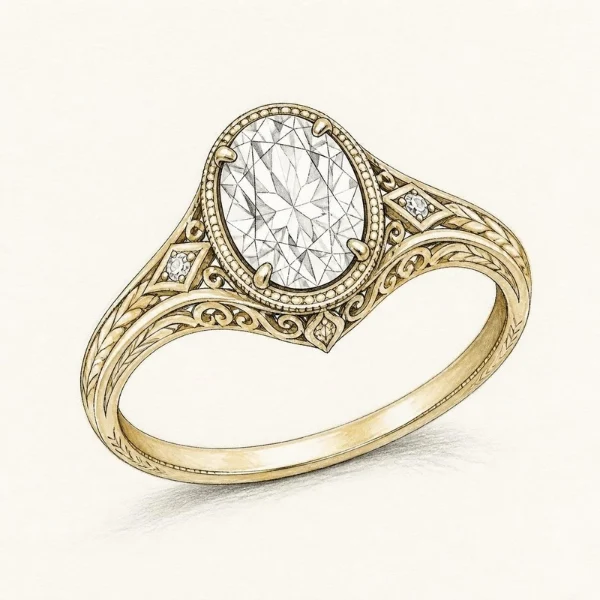
Vintage-inspired
Gorgeous with oval or cushion lab grown stones.
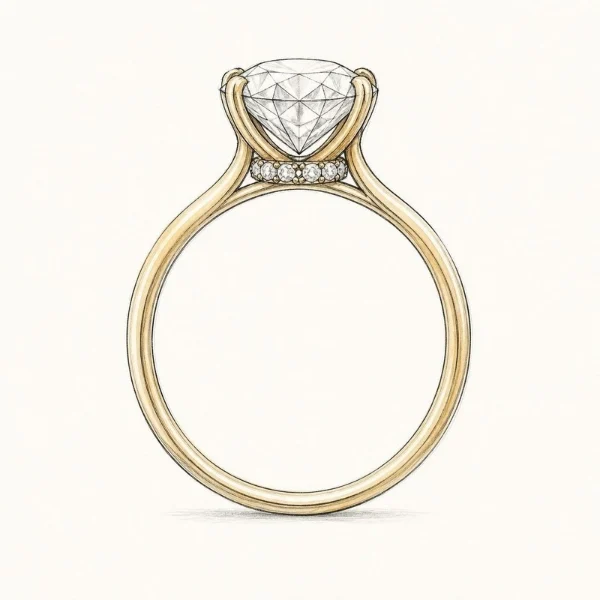
Hidden halo
A secret row of sparkle visible from the side.
Styling Hack: Try the stone in two or three different settings before you decide. The same diamond can look completely different in a solitaire, a halo, or a bezel, and the right one is the one that suits your partner’s style and everyday life.
Still deciding on a look? Compare the most popular diamond cuts, see trending engagement ring styles, and once you’ve picked the stone, our guide to engagement ring metals breaks down platinum, gold, and rose gold.
Caring for Your Lab Grown Diamond
No different from a natural diamond. Lab grown diamonds score a 10 on the Mohs hardness scale, the same as mined stones, so they resist scratches extremely well. Hardness isn’t the same as toughness, though: GIA notes a hard knock can still chip a diamond.
- Clean regularly with mild soap, warm water, and a soft brush under the setting
- Skip harsh chemicals like bleach and chlorine
- Have the prongs checked by a jeweler once a year
- Store it separately so it doesn’t scratch other jewelry
- Take it off for weightlifting, moving furniture, and other hands-on activities where the stone or setting could take a hit
Bonus: Protect it from day one. Read our guides to getting your engagement ring appraised and insuring your engagement ring.
Lab Grown Diamond FAQ
Are lab grown diamonds real diamonds?
Yes. Lab grown diamonds are pure carbon with the same crystal structure and physical properties as mined diamonds. The only difference is where they formed. Simulants like cubic zirconia and moissanite are different materials.
Do lab grown diamonds get cloudy over time?
No. A lab grown diamond won’t turn cloudy or change color. If it looks dull, it’s almost always lotion, soap, or skin oil on the surface, and a gentle cleaning brings the sparkle back.
Should I tell people my engagement ring is lab grown?
That’s entirely your call. Many couples share it proudly as a values or budget choice. There’s no rule that you have to announce it, but if you ever sell, appraise, or insure the ring, its report will identify it as lab grown, so keep that paperwork handy.
Can I insure a lab grown diamond engagement ring?
Yes. Jewelry insurers and many homeowners or renters policies cover lab grown rings. Insurers typically ask for a recent appraisal and the grading report, so keep both somewhere safe.
Can I upgrade a lab grown diamond later?
Some retailers offer upgrade or trade-in programs for lab grown stones, but terms vary widely and credit values may be limited because prices keep falling. Get the policy in writing before you buy if upgrading is part of your plan.
The Bottom Line
A lab grown diamond gives you a real, beautiful stone, often bigger and for less than a comparable mined diamond. That savings can go toward a better cut, a dream setting, your honeymoon, or your first home.
Lab grown isn’t for everyone, though. If rarity, tradition, or resale matters to you, own that. The right ring is the one that fits your relationship, your values, and your life together.
Ready to shop? Start with the report, then the cut, then everything else.
Keep Planning
Conflict-Free Diamond Engagement Rings
How to buy a natural diamond with a clear conscience.
Non-Traditional Engagement Rings
Colored stones, unique cuts, and rings that break the rules.
Antique and Vintage Engagement Rings
The complete buyer’s guide to rings with history.
Sources
Facts in this guide come from these primary and trade sources, checked October 2026:
- GIA: Updated Laboratory-Grown Diamond Services (Aug. 2025)
- GIA: Laboratory-Grown Diamond Services
- GIA: HPHT and CVD Diamond Growth Processes
- IGI: Lab Grown Diamond Report
- GIA: Laboratory-Grown Diamond Assessment Criteria
- IGI: Diamond Detection and Handheld Testers
- The Knot Worldwide: 2026 Real Weddings Study
- Rapaport: The Ring Trends, Stats and Launches Shaping ‘I Do’ This Year (Sept. 29, 2026)
- Rapaport: The Knot Real Weddings Study engagement ring data (Feb. 2026)
- JCK: Lab-Grown Diamond Prices Show Signs of Stabilizing (July 8, 2026)
- JCK: Lab-Grown Diamond Wholesale Prices Are in Freefall; Retail Margins May Be Next
- Edahn Golan Diamond Research & Data: Lab-Grown Price List
- GIA: How to Protect a Diamond From Chipping