Wedding Guest List: How to Build, Track, and Trim It Without Losing Your Mind
Your wedding guest list is the single most powerful document in your entire planning binder, and it also behaves a lot like a living organism. Left unsupervised for one family dinner, it grows. You start with “just close family and friends,” and three weeks later, you’re somehow inviting your fiancé’s college roommate’s new girlfriend, whose name nobody can confirm.
Let’s be real for a second: nobody warns you that the wedding guest list is where your whole budget quietly gets decided. You’ll agonize over napkin colors for a month, then add twelve names in one afternoon without blinking. That afternoon costs more than the napkins, the cake, and the favors combined.
Here’s the good news. Once you treat your guest list like the powerful tool it is, instead of a thing that happens to you, the rest of wedding planning gets dramatically easier. So let’s build it, organize it, track it, and trim it, with as little family drama as humanly possible.

Why Your Wedding Guest List Matters More Than Almost Anything Else
Your wedding guest list is a multiplier, not a line item. That one idea will save you more money than any coupon code ever will.
When you add one of your wedding guests, you don’t just add a plate of food. You add a chair, a place setting, a slice of cake, a share of the bar, an invitation, postage, a favor, and a seat that needs a centerpiece nearby. One name touches a dozen costs at once. That’s why the number of guests you invite drives your wedding budget more than your venue, your dress, or your flowers.
In my experience helping couples plan weddings, guest lists cause more budget overruns than almost any other decision, because every added seat affects multiple categories at once.
Key Takeaway: Every other planning decision is addition. Your guest list is multiplication. Build it first, and build it on purpose.
If you want to see exactly how this plays out across every category, our deep dive on why weddings go over budget shows where the money leaks, and our full wedding guest count guide breaks down how many guests you can actually afford.
How to Build Your Wedding Guest List, Step by Step
The secret to a sane guest list is building it in tiers from day one. When the time comes to trim, you cut from the bottom up and the hard part is already half done.
Here’s the method I walk every couple through:
- Start with your non-negotiables. Immediate family and the handful of friends you genuinely cannot imagine marrying without. For most couples this is 40 to 60 wedding guests.
- Add the “of course” tier. Extended family you’re close to, longtime friends, the people who would be genuinely hurt to be left out.
- Hold the “maybe” tier separately. Coworkers, plus-one dates, your parents’ friends, the cousins you last saw in 2009. This tier is where the living organism feeds. Guard it.
- Combine both partners’ lists and de-duplicate. Yes, you both know that one person. They only get one seat.
- Set a target number before you finalize. Your wedding budget and venue capacity both cap your list, so know your ceiling before you commit the maybes.
Here’s the tier system at a glance, the same framework I keep in front of every couple (and a handy one to pin):
| Tier | Who Belongs |
|---|---|
| Must Invite | Immediate family, closest friends |
| Should Invite | Extended family, close friends |
| Maybe Invite | Coworkers, parents’ friends, distant relatives |
Pro Tip: Give each set of parents a number, not a free pass. “You get 20 names” prevents the single most common guest list blow-up: the surprise list of forty family friends you’ve never met.
According to The Knot’s Real Weddings Study, the average wedding hosts around 116 guests, so if your number is hovering near there, you’re in good company. But average is not a goal. The right number is the one your budget and your sanity can support.
The Best Way to Organize and Keep Track of Your Wedding Guest List
Okay, here’s the part where I make you use a spreadsheet. Stay with me. Wedding planning is just project management with prettier centerpieces, and your guest list is the master project file.
You have three solid options to keep track of all your wedding guests:
| Tool | Best For | The Catch |
|---|---|---|
| Spreadsheet (Excel or Google Sheet) | Couples who want full control and a free guest list tool | You build the columns yourself |
| Wedding website RSVP manager | Couples who want guests to RSVP online | Tied to one platform |
| Dedicated guest list manager app | Couples who want it done for them | Features vary, some cost money |
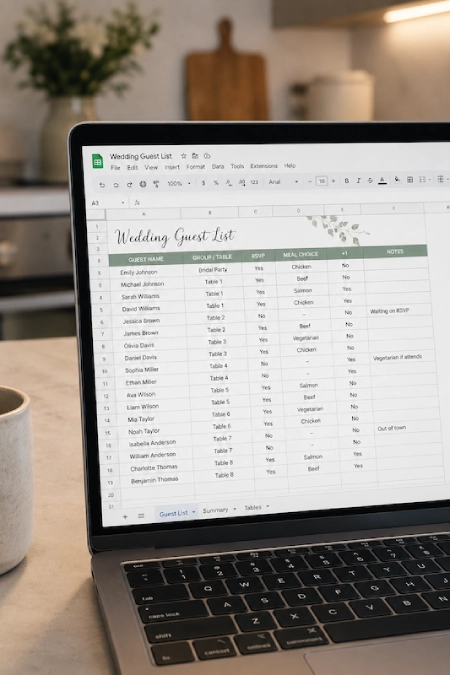
For most couples, a simple wedding guest list spreadsheet wins. A shared Google Sheet does everything many paid guest list tools do: sortable columns, a running headcount, and access from your phone at the tasting. If you prefer to build it in Excel, that works just as well. The tool matters far less than actually using it.
Actionable Tip: Whatever you choose, put it where both partners can edit it. A guest list living in one person’s head, or worse, on a napkin, is how you end up double-inviting Aunt Carol and forgetting your own godmother.
Bonus: Pair your spreadsheet with your wedding website so guests can RSVP online. The responses flow straight into your headcount, which means less manual chasing and fewer “wait, did they reply?” spirals at midnight.
What to Track on Your Wedding Guest List
A name and an address is the bare minimum. A list that actually earns its keep tracks the details about your wedding guests that turn into real planning decisions later.
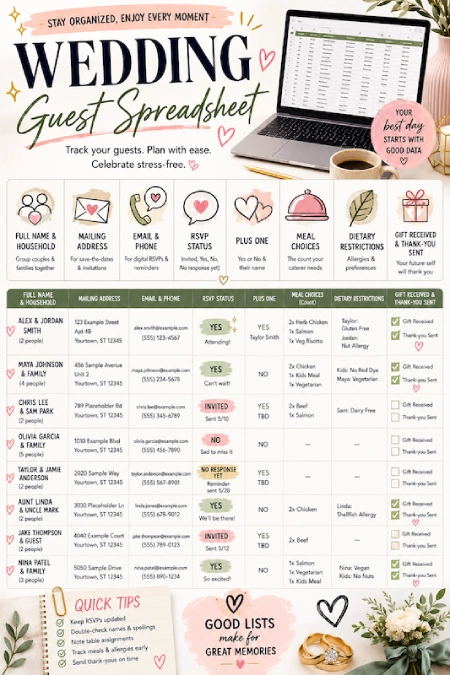
Build these columns into your spreadsheet:
- Full name and household (group couples and families together)
- Mailing address for save-the-dates and wedding invitations
- Email and phone for digital RSVPs and last-minute reminders
- RSVP status (invited, yes, no, no response yet)
- Plus one (yes or no, and their name once you have it)
- Meal choices (the count your caterer will eventually demand)
- Dietary restrictions (allergies and preferences, do not skip this one)
- Gift received and thank-you sent (your future self will thank you)
Expert Insight: The two columns couples forget are dietary restrictions and meal choices, and they’re the two your caterer needs most. Collecting them on the same form as your RSVPs saves you from texting forty wedding guests the week of your wedding. For wording that makes guests actually reply, our wedding RSVP guide has you covered.
Common Wedding Guest List Mistakes (And How to Avoid Them)
Most wedding guest list problems aren’t dramatic. They’re small, reasonable-seeming habits that quietly cost you money and sanity later. Here are the ones I see most often, plus the easy fix for each.
- Starting without a guest cap. Build the list before you set a maximum and the list sets the number for you, always rounding up. Set your cap first, then fill it.
- Giving parents unlimited invites. “Invite whoever you’d like” is a lovely sentiment and a budget grenade. Hand each set of parents a specific number instead.
- Waiting too long to trim. Trimming is easy on a spreadsheet in month two and agonizing once invitations are printed. Make the hard cuts early, before names get attached to feelings.
- Forgetting plus-one rules. Deciding plus-ones one name at a time is how 20 to 40 wedding guests sneak onto the list. Set one clear rule and apply it to everyone.
- Not tracking dietary restrictions. Collect allergies and meal choices on the same form as your RSVPs. Chasing forty people for this the week of the wedding is its own special stress.
- Using multiple versions of the list. The “final-final-v3” spreadsheet problem is real. Keep one shared file both partners edit, and never start a second copy.
Pro Tip: Run a quick audit of your wedding guest list once a month while planning. Five minutes to confirm the count, the plus-ones, and the RSVP status keeps small errors from snowballing into expensive surprises.
How to Trim Your Wedding Guest List (Time to Make the Cut)
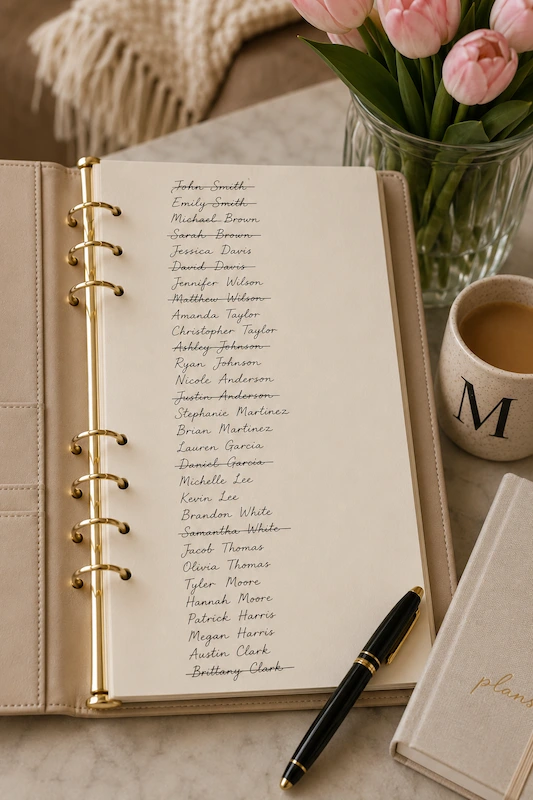
Remember the living organism? By now it has quietly added your dad’s golf foursome and a few names even he can’t explain. Trimming is the cheapest budget move you have, and the most emotionally loaded, which is exactly why most couples avoid it until invitations are already at the printer.
You’re better off making the hard calls early, on paper, before feelings attach to specific names. Here are the cuts that work, from least painful to most:
- The “have we spoken in a year?” test. No contact in a year and no dinner plans on the horizon? Maybe at best.
- Trim the plus-ones. A plus one for every single guest can add 20 to 40 wedding guests fast. A fair, widely accepted rule: plus-ones for spouses, engaged, and long-term partners, not every casual date.
- Set one clear kids policy. Adults-only or kid-friendly, decide once and apply it to everyone. Our guide on how to say no kids at the wedding gives you the exact wording to do it kindly.
- Cut the courtesy invites. Coworkers you don’t see outside work and the neighbor who invited you eight years ago. Obligation is not a reason.
- Apply the “both sides” rule. Every cut category applies to both families equally. Fair rules keep the peace.
How-To: Decide your rules as a couple first, write them down, then apply them with zero exceptions. Rules feel fair. Case-by-case feels personal, and personal is where the family group chat goes nuclear.
Wedding Guest List Etiquette: Plus-Ones, Kids, and the Awkward Stuff
A few etiquette calls come up on every single wedding guest list. Here’s the short, drama-free version.
- Plus-ones: Offer them to married, engaged, and long-term partners. Single wedding guests with a tight friend group at the wedding usually have a great time without one.
- Immediate family first: When space is tight, immediate family and the people closest to you win every time over distant connections.
- The B-list exists, just be discreet. Sending a first round of invitations and a second round as regrets come in is common. Mail the first batch early so the timing never shows.
- Work invites are all-or-nothing. Invite the whole team or keep it out of the office entirely.
Perfect Pairing: Your guest list and your seating chart are a package deal. Lock the list first, because you cannot seat people you haven’t finalized. (Yes, the seating chart is harder than your taxes. No, that is not an exaggeration.)
Don’t Forget the Lists Hiding Inside Your Wedding Guest List
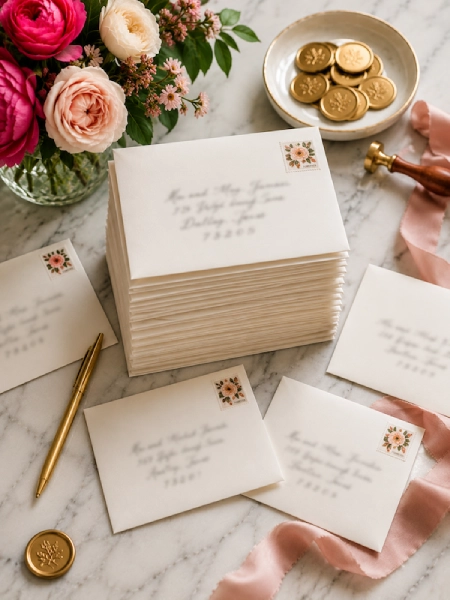
Your master list quietly spawns a few smaller ones. Plan for them now so they don’t surprise you later:
- Save-the-date and wedding invitations list. Usually your full guest list, minus anyone added after save-the-dates went out. Need help with the wording? See our guide to wedding invitation wording.
- Rehearsal dinner list. A smaller, more intimate group. Our rehearsal dinner guide walks through who to include.
- Day-of contact list. A short list of key people, shared with your planner or coordinator, so nobody is calling the bride for directions.
Extra Touch: Keep all of these as separate tabs in the same spreadsheet. One file, every list, zero “which version is current?” panic.
The Bottom Line
The bottom line is this: your wedding guest list is not a detail to settle later. It’s the first real decision that sets the ceiling on everything else, from your budget to your venue to your stress level.
Build it in tiers. Organize it in one shared spreadsheet. Track RSVPs, plus-ones, meal choices, and dietary restrictions in the same place. And when it’s time to trim, cut by rules, not by names.
Do that, and your guest list, that hungry little organism, finally stops growing the moment you tell it to. You’ve got this. And now you’ve got a plan.
Frequently Asked Questions
How many people should be on a wedding guest list?
The average wedding hosts around 116 guests, according to The Knot’s Real Weddings Study, but the right number for you depends on your budget and venue capacity. A small wedding is typically 20 to 50 guests, medium is 50 to 100, large is 100 to 150, and grand is 150 or more. Set your number to your budget, not the other way around.
How do I make a wedding guest list for free?
A free Google Sheet or Excel file is all you need. Create columns for name, address, RSVP status, plus one, meal choices, and dietary restrictions, then share it so both partners can edit. A simple spreadsheet does everything a paid guest list manager does, at no cost.
What should a wedding guest list include?
At minimum: full name, household grouping, mailing address, and RSVP status. A list that earns its keep also tracks email, plus-one status, meal choices, dietary restrictions, and whether a thank-you note has been sent. These details feed straight into your catering and stationery decisions.
How do I organize my wedding guest list in Excel or Google Sheets?
Use one row per guest or household, with a column for each detail you need to track. Add a column that tallies RSVP status so you always have a running headcount. Keep related lists, such as your rehearsal dinner and save-the-date lists, as separate tabs in the same file.
When should I finalize my wedding guest list?
Aim to lock your list before save-the-dates go out, usually six to eight months before the wedding, and confirm the final count when RSVPs close, typically three to four weeks before the day. Your caterer and venue will need that final number to finalize meal choices and seating.
Should I invite coworkers to my wedding?
Only if you’d genuinely spend time with them outside of work. Coworker invites are one of the fastest ways to inflate a wedding guest list, and they tend to be all-or-nothing: invite the whole team or keep work off the list entirely. When the budget is tight, your closest people should come first.
How do I cut down my wedding guest list without offending people?
Decide your rules as a couple first, then apply them evenly to both families: plus-ones only for serious partners, one clear kids policy, no courtesy invites. Rules feel fair, while case-by-case decisions feel personal. Make the cuts on paper before the invitations are printed.