Why Weddings Go Over Budget (And Exactly Where the Money Goes)
Here’s something nobody puts in the wedding magazine: why weddings go over budget has almost nothing to do with bad math and almost everything to do with the order in which couples make decisions.
You didn’t fail at budgeting. You just fell in love with a venue before you built a line-item breakdown. Welcome. I’ve watched this happen approximately three hundred times, and it plays out almost identically every single time.
The couple sets a number. Let’s say $35,000. They feel good about it. They’ve been reasonable adults about money their whole lives. Then they tour a venue. The venue is stunning. The venue is $16,000 before catering. The venue has floor-to-ceiling windows and a bridal suite that smells like an Anthropologie candle. They sign.
And just like that, 46% of the budget is gone before a single photographer has been contacted.
And it isn’t just you. According to Zola’s 2025 First Look Report, which followed up with 1,500 newly married couples, roughly 74% ended up going over their original wedding budget — and about 1 in 5 (20%) overspent by at least $10,000. So if your number is already creeping, you’re in very normal company.
That’s not a cautionary tale. That’s a pattern. And once you can see the pattern, you can plan around it.
Here’s what I’ve learned after years of doing this: the most expensive wedding budget mistakes are rarely reckless splurges. They’re quiet, reasonable decisions made in the wrong order. That’s what this guide is really about.

The Planned vs. Actual Problem
Most couples go into wedding planning with a rough idea of how they want to divide their budget. In theory, it’s perfectly sensible. In practice, there’s a significant gap between what couples intend to spend by category and what they actually spend once vendors, upgrades, and the general reality of wedding pricing enter the picture.
Based on industry surveys and years of real-world wedding-planning experience, couples often allocate their budgets very differently from what they originally intended. Think of the numbers below as illustrative of a pattern I see constantly, not a precise national average:
Here’s what that pattern tends to look like:
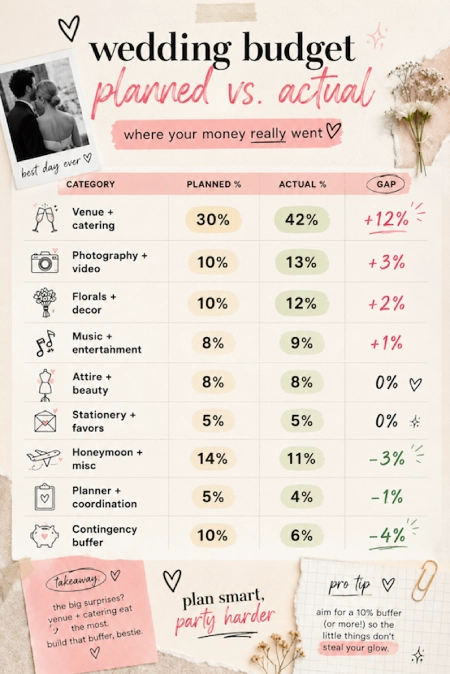
On paper, none of those individual overages look catastrophic. Three percent here, two percent there. But here’s the catch: the overages all happen in the same direction, and they all get funded from the same places. The honeymoon gets trimmed. The contingency buffer shrinks to almost nothing. The planner line disappears. By the end, couples have spent exactly what they planned to spend in total, they’ve just spent it completely differently than they intended.
Key Takeaway: Wedding budget overruns are rarely dramatic blow-outs. They’re a series of small, totally logical upgrades that quietly eat the categories nobody was guarding.
Where Couples Actually Overspend: Category by Category
The Venue and Catering Trap (The Big One)
The venue is the single biggest driver of wedding budget overruns, and it’s not particularly close.
Couples typically plan to spend about 30% of their total budget on venue and catering combined. They end up spending closer to 42%. On a $35,000 budget, that’s the difference between $10,500 and $14,700. Almost $4,200 in overspend, on one line item, before the rest of the planning has even started.
Here’s why it happens so consistently:
- The venue is usually the first vendor booked, before the budget is truly locked in. You tour the space when the number still feels abstract.
- Venue pricing has a lot of add-ons that sound small but compound fast: ceremony fees, setup and breakdown charges, valet, coat check, overtime, the lighting upgrade you’ll want once you see the default package.
- Catering minimums are non-negotiable, and they scale directly with your guest count, which is the single biggest multiplier in your whole budget.
- The “anchor effect” is real. Once a couple has committed to a venue at $14,000, spending $2,500 on florals feels modest by comparison. Every subsequent decision gets evaluated against the big number, not the original budget.
Pro Tip: Before you tour a single venue, build a complete line-item budget and assign a firm ceiling to venue and catering combined. Walk into every tour knowing your number, and know how to choose a wedding venue, plus the right questions to ask a wedding venue, so the add-ons don’t blindside you. If the venue exceeds it, you can acknowledge its beauty and keep moving. If you tour first and budget later, you’ll spend the rest of your planning trying to work backward from an emotional decision you’ve already made.
Photography and Video (The Sneaky Upgrade)
Couples plan for around 10% of their budget on photography and video. They end up spending closer to 13%.
A three-percent overage sounds minor. On a $35,000 budget, that’s a $1,050 difference. But it almost never stops there, because photography has its own upgrade ecosystem: second shooters, videography added late, engagement sessions, albums, extended coverage hours. Each one is individually easy to justify. Together, they push the category well past its original allocation.
But here’s the deal: photography is also the one budget category I’d argue is worth overspending on slightly, because it’s the only vendor whose work you’ll still have in forty years. Your flowers are gone by Monday. Your photos are forever.
The solution isn’t to spend less on photography. It’s to plan for the full number from the start, instead of anchoring on a low estimate and adding to it one upgrade at a time.
Expert Insight: When you’re comparing photographers, ask for the all-in package price: second shooter, edited gallery, and travel fees included. That’s the real number. The base rate on the website is almost never what couples actually pay. The same discipline applies everywhere, and knowing how to negotiate with wedding vendors keeps these upgrades from quietly turning into wedding budget overruns.
Florals and Decor (Where Pinterest Does Real Financial Damage)
You Googled “wedding florals,” spent four hours on Pinterest, and now you’re considering becoming a florist. We’ve all been there. (Well, I’ve watched hundreds of couples go there. Same thing.)

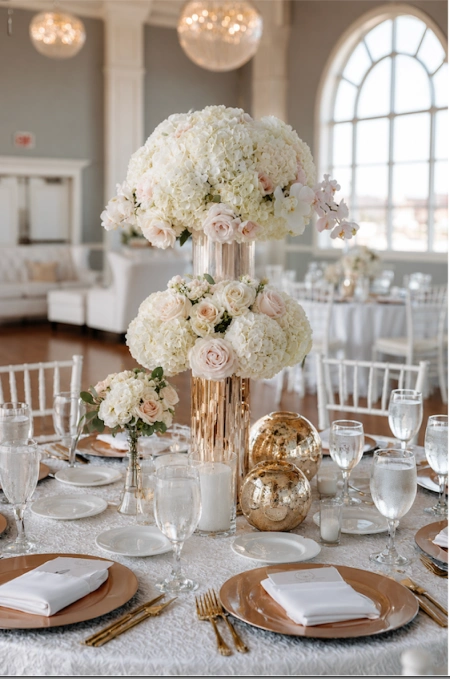
Florals are the category where vision and reality collide most visibly. The lush, romantic, overgrown ceremony arch you saved looks incredible in that photo. It also costs $3,500 to $6,000, depending on your market and florist. The centerpieces on that one tablescape? Another $200 to $400 each.
Couples typically plan about 10% of their budget for florals and decor. They end up spending 12%. The gap comes from:
- Adding florals to spaces they didn’t originally plan for: cocktail hour, escort card table, bathroom arrangement, cake table.
- Choosing more elaborate designs after seeing samples in person.
- Delivery, setup, and breakdown fees that aren’t always included in the quoted flower price.
Styling Hack: Ask your florist what they can do with your budget before you describe what you want. A good florist will give you three or four design directions that actually work for your number. Starting from “here’s my vision, what will it cost?” usually leads to a number you weren’t prepared for.
Music and Entertainment (The Upgrade That Happens at the Contract Stage)
Entertainment typically comes in close to the planned allocation, but it’s a category where the initial quote and the final invoice rarely match.
The gap comes from extras that get added during contracting: extended cocktail hour coverage, ceremony musicians, a photo booth, late-night snack packages, lighting upgrades from the DJ. Each is a reasonable add-on. None of them were in the original number.
Actionable Tip: When you book your DJ or band, ask for a complete menu of every possible add-on upfront, with pricing. Add the ones you want immediately, total the number, and budget for that figure. Discovering the photo booth is $850 after you’ve already allocated every dollar elsewhere is an avoidable conversation.
Attire and Beauty (Surprisingly Stable, But With One Caveat)
Attire and beauty tend to come in close to plan, couples are often more thoughtful about this category because they’ve done the research before the first appointment.
The one consistent exception is alterations. Bridal gown alterations are rarely included in the purchase price and can run anywhere from $300 to $1,500 depending on the complexity of the dress and your alterations timeline. Most brides don’t budget for this separately because nobody told them to. Budget for it now.
Pro Tip: When you’re budgeting for your dress, add at least $400 to $600 as an alterations line. If you end up spending less, great. If you have a structured bodice or significant bustle work, you’ll be glad you planned for it.
Stationery and Favors (Where You’ll Spend Less Than You Think)
Good news here: stationery and favors almost always come in at or below plan, because couples tend to simplify once they see how quickly other categories add up. Digital RSVPs, QR code menus, and scaled-back favor choices are increasingly common, and honestly, your guests will not notice the napkin fold. I promise. I have been to many weddings.
The Categories That Get Raided
Look at the gap column in the table again. The overspend in venue, photography, and florals has to come from somewhere. Here’s where it comes from:
The Honeymoon Fund (-3%). This is the line item that quietly absorbs the first wave of overspend. A scaled-back honeymoon, a shortened trip, or a “we’ll do the big trip later” conversation that doesn’t always materialize.
The Contingency Buffer (-4%). This is the one that genuinely stings. Most financial planners recommend a 10 to 15 percent contingency buffer on any large event budget. Most couples end up with 6% or less by the time they’ve finished booking. That leaves almost no margin for the vendor who raises their rate, the overtime charge, or the last-minute catering increase.
The Planner and Coordination Budget (-1%). Ironically, the person whose job it is to keep your budget in line is often the first line item to get cut. More on that in a moment.
Key Takeaway: Your contingency buffer is not a nice-to-have. It’s an insurance policy against every vendor conversation that doesn’t go according to plan. Protect it like it matters, because it does.
The Guest Count Effect Nobody Talks About
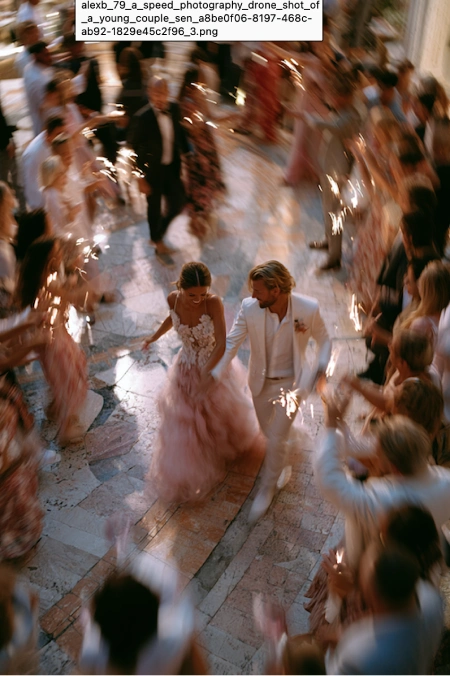
If venue and catering are where the money goes, your guest count is the dial that decides how fast it gets there. It’s the single biggest multiplier in wedding budget management, and it’s the one most couples adjust last instead of first.
Here’s the trap. When couples think about adding people, they think in meals. “What’s another 25 guests? That’s just 25 more plates.” But a guest is never just a plate.
Add 25 guests and you don’t only add 25 meals. You add:
- More tables, chairs, and linens to rent
- More centerpieces and floral arrangements
- More invitations, postage, and save-the-dates
- More favors and welcome bags
- More bar consumption and cake servings
- More place settings, glassware, and flatware
- Sometimes a larger venue tier, extra staff, or added transportation
One number quietly multiplies across a dozen line items at once. That’s why guest count is where wedding costs add up faster than almost anything else, and why trimming a list by even 10% often does more for a stretched budget than cutting any single vendor.
Bonus: Before you finalize your list, calculate your true per-guest cost, not just the catering quote. Take your total budget and divide it by your guest count. In most markets that lands somewhere between $200 and $500 per person once everything is accounted for. Seeing that real number makes the “should we invite them?” conversation a lot easier.
The flip side is encouraging: guest count is also the lever you control most directly. You can’t usually negotiate a venue’s base rate down by 30%, but you can decide whether the plus-ones, the work colleagues, and the third cousins make the cut. Strong wedding budget management often comes down to one honest pass through the guest list before anything gets booked.
The bottom line: guard your guest count as carefully as you guard your contingency buffer. It’s the cheapest way to keep your wedding budget under control.
Why Weddings Go Over Budget Time and Again
The planned vs. actual gap isn’t a discipline problem. It’s a sequencing problem. Most couples make their biggest financial commitments (venue, photographer) before they’ve fully worked out the downstream implications for every other category.
The Most Common Wedding Budget Mistakes Couples Make
Most wedding budget problems trace back to this one thing. The most common wedding budget planning mistakes aren’t about overspending on any single item, they’re about locking in the big numbers before the small ones are even on paper.

Here’s the sequence that causes overspend:
- Set a total budget number.
- Tour venues before building a line-item breakdown.
- Fall in love with a venue that exceeds the original allocation.
- Sign the contract anyway, mentally promising to “make up for it” elsewhere.
- Realize there’s nowhere to make up for it that doesn’t hurt.
And here’s the sequence that prevents it:
- Set a total budget number.
- Build a complete line-item breakdown with a ceiling for every category.
- Add your contingency buffer last, as a true reserve.
- Tour venues knowing your ceiling before you walk in.
- Evaluate every vendor quote against the category allocation, not the total number.
The practical difference between these two sequences is one spreadsheet built before the first vendor contact. That’s it. One document, before you fall in love with anything.
Our complete wedding budget breakdown gives you the full category-by-category framework to build that spreadsheet before your first venue tour. And if you want to see every line item most couples forget to include before it’s too late, our guide to 17 hidden wedding costs is required reading before you finalize your numbers.
The One Budget Decision That Pays for Itself
Here’s a counterintuitive one: the planner budget getting cut is often the most expensive wedding planning mistake a couple can make.
A good wedding planner or coordinator doesn’t just manage logistics. They catch vendor overcharges, negotiate contracts, prevent costly last-minute changes, and know which venue add-ons are worth paying for and which ones aren’t. Couples who work with a planner from the beginning tend to have fewer budget surprises, not more, because someone with experience is reviewing every quote before it becomes a commitment.
If your budget is tight and a full-service planner isn’t realistic, a partial planner or day-of coordinator still gives you a professional set of eyes on the most expensive decisions. You’re better off allocating for it early than discovering you needed it in month eight. If you’re weighing whether it’s worth it, we make the full case in do wedding planners save money?

The Bottom Line
The bottom line is this: most couples don’t go over budget because they’re careless with money. They go over budget because they make their biggest financial commitments before they have the full picture, and then spend the rest of planning trying to catch up.
The fix is boring. It’s a spreadsheet with category ceilings built before you tour your first venue. It’s an honest contingency buffer treated as off-limits until there’s an actual emergency. It’s the discipline to walk away from a venue that’s beautiful but exceeds your ceiling, knowing the right venue for your number is out there.
You’ve got this. And now you’ve got a plan.
Before you contact a single venue, do these three things: download your complete wedding budget breakdown, set a firm ceiling for every category, and calculate your true per-guest cost. Those three steps alone will prevent most wedding budget overruns. For more wedding budget tips, start there and build your numbers before you book a thing.
Frequently Asked Questions
Why do most weddings go over budget?
The most common reason is sequencing: couples tour and book venues before building a detailed line-item budget, which means the biggest financial commitment gets made without a full picture of what it displaces. Venue and catering overruns are the single largest driver of total budget overruns.
What is the biggest wedding expense most couples underestimate?
Venue and catering, consistently. Couples typically plan to spend about 30% of their total budget on this combined category and end up spending closer to 42%. That 12-point gap affects every other category.
How much should you set aside as a wedding contingency buffer?
Most event planning professionals recommend 10 to 15% of your total budget as a contingency. In practice, most couples start with that intention and end the planning process with 5 to 6% remaining, because the contingency quietly absorbs overspend elsewhere. Treat it as untouchable until you have a genuine emergency.
Is it normal for a wedding to go over budget?
Very common, yes. Industry surveys suggest a significant majority of couples spend more than their original wedding budget. The key is understanding where the overruns typically occur, and building your category allocations to account for them before you start booking.
Why do wedding venues cost so much?
Venues carry the highest fixed costs of any vendor: labor, insurance, overhead, and often exclusive in-house catering with per-person minimums. Labor alone tends to run around 30% of a venue’s costs, and weekend or holiday dates can add overtime and surcharges on top. For the full picture, see why weddings are so expensive.
How much should I spend on a wedding venue?
A common starting point is about 30% of your total budget for venue and catering combined, but plan for it to climb closer to 40% once add-ons and minimums are factored in. The smarter move is to set a firm ceiling before you tour. Our wedding budget breakdown shows where that number fits alongside every other category.
Should you tell vendors your maximum budget?
No. Give vendors a target number, not your ceiling. If a vendor knows your maximum, they have no incentive to come in below it. Quote a number somewhat below your true ceiling and leave room to negotiate.
What is the best way to avoid going over a wedding budget?
Build a complete line-item breakdown before you contact any vendor. Assign a firm ceiling to venue and catering before your first tour. Protect your contingency buffer as a true reserve, not a slush fund. And get all quotes in writing before you factor them into your running total.