
Wedding Guest Count: How Many Guests Should You Invite (And Afford)?
Your wedding guest count is the single most powerful number in your entire budget, and almost nobody treats it that way. Couples agonize over flowers and napkin colors for months, then add fifteen names to the list in a single afternoon without blinking. That one afternoon usually costs more than the flowers, the napkins, and the cake combined.
Here’s what I’ve learned after years of planning weddings: the guest list is where the whole budget is quietly decided. Get the number right early and everything downstream gets easier. Get it wrong and you’ll spend the rest of planning trying to claw the money back.
So let’s talk about it honestly. How many people should you actually invite, what each guest truly costs, and how to trim the list without starting a family feud.
Why Your Wedding Guest Count Is the Most Important Number You’ll Pick

Your wedding guest count is a multiplier, not a line item. That’s the whole thing in one sentence.
When you add a guest, you don’t just add a plate of food. You add a chair, a place setting, glassware, a share of the bar, a slice of cake, an invitation, postage, a favor, and a seat that needs a centerpiece nearby. One name touches a dozen categories at once.
Key Takeaway: Every other budget decision is addition. Guest count is multiplication. That’s why it deserves your attention before you fall in love with a venue, a dress, or a single peony.
For the full picture of how this plays out across your whole budget, our guide to why weddings go over budget breaks down exactly where the money leaks. Spoiler: guest count is usually upstream of the leak.
How Many Guests Should You Invite? Let’s Start With Real Numbers
Most weddings today host about 116 guests, according to The Knot’s Real Weddings Study. Small weddings typically have 20 to 50 guests, medium weddings 50 to 100, large weddings 100 to 150, and grand weddings more than 150 guests. The right number depends on your budget, venue capacity, and priorities.
There is no universally correct guest count, but there is real data to anchor against.
According to The Knot’s Real Weddings Study, the average wedding in 2024 hosted around 116 guests, with the typical headcount ranging from 115 in 2023 to 117 among couples married in 2025. That’s still below the pre-pandemic average of roughly 131 guests in 2019. Generation matters too: the same research found Gen Z couples average about 129 guests, Millennials around 112, and Gen X closer to 90.
So if you’re picturing 120 or so faces, you’re squarely in the modern norm. But normal is not the same as right for you.
Here’s a simple way to find your number:
- Start with your non-negotiables. Immediate family and the friends you genuinely cannot imagine marrying without. This is usually 40 to 60 people.
- Add your “of course” tier. Extended family you’re close to, longtime friends, the people who’d be hurt and rightly so if they weren’t there.
- Pause before the “maybe” tier. Coworkers, plus-ones for single friends, your parents’ friends, the cousins you see once a decade. This tier is where budgets quietly explode.
- Run the math before you commit the maybes. Multiply your current count by your real per-guest cost (more on that below) and see what the maybe tier actually adds.
Actionable Tip: Build your list in those three tiers from day one. When you need to cut, you cut from the bottom up, and the decision is already half made. Once your list is set, our wedding RSVP guide covers the wording, timelines, and tracking that keep your final headcount accurate.
The Real Cost of One Extra Guest
This is the section I wish every couple read before finalizing their list.
People assume an extra guest costs whatever the catering quote says per head. Say $150. But the true per-guest cost is almost always higher, because catering is only one of the things that scales with your guest count.
Add one guest and you typically add a share of:
- Catering and the bar (per head, plus any minimums)
- Rentals: chair, linens, place setting, glassware, flatware
- Florals: more tables means more centerpieces
- Stationery: invitation, postage, save-the-date, escort card, favor
- Cake and dessert servings
- Staffing ratios, and sometimes a larger venue tier entirely
Pro Tip: To find your true per-guest cost, take your total budget and divide it by your current guest count. In most markets that lands somewhere between $200 and $500 per person once everything is counted, not just the catering line. Run that number, then look at your “maybe” list again. Twenty maybes at $300 each is $6,000. That’s a honeymoon.
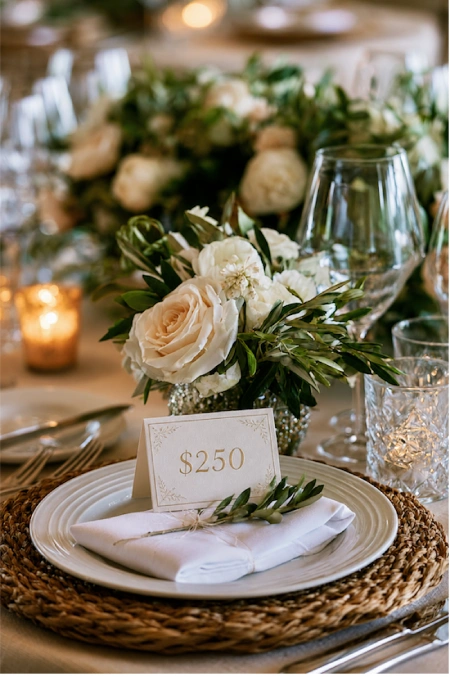
If the per-guest number stings, it’s worth understanding what’s behind it. Our breakdown of why weddings are so expensive explains why guest count is consistently the biggest culprit.
After years of working with couples, here’s something I can tell you for certain: guest count is almost never the number people regret reducing. What couples regret is stretching their budget so thin that they couldn’t afford the experience they really wanted. I’ve watched couples cut 25 guests and use the savings to upgrade from a buffet to a plated dinner, add live music, or extend their photography coverage. Years later, they remember the experience, not the names that never made the final list.
How Many Wedding Guests Can You Afford?
This is the question worth asking before “who do we want to invite?” Your budget sets a ceiling on your guest count whether you plan for it or not, so you may as well do the math on purpose.
The fastest way to estimate it: divide your total budget by a realistic cost per guest. Here’s roughly how that shakes out at an estimated $250 per guest:
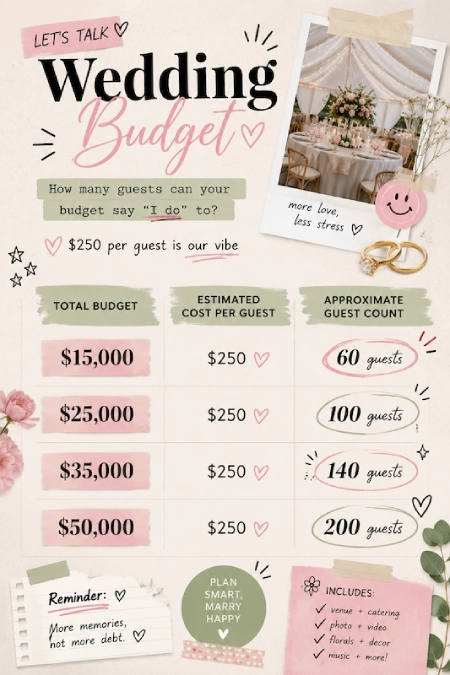
But here’s the catch: that $250 is a starting estimate, not a rule. Your real average cost per wedding guest swings widely by market, season, and style. In major metros, or for plated dinners with an open bar, it can climb to $400 or more per head. In smaller markets, or for daytime and buffet-style weddings, it can drop well below $250.
How-To: To build your own wedding guest list budget, work backward. Take your total budget, subtract the fixed costs that don’t scale with headcount (photographer, attire, planner, music), then divide what’s left by your real per-guest cost. That gives you a far more honest answer to how many wedding guests you can afford than any generic calculator.
Key Takeaway: Set your guest count to your budget, not your budget to your guest count. Couples who decide in that order almost never go over.
How to Cut Your Wedding Guest List Without the Drama
Trimming the list is the cheapest budget move you have, and the most emotionally loaded. That’s why most couples avoid it until it’s too late. You’re better off making the hard calls early, on paper, before invitations are printed and feelings get attached to specific names.
Here are the cuts that work, roughly in order of least painful to most:
- The “have we spoken in a year?” test. If you haven’t talked since last year and wouldn’t grab dinner with them next month, they’re a maybe at best.
- Trim the plus-ones. A plus-one for every single guest can add 20 to 40 people fast. A common and completely acceptable rule: plus-ones for spouses, engaged, and long-term partners, not for every casual date.
- Set a clear policy on kids. Whether you go adults-only or kid-friendly, decide once and apply it to everyone. Our guide on how to say no kids at the wedding gives you the exact wording to do it kindly.
- Cut the courtesy invites. Coworkers you don’t see outside work, your parents’ friends you’ve met twice, the neighbor who invited you to theirs eight years ago. Obligation is not a reason.
- Apply the “both sides” rule. Every cut category has to apply to both families equally. That’s what keeps it fair and keeps the peace.
Expert Insight: The hardest part of cutting a list is rarely the decision. It’s the fear of the conversation. Decide your rules as a couple first, write them down, then apply them without exceptions. Rules feel fair. Case-by-case feels personal.
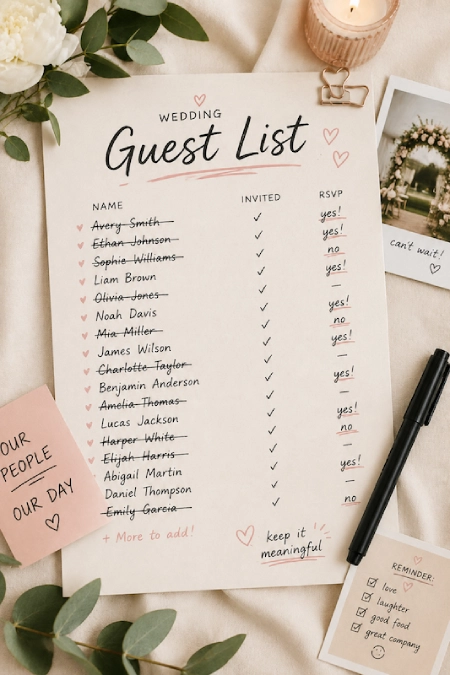
Wedding Guest Count by Wedding Size
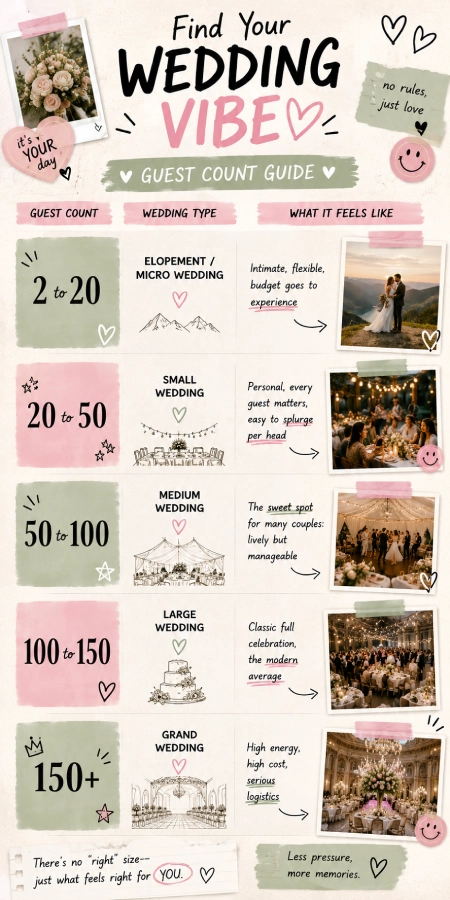
Different guest counts create genuinely different weddings, not just different bills. Here’s what each range tends to feel like, so you can match your number to the day you actually want.
| Guest Count | Wedding Type | What It Feels Like |
|---|---|---|
| 2 to 20 | Elopement / micro wedding | Intimate, flexible, budget goes to experience |
| 20 to 50 | Small wedding | Personal, every guest matters, easy to splurge per head |
| 50 to 100 | Medium wedding | The sweet spot for many couples: lively but manageable |
| 100 to 150 | Large wedding | Classic full celebration, the modern average |
| 150+ | Grand wedding | High energy, high cost, serious logistics |
Trend Alert: Micro weddings and intimate guest lists haven’t gone away. Many couples are deliberately keeping the count low and spending more per guest on the experience: better food, real cocktails, a band instead of a playlist. A smaller wedding guest count is one of the few choices that makes the day feel more luxurious and cost less overall.
The Wow Factor: Make a Smaller Guest List Look Intentional, Not Small
If you trim your guest count, do not apologize for it. Design around it.
A shorter list lets you do things a 200-person wedding simply cannot afford:
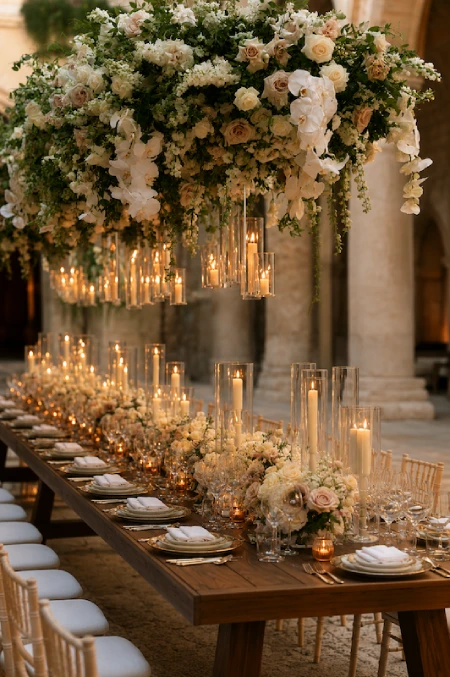
- One long banquet table instead of scattered rounds, for a dramatic, editorial look
- A genuinely upgraded menu, plated and served, instead of a stretched buffet
- Real florals on every table because there are fewer tables to fill
- A signature experience, like a live raw bar, a champagne tower, or a string quartet, funded entirely by the guests you didn’t invite
Styling Hack: Take the money saved from 30 trimmed guests and pour it into one unforgettable centerpiece moment. A champagne tower or a floral installation over a single long table photographs better and lingers in memory longer than 30 extra place settings ever would.
The Bottom Line
The bottom line is this: your wedding guest count is not a detail to settle later. It’s the first real budget decision you’ll make, and it quietly sets the ceiling on everything else.
Decide your number early. Build the list in tiers. Know your true per-guest cost before you commit the maybes. And if you need to cut, cut by rules, not by names. That one discipline will save you more money, and more arguments, than any other choice in your planning.
Before you finalize anything, do these three things: build your guest list in tiers, calculate your true per-guest cost, and set your plus-one and kids policies in writing. Those three steps alone will keep your wedding guest count from quietly running your budget.
You’ve got this. And now you’ve got a plan.
Frequently Asked Questions
What is the average wedding guest count?
According to The Knot’s Real Weddings Study, the average wedding hosted around 116 guests in 2024, with recent years sitting between 115 and 117. That’s still below the pre-pandemic average of roughly 131 in 2019. Gen Z couples tend to invite more (around 129) than Millennials (about 112) or Gen X (closer to 90).
Source to link: https://www.theknot.com/content/average-wedding-guest-list-size
How much does one extra wedding guest cost?
More than the catering quote suggests. Beyond the per-head food and bar cost, each guest adds rentals, a place setting, a share of florals, stationery, and cake. Divide your total budget by your guest count and you’ll usually land between $200 and $500 per person, which is the real cost of each name on the list.
How do I cut my wedding guest list without offending people?
Decide your rules as a couple first, then apply them evenly to both families: no coworkers, plus-ones only for serious partners, a single clear kids policy. Rules feel fair, while case-by-case decisions feel personal. Make the cuts on paper before invitations are printed.
Should I invite coworkers to my wedding?
Only if you’d spend time with them outside of work. Courtesy invites are one of the fastest ways to inflate a wedding guest count. If you can’t invite the whole team, it’s usually cleaner to invite none of them and keep work and wedding separate.
Do I have to give every guest a plus-one?
No. A common and widely accepted rule is to offer plus-ones to spouses, engaged couples, and long-term partners, but not to every single guest. Plus-ones are often where a guest list quietly grows by 20 to 40 people.
Is 100 guests a small wedding?
Not quite. 100 guests sits at the upper end of a medium wedding and just below the modern average of about 116. A small wedding is typically 20 to 50 guests, while 50 to 100 is considered medium. At 100 guests you’re hosting a full, lively celebration, not an intimate one.
How many wedding invitations should I order?
Order by household, not by head, since couples and families share a single invitation. Count your invited households, then add 10 to 15% extra for last-minute additions, keepsakes, and addressing mistakes. Running out mid-addressing and reordering a small batch is slow and expensive, so the small overage is worth it.
Is a smaller wedding actually cheaper?
Yes, and often dramatically so, because guest count multiplies across nearly every category. A smaller wedding guest count also lets you spend more per guest, which is why intimate weddings frequently feel more luxurious while costing less overall.
Keep Reading
- The Complete Wedding Budget Breakdown: Where Every Dollar Should Go: set a firm ceiling for every category before you book a thing.
- The Wedding RSVP Guide: Wording, Timelines, and Tracking: once your list is set, manage responses without the chaos.