What to Do First After Getting Engaged (Complete Checklist)
If you’re wondering what to do first after getting engaged, you’re not alone, and you’ve already done the hardest part: saying yes. What comes next is five seconds of pure joy, immediately followed by your brain going, “Okay, but now what?”
And if you are reading this before the big moment to get ahead of the game, our 40 proposal ideas she’ll never stop talking about will help you nail the ask first.
You said yes. The ring is on your finger. You’re officially engaged, and somewhere between the happy tears and the champagne, someone is already asking if you’ve set a date. (Probably your mother. Or your mother-in-law. Or both, at the same time, via a group chat you didn’t know existed until this moment.)
First: take a breath. Bask in it for a second. Getting engaged is huge, and you’re allowed to enjoy it before the planning takes over your life.
This newly engaged checklist walks you through the first post-engagement decisions in the order that actually keeps wedding planning manageable. Not every couple takes every step in the same order, but this is the sequence that creates the least stress for most people.
Quick-Reference: First Things to Do After Getting Engaged
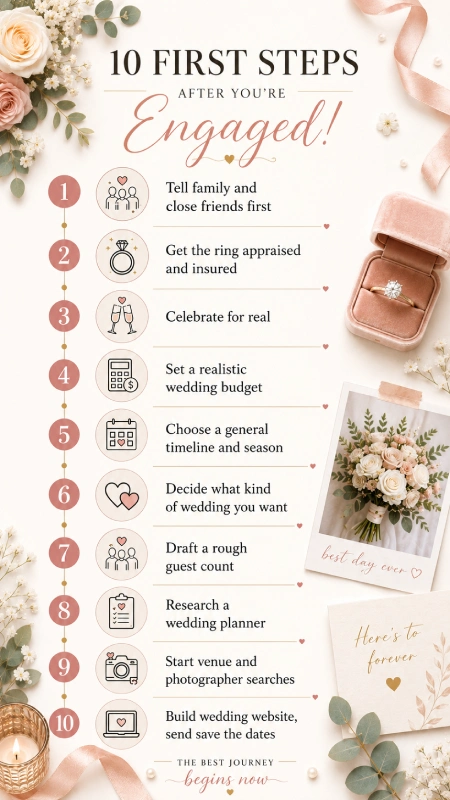
Before we get into the full breakdown, here’s your at-a-glance priority map.
| Step | Priority | Why It Matters |
|---|---|---|
| Tell family and close friends first | High | Avoid hurt feelings before you’ve even started |
| Get the ring appraised and insured | High | Protect a major purchase immediately |
| Celebrate for real | High | The engagement deserves its own moment |
| Set a realistic wedding budget | High | Drives every single decision that follows |
| Choose a general timeline and season | High | Determines venue availability and vendor options |
| Decide what kind of wedding you want | High | Shapes the entire planning path |
| Draft a rough guest count | Medium-High | Affects budget, venue size, and catering cost |
| Research a wedding planner | Medium | The best ones fill up fast |
| Start venue and photographer searches | Medium | Both book out well in advance in most markets |
| Build wedding website, send save the dates | Later | Once date and venue are confirmed |
Phase 1: What to Do in the First 48 Hours After Getting Engaged
Tell Your People Before You Post
Before you share anything on Instagram, call the people who matter most. This sounds obvious, but plenty of newly engaged couples accidentally let a parent find out through a Facebook notification. That conversation does not go well.
The right order:
- Parents and immediate family (in-person or by phone, never a text)
- Close friends and potential wedding party candidates
- Extended family
- Social media, group chats, skywriting: whatever feels right
Pro Tip: If one set of parents didn’t know about the proposal ahead of time, make sure both sides hear the news at roughly the same time. Starting your engagement with an accidental slight is the kind of thing that echoes.
Get Your Engagement Ring Appraised and Insured

One of the earliest mistakes I see newly engaged couples make is waiting months to insure the ring, and then something happens. Put this on your list for the first week or two.
Before you can insure it, you need an appraisal: a formal document from a certified jeweler that establishes what the engagement ring is worth. While you’re at it, get it sized if needed. Same trip, same jeweler.
For the full walkthrough, here’s how to get your engagement ring appraised without the overwhelm.
Actionable Tip: Contact your homeowner’s or renter’s insurance provider first. Many policies let you add a jewelry rider at a relatively low annual cost, but you’ll need the appraisal document first.
Celebrate Your Engagement (This Is Not Optional)
Your engagement is its own season, not just a countdown to the wedding.
Go to dinner. Tell the proposal story seventeen times. Wear the ring somewhere fancy just because. Take a beat before the logistics take over.
The couples I’ve seen burn out early are often the ones who never gave themselves space to enjoy being engaged first. You’re engaged. Enjoy it before it becomes a project.
Phase 2: What to Do in the First Month After Getting Engaged
Have the Wedding Budget Conversation Early

Budget early. Before you tour a venue. Before you fall in love with a photographer. Before you even open a browser tab.
Wedding costs vary widely by market, guest count, and priorities, but many couples are surprised by how quickly the numbers add up. What matters isn’t the national average.
For context, the average wedding cost in 2026 is around $34,200, according to The Knot.
It’s your number, agreed on before you start the early planning stage.
Things to work through together:
- What is our total wedding budget?
- Are families contributing, and what does that mean for decision-making? If they are, clarify early whether that money comes with opinions about guest count, venue, traditions, or decisions. Money and expectations tend to arrive together.
- What are our non-negotiables?
- What are we genuinely willing to scale back?
- Are we open to a destination wedding or elopement if it means getting more of what we actually want?
Key Takeaway: The budget drives every decision. Guest count drives the budget. Venue drives the guest count. Set the budget first, and every other decision gets easier.
But here’s the catch: most couples set a number and then accidentally spend 40% of it on the venue before they’ve accounted for catering, photography, or any other wedding vendors. Build a line-item breakdown before you commit to anything. Our complete wedding budget guide walks you through exactly how to divide every dollar, and our breakdown of 17 hidden wedding costs covers the line items most couples completely miss.
Choose Your Wedding Date and General Timeline

You don’t need an exact date yet. You need a window.
Questions to work through:
- How long of an engagement do we actually want? Most couples find a longer engagement gives them better access to venues and vendors, and more breathing room to make decisions without pressure.
- Is there a season that matters to us?
- Are there dates to avoid: holidays, family conflicts, work blackouts?
- How far in advance do venues in our market typically book?
Expert Insight: If you already have a dream venue in mind, reach out to check availability before you commit to a date range. In many markets, the most sought-after venues fill up 12 months or more in advance. Finding that out after you’ve told everyone the year is not a fun conversation.
Decide What Kind of Wedding You Actually Want

This conversation is worth having early, because the answer shapes the entire planning path.
Elopement has completely shed its old reputation. Today, couples who elope are often making a deeply intentional choice: more intimacy, more budget flexibility, and a wedding day that is entirely about them. A destination wedding sits in the middle, offering a travel-forward experience with a smaller, curated guest list.
Things to consider:
- How important is having family and friends there in person?
- What would you do with the budget if you didn’t spend it on a traditional wedding?
- Does the idea of a micro-wedding or elopement feel like relief, or disappointment?
There’s no wrong answer. But knowing where you both land early means the first wedding decisions move in the right direction from the start.
Trend Alert: Many couples now choose micro-weddings and elopements as intentional alternatives to a traditional wedding, opting for private estates, wineries, and scenic outdoor locations. If you’re leaning smaller, you have more options than ever before.
Draft a Rough Wedding Guest List

You don’t need final names yet. You need a ballpark number, because that number touches your budget, your venue size, your catering cost per head, and how much stress you carry into the venue search.
Start with two columns: “must invite” and “would love to include if budget allows.” The second list grows faster than expected the moment extended family enters the conversation. Build in that buffer now.
Expert Insight: In my experience, the couples who stay calm throughout the planning process are not the ones who plan the fastest. They’re the ones who set a firm guest count early and make decisions within it. Every person you add is a cost decision. Every person you remove is a relationship conversation. Set the number first, then build the list to fit it.
Research Whether You Want a Wedding Planner
If you’re considering a wedding planner, start looking now, not in six months. The best planners fill up quickly, and many newly engaged couples discover their top choice is already booked by the time they reach out.
Full-service isn’t the only option. Many couples handle most of the planning themselves and still benefit from a partial planner or a day-of coordinator.
- Full-service wedding planner: Manages everything start to finish.
- Partial planner: You lead the process; they advise and manage key relationships.
- Day-of coordinator: You’ve planned everything; they execute it on the day.
The day-of coordinator is the minimum I’d recommend for any couple who wants to actually enjoy their own wedding. For a full side-by-side comparison, here’s our guide to wedding planner vs. coordinator, including which one actually fits your situation. And if you’re planning to go it alone, these 16 tips for planning without a planner are a solid place to start.
Phase 3: What to Do Next in the Planning Process
Start Your Venue Search

The wedding venue anchors every other decision: guest count, ceiling, catering approach, your confirmed date, and often your entire vendor team. Venue search comes before most other first wedding decisions.
Questions to ask every venue:
- Is catering in-house or do you hire separately?
- Do you have a preferred vendor list, or can we bring our own?
- What is the capacity, and does it match our expected guest count?
- Are there curfews, noise limits, or alcohol restrictions?
- What does this space look like in our target season?
Look at several venue options before committing. Many couples fall in love with the first space they tour and miss a better fit two visits later. If you find yourself torn between two finalists, here’s exactly how to decide between two wedding venues without losing your mind.
Book Your Wedding Photographer (and Schedule Your Engagement Session)

In many markets, wedding photographers, especially in-demand names, fill their calendars well ahead of the wedding season. Your wedding photography is the one thing you will have forever from your wedding day. Prioritize it accordingly.
How-To: Gather 10 to 15 photographers whose work you love, narrow to your top five, and reach out to all of them at once. Your first choice may already be booked.
Once you’ve booked, schedule your engagement session. Couples are almost always more relaxed on the wedding day when they’ve already worked with the same photographer once. The camera becomes familiar, and so does the working relationship. Your engagement photos can do triple duty: save the dates, your wedding website header, and engagement party invitations.
Choose Your Wedding Party

This step doesn’t need to happen immediately, but many couples start thinking about it early once the reality of the wedding begins to settle in. And it is more emotionally complex than it looks. Choosing your wedding party means navigating friendships, family expectations, and the occasional loaded history with a college roommate you haven’t seen in years.
- You don’t have to have equal numbers on each side.
- You don’t have to have a wedding party at all.
- The people who are disappointed they weren’t asked tend to recover faster than you’d expect.
How-To: Ask privately before you announce publicly. A one-on-one conversation gives people room to say yes honestly, or to flag life circumstances that might make participation difficult. Once the team is set, our bridesmaid etiquette guide covers the expectations, costs, and conversations every bridal party needs to have upfront.
Plan Your Engagement Party
Entirely optional, but a genuinely lovely way to celebrate your engagement before the wedding takes over everyone’s schedule.
Keep the guest list tight: anyone invited to an engagement party generally expects a wedding invitation too. It doesn’t need to be elaborate. Use your engagement photo as the invitation header and call it a day.
Set Up Your Wedding Website and Send Save the Dates

A wedding website is one of the smartest early moves in post-engagement planning. It becomes the central hub for your date, venue details, travel info, accommodation blocks, and registry. Most platforms, like The Knot or Zola, are free or very low-cost.
Once your date and venue are confirmed, send save-the-dates. Six to eight months out is standard; eight to twelve months for destination or holiday weekend weddings. Your save-the-dates don’t need to be elaborate: your names, the date, the location, and your wedding website URL are all your guests need. For a step-by-step setup guide, our complete wedding website blueprint covers everything from platform choice to what to include and when.
Schedule a Regular Date Night
Wedding planning has a way of consuming every conversation for 12 to 18 months. At some point, you’ll realize you’ve spent your last several dinners discussing vendor contracts and you can’t remember the last time you talked about something that had nothing to do with the wedding.
Put a recurring date night on the calendar where planning is off the table. Your relationship is the whole point. Give it some room to breathe.
Everything to Do After Getting Engaged: Complete Checklist

First 48 Hours:
- Tell family and close friends before posting on social media
- Get the engagement ring appraised, insured, and sized
- Celebrate your engagement: genuinely bask in it
First Month:
- Have the wedding budget conversation with your fiance
- Clarify family contributions and any expectations attached
- Choose a general wedding date and timeline
- Decide: traditional wedding, micro-wedding, destination wedding, or elopement?
- Draft a rough wedding guest list
- Research wedding planners and coordinators
Next Phase:
- Start your venue search
- Book your wedding photographer early
- Schedule your engagement session
- Choose your wedding party
- Plan your engagement party
- Set up your wedding website
- Send save the dates once your date and venue are confirmed
- Schedule a recurring date night (non-negotiable)
What NOT to Do Right After Getting Engaged
- Don’t book vendors before setting a budget. It feels like progress. It’s chaos.
- Don’t tell a vendor your maximum budget. Give them your target and keep room to negotiate.
- Don’t post your wedding date publicly before the venue is confirmed. Guests will make travel plans around a date that might change.
- Don’t let the engagement become entirely about wedding planning. Your relationship deserves attention too.
- Don’t ignore a gut feeling about a vendor. If something feels off in the first meeting, it won’t improve after you’ve signed a contract.
- Don’t rush into a timeline because of outside pressure. A longer engagement is often the smarter move.
Frequently Asked Questions
What is the first thing to do after getting engaged?
Tell your immediate family and closest people before announcing publicly. After that: get the engagement ring appraised and insured, then have the wedding budget conversation before you look at venues or vendors.
How long should you wait before planning a wedding after getting engaged?
Most couples begin the foundational planning (budget, timeline, guest count) within the first month or two. Industry surveys often place the average engagement at just over a year, which gives you plenty of runway if you start intentionally rather than urgently.
Who do you tell first when you get engaged?
Parents and immediate family, ideally in person or by phone. Then, close friends and potential wedding party members. Social media is the last step, not the first.
Should newly engaged couples hire a wedding planner right away?
If you’re considering one, reach out early. In many markets, the most in-demand wedding planners fill their calendars a year or more in advance. An initial conversation costs nothing and gives you a much clearer picture of what to expect.
How soon should you book a wedding venue after getting engaged?
As soon as you’ve established your budget and a rough guest count, begin the venue search. In many markets, popular venues fill up 12 months or more in advance. If you have a specific venue in mind, reach out to check availability immediately.
What’s the difference between a wedding planner and a day-of coordinator?
A wedding planner manages the entire planning process from start to finish. A day-of coordinator, sometimes offered as month-of coordination, steps in late in the planning process to execute the plan you’ve already built. Both are valuable. The right choice depends on how much of the planning you want to manage yourself.
Is a longer engagement worth it?
Often, yes. A longer engagement tends to mean better access to venues and vendors, more time to make decisions without pressure, and more room to actually enjoy being engaged before the wedding day arrives.
What should newly engaged couples do before picking a wedding date?
Set your budget and draft a rough guest count first. Those two numbers will tell you what venues are realistic, and that tells you what dates are available. Date selection works best when it follows budget and guest list, not the other way around.
You’ve Got This
The bottom line is this: the couples who start their engagement with clarity and a plan are the ones who enjoy the process instead of just surviving it.
You’re already ahead of where you think you are, because you’re here asking the right questions early instead of six months in and overwhelmed. One decision at a time. Your dream wedding is closer than your last Instagram scroll made it feel.
Go enjoy your engagement. The logistics can wait five more minutes.