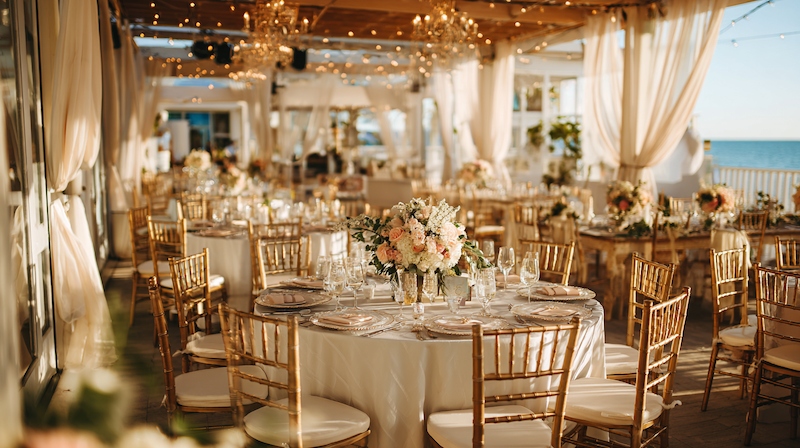
Wedding Planning Timeline
6-Month Wedding Planning Timeline – How to Plan a Wedding in 6 Months
If you need a 6 month wedding planning timeline, take a breath, because you have more room than you think. Six months is genuinely enough time to plan a beautiful, well-run wedding, as long as you make your big decisions in the right order and stop treating a shorter runway like an emergency.
Here’s what I’ve learned after planning weddings on every timeline imaginable: the couples who start with twelve months and the couples who start with six often end up at the exact same place. The long-runway couples just spend the first several months rebooking things they picked too early.
For context, The Knot’s latest Real Weddings Study found that couples married in 2025 were engaged for an average of 14 months. A six-month engagement is shorter than average, but it is still completely workable when every major decision has a clear deadline.
Let’s be real for a second: planning a wedding this fast can feel like assembling furniture while the guests watch and the clock ticks. It is not that. It is a to-do list with good manners, and I am about to hand you the whole thing.
Key Takeaway: A short timeline does not lower the quality of your wedding. It lowers the number of times you get to change your mind. That is a feature, not a flaw.

On this page
- Can You Really Plan a Wedding in 6 Months?
- Your First 14 Days
- Your 6 Month Wedding Planning Timeline, Month by Month
- Month 6: Lock the Non-Negotiables
- Month 5: Build the Look and the Team
- Month 4: Paper, Food, and the Details
- Month 3: Send, Fit, and Firm Up
- Month 2: Logistics and Loose Ends
- Month 1: The Final Countdown
- The Final Week
- What to Simplify When You Are Short on Time
- Your 6-Month Wedding Checklist, Month by Month
- 6-Month Wedding Planning FAQ
Can You Really Plan a Wedding in 6 Months?
Yes, and there are plenty of valid reasons to choose a shorter engagement. A lease ending, a deployment, family timing, or simply not wanting a two-year process are all normal reasons to work on a short timeline.
The trick with a 6 month wedding planning timeline is sequencing. In a twelve-month plan, you can afford to wander. In six months, you lock the decisions that everything else depends on first: date, venue, and the vendors that book out furthest in advance.
But here’s the catch: the pieces that eat the most calendar time are not the fun ones. Dress alterations, the invitation suite, and your final headcount all have hard lead times you cannot rush. That is why we protect those windows from day one.
Expert Insight: The single biggest mistake short-timeline couples make is spending week one shopping for a color palette instead of signing a venue. Book the things that sell out. Decorate later.
Your First 14 Days
Before the month-by-month plan begins, spend your first two weeks locking the foundation. Nothing else can move until these are settled.
- Confirm who is contributing financially, and how much.
- Set your maximum budget and an approximate guest count.
- Identify three acceptable dates so you can stay flexible with venues.
- Contact five to eight venues with one standardized inquiry email.
- Book the venue and get every included-service detail in writing.
- Contact your priority vendors immediately after the date is secured.
- Set a decision deadline for every open category, and hold yourself to it.
Actionable Tip: Send every venue the exact same inquiry: date options, guest count, and your must-haves. Identical questions make the quotes easy to compare side by side.
Your 6 Month Wedding Planning Timeline, Month by Month
Once the foundation is set, here is how your 6 month wedding planning timeline unfolds, month by month. Each month has a clear job, so you always know what to tackle next.
Month 6: Lock the Non-Negotiables
This is your busiest month, and that is intentional. Everything you secure now buys you calm later.
- Set your budget. Agree on a real number and a rough budget allocation across venue, catering, and photography. If you want a category-by-category starting point, our wedding budget breakdown shows where the money usually goes.
- Choose your date and book your venue. Flexibility on the date is your best friend, so ask about off-peak Fridays, Sundays, and daytime slots. Our guide to choosing a wedding venue walks through what to ask. If you are eyeing a destination wedding, expect to move even faster on travel and lodging.
- Book the vendors that vanish first. Your photographer, caterer or venue coordinator, and band or DJ tend to book out furthest. Secure them now, deposits and signed vendor contracts included.
- Draft your guest list. Your guest count drives your venue size, your catering bill, and nearly every other number. Our wedding guest list guide helps you build it without the family friction.
- Build a simple wedding website and send save-the-dates. A wedding website shares the date, travel details, and your registry in one link. Send save-the-dates right after, especially to anyone traveling.
- Handle time off and travel. Request the wedding week and your honeymoon dates from your employer now, book the honeymoon, and renew passports early if you are traveling internationally.
- Consider wedding insurance. A liability or cancellation policy is inexpensive peace of mind, and some venues require proof of coverage before your date.
Pro Tip: If hiring a full planner is not in the budget, a month-of coordinator often is, and on a short timeline they are worth every dollar. Their work starts weeks before the wedding, so book that person now, not at the end.

Month 5: Build the Look and the Team
With the foundation set, this month is about the vendors who shape how the day looks and feels.
- Book your florist and start talking through bouquets, centerpieces, and any ceremony arrangements.
- Order your dress if you are buying off the rack, since made-to-order gowns usually need more runway than six months allows. Ask the salon about their production and alterations window.
- Choose bridesmaid dresses and get your wedding party ordering early, since group orders and alterations take time.
- Book hair and makeup artists, and schedule a trial if their calendar allows one.
- Reserve your officiant, book any ceremony musicians, and confirm the audio or sound requirements for your ceremony space.
- Schedule engagement photos if you want them. They can double as save-the-date and website images.
- Create your wedding registry so shower guests and early gift-givers have somewhere to shop.
- Lock your color palette and overall style so every later decision has a north star.
That’s why nailing your palette now matters more than it seems. Once your colors are set, your stationer, florist, and rental choices all fall into line instead of pulling in five directions.
Styling Hack: Choose one hero element, a statement floral install, a dramatic tablescape, or a killer entrance moment, and let the rest of your decor stay simple around it. One wow moment reads as intentional. Five compete with each other.
Month 4: Paper, Food, and the Details
Now the day starts to feel real. This is a paperwork-and-tasting month.
- Order your invitation suite from your stationer and confirm your RSVP deadline against the caterer’s final headcount date.
- Attend your catering tasting and finalize the menu, including a plan for dietary needs and any allergy-safe options.
- Book remaining vendors: cake baker, videographer, transportation, and your rentals from a rental company.
- Shop for wedding party attire and the groom’s or partner’s look so alterations have time.
- Nail down pre-wedding events. Confirm the rehearsal dinner plan, and coordinate with whoever is hosting the bridal shower so dates do not collide.
- Reserve hotel room blocks for out-of-town guests, and ask the hotel coordinator to add your details to guests’ reservations.
Actionable Tip: Set your RSVP deadline about three to four weeks before the wedding, then confirm that timing against your caterer’s final headcount deadline. If many guests are traveling, build in extra follow-up time.
Month 3: Send, Fit, and Firm Up
You are at the halfway-to-the-altar mark, and the pace eases slightly.
- Mail your invitations. Standard timing is six to eight weeks out, but on a short engagement, sending around three months ahead gives traveling guests more runway, especially when the invitation doubles as your main announcement.
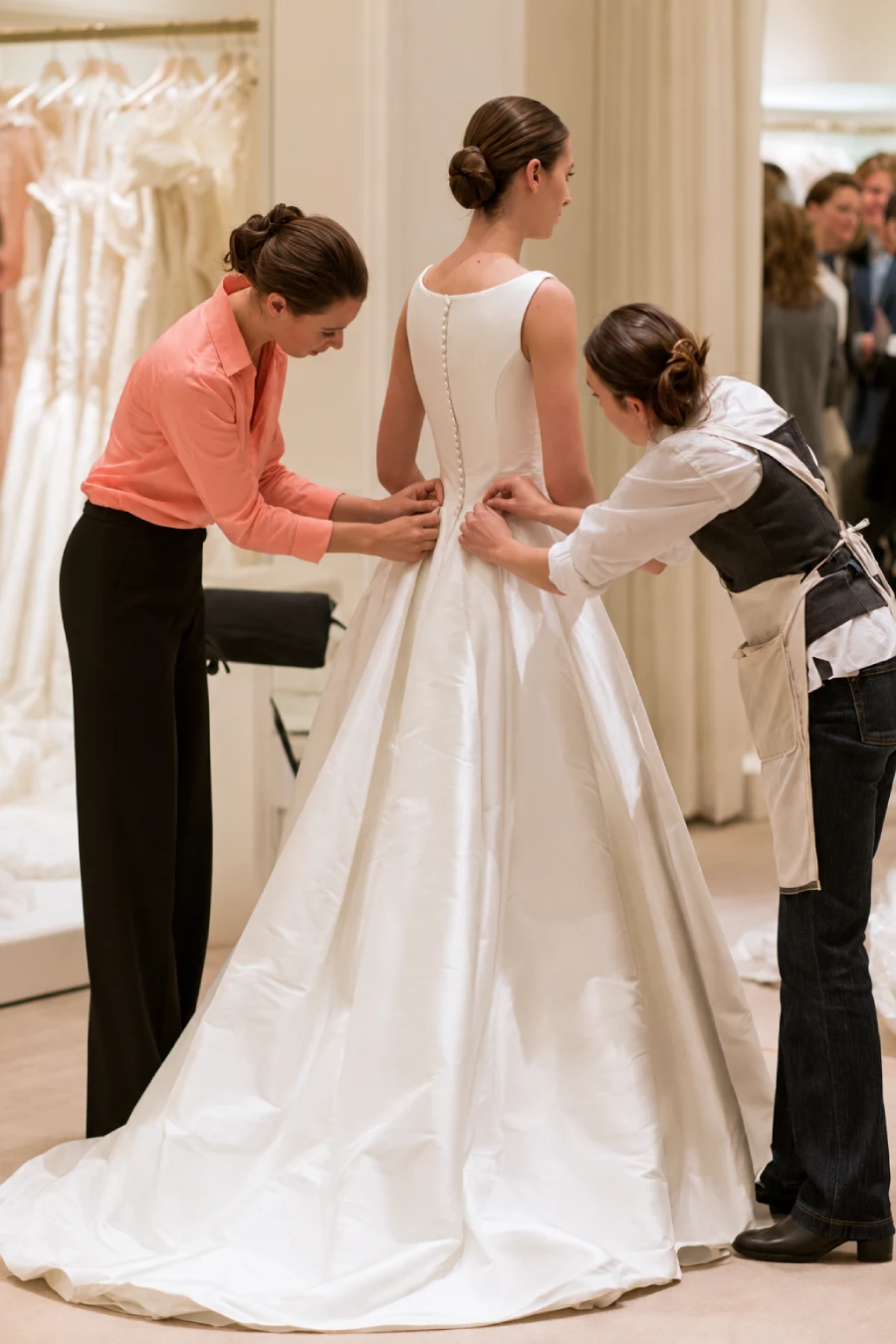
- Start dress fittings and schedule alterations with your seamstress.
- Buy wedding bands and allow time for any sizing or engraving.
- Purchase or confirm shoes and accessories.
- Approve the final floral and stationery proofs before anything goes to print or production.
- Begin building your day-of timeline, also called the run of show, with your coordinator. Our day-of wedding timeline guide gives you a template to start from.
Perfect Pairing: Break in your wedding shoes at home while you finalize your dress length at fittings. Getting both settled together saves you a panicked hem adjustment the week of.
Month 2: Logistics and Loose Ends
This is where organized couples pull ahead. The big bookings are done, so now you tighten the logistics.
- Track RSVPs and follow up with anyone who has gone quiet. Guests are chronically late to reply, a law of nature about as reliable as cake vanishing at midnight, so chase early.
- Apply for your marriage license, and check your state’s waiting period, how long the license stays valid before it expires, and whether you need witnesses.
- Finalize your ceremony details, readings, and vows.
- Confirm vendor meals and final counts with your caterer.
- Confirm rental quantities and your final order deadline with the rental company.
- Schedule the rehearsal and confirm who needs to attend.
- Confirm the run of show with every vendor so arrival times, load-in, and the flow of the day all match.
- Purchase or assemble favors, welcome bags, and any signage.
How-To: Build one shared document with every vendor’s name, arrival time, contact number, and balance due. Hand it to your coordinator. This single page can prevent many common day-of communication problems.
Month 1: The Final Countdown
Almost there. This month is about locking numbers and handing off control.
- Give your caterer the final headcount.
- Build your seating chart, escort cards, and floor plan now that responses are in.
- Share your photography shot list with your photographer, and give your band or DJ the music requests and the do-not-play list.
- Do your final dress fitting.
- Confirm the run of show and share the finished day-of timeline with your wedding party and family.
- Delegate every day-of task. You should be a guest at your own wedding, not the stage manager.
Bonus: Assemble a small emergency kit: safety pins, stain wipes, blister bandages, a phone charger, and pain reliever. You will not need most of it, and you will be thrilled it exists if you do.
The Final Week
You’re better off spending this week resting than reworking. The planning is done. Now you protect your energy.
- Do your final venue walkthrough and confirm the floor plan and layout.
- Pick up attire and pack for the honeymoon.
- Drop off welcome bags and any items your vendors need in advance.
- Prep final payments and gratuities in labeled envelopes.
- Sleep. Hydrate. Trust the plan you built.
What to Simplify When You Are Short on Time
Part of planning a wedding in six months is deciding what not to do. A few graceful cuts protect your timeline without anyone noticing a thing.
- Skip the fully custom gown. Off-the-rack and made-to-measure looks stunning and fits the calendar.
- Trim the DIY. Handmade everything is a time trap on a short runway. Pick one meaningful project, then buy the rest.
- Consider an all-inclusive venue. A venue that provides catering, tables, and coordination collapses five decisions into one.
- Keep the guest list tight. Fewer guests means fewer invitations, less catering, a simpler seating chart, and lower cost across the board.
Trend Alert: Smaller, more intentional guest lists have stayed popular, and they are a short-timeline couple’s secret weapon. Every name you remove buys back time and budget somewhere else.
Your 6-Month Wedding Checklist, Month by Month
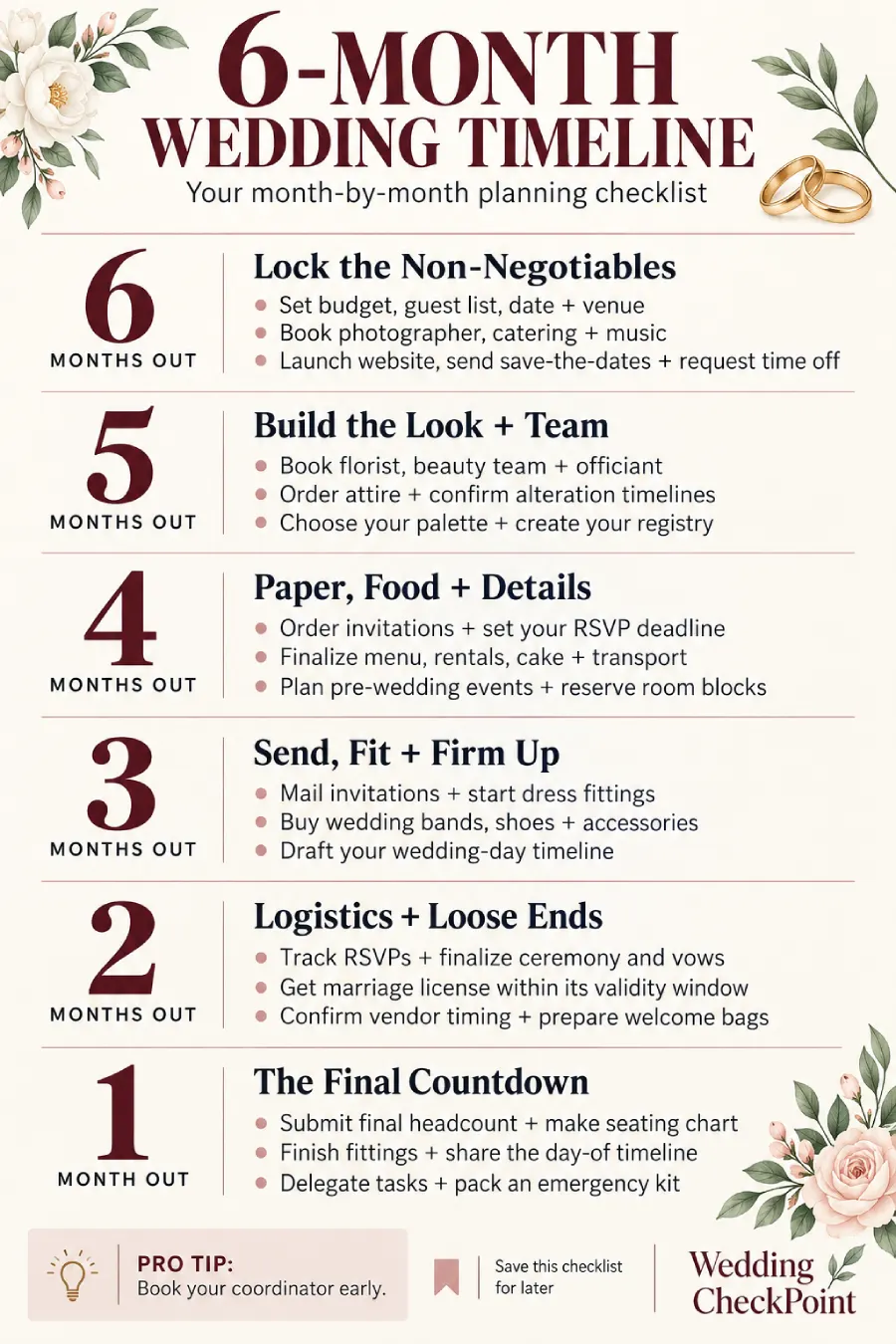
Here is the whole 6 month wedding planning timeline in one glance. Save it or pin it, then check off each block as you go. It is built to fit your screen top to bottom, so there is no scrolling sideways on desktop, tablet, or phone.
| When | Checklist |
|---|---|
| First 14 Days | Confirm contributors, set budget and guest count, pick three dates, inquire with venues, book the venue, contact priority vendors, set decision deadlines |
| Month 6 | Set budget, book venue, book photographer, caterer, band or DJ, draft guest list, build wedding website, send save-the-dates, book honeymoon, consider wedding insurance |
| Month 5 | Book florist, order dress, choose bridesmaid dresses, book hair and makeup, reserve officiant and ceremony musicians, engagement photos, create registry, lock color palette |
| Month 4 | Order invitations, catering tasting, book cake, videographer, rentals, confirm rehearsal dinner and bridal shower, reserve room blocks |
| Month 3 | Mail invitations, start fittings and alterations, buy wedding bands, approve final proofs, draft day-of timeline |
| Month 2 | Track RSVPs, marriage license, finalize ceremony, confirm vendor meals and rental quantities, schedule rehearsal, confirm run of show, assemble favors |
| Month 1 | Final headcount, seating chart, escort cards, floor plan, shot list, do-not-play list, final fitting, delegate everything |
| Final Week | Venue walkthrough, final payments, pack for honeymoon, rest |
Extra Touch: Save this checklist to your phone’s home screen so it travels with you to every vendor meeting. A short timeline runs on quick reference, not long spreadsheets.
6-Month Wedding Planning FAQ
Can you realistically plan a wedding in 6 months?
Yes. Six months is a shorter-than-average timeline, but it is very workable when you book your date, venue, and fast-selling vendors first and stay flexible on details. Some couples find that a shorter timeline leaves less room for prolonged second-guessing.
What should you book first when planning a wedding in six months?
Book the venue first, because it establishes your date, location, capacity, and often your catering requirements. Once the contract is signed, immediately secure the photographer, caterer, entertainment, planner or coordinator, and any other vendor whose availability is essential to your day.
What should you plan 6 months before a wedding?
Your first month is the heaviest: set the budget, lock the date and venue, book your photographer, caterer, and band or DJ, draft the guest list, build a wedding website, and send save-the-dates. These are the decisions everything else depends on.
Is a last-minute wedding cheaper?
Not automatically. Some venues and vendors may offer more flexibility for off-peak openings, but never assume a last-minute date will be discounted. In most cases, the real savings come from a tighter guest list and fewer add-ons, not the calendar itself.
The bottom line is this: a six-month timeline is not a compromise, it is a discipline. When every month has a clear job and you resist the urge to redo settled decisions, six months delivers a wedding that looks exactly as considered as one planned in two years.
You have the date. You have the checklist. Now go book that venue, because everything else is waiting on it.
Then go enjoy your engagement. The logistics can wait five minutes.