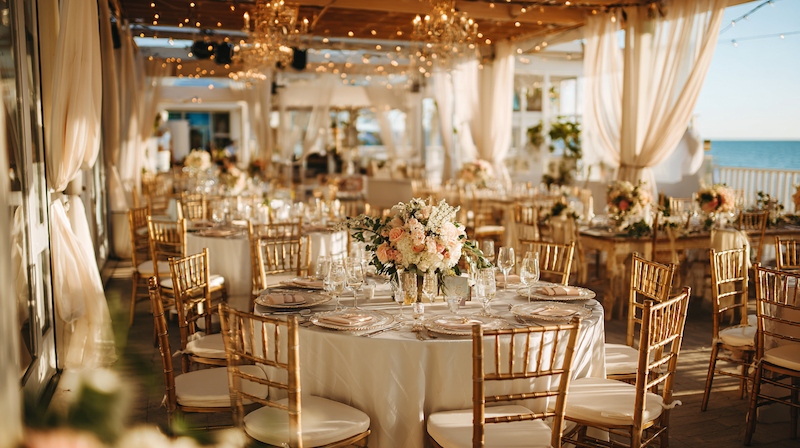
How to Choose a Wedding Venue: A 6‑Step System
Choosing a wedding venue is the first big yes after the ring, and it shapes almost every decision that follows. This guide walks you through how to choose a wedding venue the way the person across the sales desk would: real numbers first, then the shortlist, the tour, the comparison and the contract.
I’ve spent years running the special events office for a private club, which means I’ve sat on the venue’s side of the table for more wedding consultations than I can count. I’ve watched couples fall in love with a room in the first five minutes, and I’ve watched them meet the real price tag three months later. (That second part is the one we’re going to fix.)
Here’s the honest truth: most couples are completely capable of choosing a great venue on their own. What they’re missing isn’t taste. It’s the order of operations and the handful of questions the sales manager won’t volunteer.
So let’s take it in order: six steps, one scorecard, and far fewer expensive surprises.
Key Takeaway: To choose a wedding venue, (1) set your true all-in budget, (2) estimate your guest count, (3) decide whether the date or the venue comes first, (4) shortlist three to five venues by type, (5) call and tour with the same questions everywhere, and (6) compare with a scorecard and read the contract before you sign.

In this guide
Budget, guest count and date narrow the field faster than anything else, so the steps start there and save the pretty part for later. Each one sets up the next.
Step 1: Know Your Real Number Before You Fall in Love
Falling in love with a venue you can’t afford is the most common, most painful mistake I see. Venue pricing is built in layers, and the number on the brochure is rarely the number on the final invoice.
How venue pricing actually works
- Price per person. Most full-service venues sell a package (dinner, bar, cake cutting and staffing) priced per guest.
- Food and beverage minimum. The amount you must spend on food and drinks before fees and tax. If your guest count comes in low, you pay the difference anyway.
- Service charge. A percentage added to food and beverage. It is often around 20% or more, so ask for the exact figure.
- Venue or rental fee. A flat fee for the room, sometimes higher if the ceremony is on-site.
- Tax. Applied by your local government, and in many areas it applies to the service charge too.
The true cost of a wedding venue, with real math
Here is a sample estimate for 200 guests with a $200 per person package, a 22% service charge and a $4,500 venue fee:
| Item | Cost |
|---|---|
| 200 guests x $200 per person | $40,000 |
| 22% service charge | $8,800 |
| Food and beverage plus service charge | $48,800 |
| Venue fee | $4,500 |
| Estimated total before tax | $53,300 |
| Hypothetical tax at 8.875% on the full amount | $4,730.38 |
| Estimated total with tax | $58,030.38 |
| Cost per guest | $290.15 |
That’s how a $200 package becomes roughly $290 per guest. The tax line is only an illustration: rates differ by location, and venues differ on whether tax applies to the service charge and the venue fee. Ask each venue to show the tax on its written quote.
How a food and beverage minimum works
Say a venue has a $30,000 food and beverage minimum for your date, and you book 120 guests at $200 per person. That’s $24,000, so you’re $6,000 short. Depending on the contract, you either pay the $6,000 difference as a fee, or you put it toward upgrades like a better bar package, passed hors d’oeuvres or a late-night snack. Ask whether the service charge and tax are also applied to that shortfall.
Whatever the venue costs, keep a contingency in your overall wedding budget. I suggest starting with at least 6%, and more if your guest count is still moving.
Expert Insight: Couples often assume the service charge is the tip. Sometimes part of it goes to staff, and sometimes none of it does. Ask what the charge covers, whether any of it is paid to the team who serves you, and whether gratuity is included or expected on top.
How much of your budget should go to the venue?
Think of two numbers: your total wedding budget, and the share of it you’re willing to put toward the venue and catering together. For many couples that combined line is the biggest in the budget, but the right share depends on your priorities. For a national benchmark, couples spent an average of $12,900 on their reception venue alone, according to The Knot Real Weddings Study, and big-city numbers run well above that. If the venue is a raw space and catering is separate, add the two before you compare it with an all-inclusive quote. Our wedding budget breakdown shows where the rest of the money tends to go, and these hidden wedding costs are worth reading before you sign anything.
Ask every venue these questions before you book a tour:
- What is the food and beverage minimum for my date?
- What is the price per person, and what does the package include?
- What is the venue fee, with and without an on-site ceremony?
- What is the service charge, and what is the tax rate?
- Are quoted prices locked in, or can they increase before the wedding?
- Are there any other fees I should know about now?
Actionable Tip: Ask for a written proposal from every venue, built on the same guest count. It’s the only fair way to compare prices, and a venue that won’t put numbers in writing is telling you something.
Step 2: Guest Count and Real Capacity
The first question any venue will ask is “How many guests?” Your number decides whether you qualify for a room at all, how much you’ll spend, and how the space will feel on the night.
Advertised capacity vs. real capacity
Capacity charts on venue websites are usually based on a particular layout, and it may not be yours. Ask what setup the advertised number assumes, then request a floor plan drawn for your actual guest count with your dance floor, band or DJ, bars, sweetheart table, cake table and any photo booth in place. The comfortable number can be noticeably lower.
- How many round tables fit comfortably, and how many guests per table?
- How big is the dance floor, and where does it go?
- How much space does a band need compared to a DJ?
- Is there room between tables for a full gown, servers and guests to move easily?
- What is the minimum guest count, and what happens if we come in under it?
Pro Tip: A room that is too big is a problem too. A half-full ballroom feels flat, no matter how good the band is. If your number is small, ask whether the venue can section the room with drapery or offer a smaller space.
Still settling your number? Our guide to wedding guest count helps you find a realistic range, and the wedding guest list guide helps you build it without the family drama.
Step 3: Date First or Venue First?
Some couples have a date that matters: an anniversary, a holiday weekend, a number that means something. That’s completely valid. But if a specific venue is your dream, be ready to be flexible with the date. In busy markets, popular venues can book 12 to 18 months ahead for peak-season Saturdays, while off-peak dates and less in-demand venues often open up much later. Ask each venue how far out your preferred dates usually book.
How to choose a wedding venue for less
- Ask about Fridays and Sundays. Many venues price them lower or reduce the food and beverage minimum.
- Ask about off-peak months. Seasonal pricing can make a big difference at the same venue.
- Ask about daytime weddings. A brunch or lunch reception can come with a lower minimum.
How a soft hold works
Some venues will place a soft hold on a date without a contract, so you have time to compare. Policies vary a lot, so get the details in writing: when the hold expires, whether you have first right of refusal if another couple asks for the date, and how much notice you’ll get before it’s released.
Expert Insight: A soft hold is a courtesy, not a reservation. Only a signed contract and deposit secure your date, so treat the hold’s expiration as your real decision deadline.
Weighing dates? Our guide to choosing your wedding date covers the trade-offs, and the 12-month wedding timeline shows where the venue fits in your plan.
Step 4: Build Your Venue Shortlist
Now the fun part. Aim for a shortlist of three to five venues that fit your budget, guest count and date range. Start with the type of venue, because each type comes with its own costs and its own workload.
| Venue type | Usually included | Often rented separately | Best for |
|---|---|---|---|
| Hotel | Catering, bar, tables, chairs, linens, staff, room blocks | Florals, decor, entertainment | Couples who want one contact and guest rooms on-site |
| Private or country club | Catering, bar, staff, elegant rooms | Florals, decor, entertainment | Classic, formal weddings with polished service |
| Restaurant | Food, drinks, staff | Decor, possibly a private room fee | Smaller weddings with a food focus |
| Barn or farm | The space, sometimes tables and chairs | Catering, bar, rentals, restrooms, lighting | Rustic, outdoor-leaning celebrations |
| Vineyard or winery | Space, wine, sometimes catering | Rentals, decor, a rain plan tent | Scenic, relaxed weddings |
| Loft or raw space | Four walls and power | Nearly everything | Couples who want a blank canvas |
| Estate or mansion | Grounds and rooms | Catering, rentals, tent | Garden or historic weddings |
| Museum or gallery | A striking setting | Catering, rentals, security | Art-lovers and city weddings |
| Beach or destination | The view | Varies widely | Small to mid-size, travel-friendly guests |
All-inclusive vs. raw space
An all-inclusive venue bundles catering, bar, rentals and staff. A raw space gives you freedom, but you hire and coordinate everyone yourself: caterer, bar, tables, chairs, linens, lighting, sometimes restrooms and a generator. The rental fee might look lower, yet the total often isn’t. Price both on the same guest count before you decide.
Location, travel and accessibility
- Where do most of your guests live, and will they need hotel rooms nearby?
- How close is the nearest airport for out-of-town guests?
- Is there parking on-site, valet, or a nearby garage with a group rate?
- Is the venue accessible for guests who use a wheelchair or can’t manage stairs?
- Can you reach the venue easily for planning meetings and the tasting?
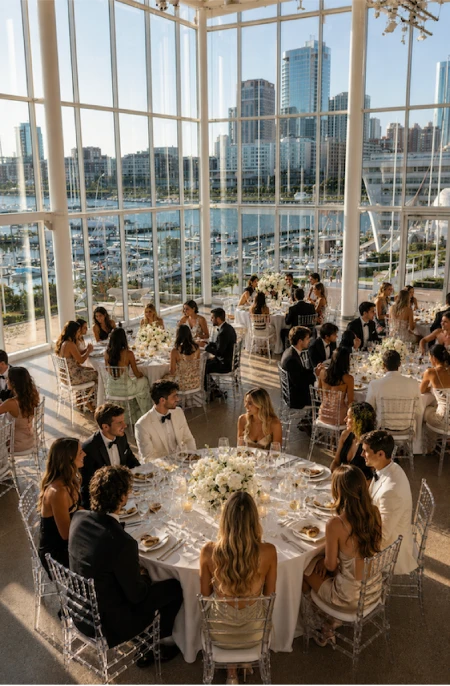
Pro Tip: Look past the venue’s own photos. Wedding photographers’ blogs show real setups with real guests, which gives you a much more honest idea of how a room looks on a wedding night.
Step 5: The First Call and the Tour
Before you call, have three things ready: your approximate guest count, your date range, and whether the ceremony will be on-site. If you and your partner are splitting calls, keep a shared list so no venue gets contacted twice.
Questions to ask a wedding venue, and what the answers tell you
Ask every venue the same questions so your comparison is fair. A policy you don’t love isn’t automatically a warning sign; plenty of great venues require their own caterer or charge for a tasting. What matters is whether you get clear answers before you commit, and whether those answers fit your plans.
| Question | What to establish | What should make you pause |
|---|---|---|
| What is the total cost for my guest count, with all fees and tax? | A written, itemized proposal for your actual guest count | No written numbers, or “we’ll figure that out later” |
| What is the food and beverage minimum, and what if we fall short? | The minimum for your date and how a shortfall is charged | Answers that change from one conversation to the next |
| Are these prices locked in, or can they increase? | Whether menu and package prices are fixed and until when | No answer on how increases are handled |
| How many hours are included, and what does overtime cost? | The included hours and the overtime rate, in writing | Overtime that can only be priced on the night |
| How much is the deposit, and when are payments due? | A payment schedule written into the contract | Pressure to pay before you’ve seen the contract |
| What is the cancellation and postponement policy? | Written terms for canceling and for moving the date | No written policy |
| Do you require specific vendors? Are outside vendors allowed? | The required or preferred vendors, their prices, and any outside-vendor fees | Restrictions you only learn about after you sign |
| Is a menu tasting included, and when does it happen? | Whether there’s a cost, how many guests can attend, and when it’s scheduled | Tasting terms that aren’t disclosed until after booking |
| Who handles our planning, and who runs the wedding day? | Who is responsible at each stage and when the handoff happens | No clear owner for the wedding day |
| What is the rain plan for an outdoor ceremony? | The backup space, and the deadline for making the call | A backup space you would not be happy using |
| Is there a noise curfew or music limit? | The end time and any sound limits, upfront | Limits that only show up in the contract |
| Will other events be happening on our date? | Which spaces are shared, and how events are kept separate | Shared spaces and overlapping timelines you didn’t expect |
| Are getting ready suites included? | Access times and any charges | Access that doesn’t fit your timeline |
Want the full list? Our complete guide to questions to ask a wedding venue covers menus, bars and staffing in more detail.
What to check on a wedding venue tour
- Try to see the room set for a real wedding before guests arrive. It’s the most honest look you’ll get.
- Find the restrooms and the coat check, and check whether there’s an attendant.
- Visit the bridal suite or dressing rooms.
- Look for photo spots for a first look and family portraits.
- Ask how early vendors can load in, and where they unload.
- Ask what other events may be happening in the building on your date.
- If it’s a hotel, ask to see a guest room and the suite for your wedding night.
On-site or off-site ceremony?
If the ceremony and reception share a venue, ask how guests move between rooms and how long it takes. If the ballroom is used for both, ask whether the team can flip it during cocktail hour and whether that fits your timeline and budget. For an off-site ceremony, plan transportation and the gap between the ceremony and the reception.

Actionable Tip: Arrive on time, bring your partner and anyone whose opinion matters, and take photos and short videos of every space. Weekday tours outside lunch and dinner hours usually get you the most attention.
Step 6: Compare and Decide
Choosing between wedding venues gets hard when two or three all look lovely. That’s when feelings need a little structure.
- Filter out deal-breakers first. Over budget, too small, wrong date, no rain plan: remove those venues before you score anything.
- Score what’s left. Use the scorecard below. Rate each venue 1 to 5 on every factor, multiply by the weight, and add it up.
- Run the morning-after test. Sleep on it. Which venue are you still thinking about the next morning?
- Trust your gut, with a reason. If the scores are close, pick the venue where you can picture your day most clearly.
Still stuck between two? Our guide on what to do when you can’t decide between two wedding venues breaks the tie.

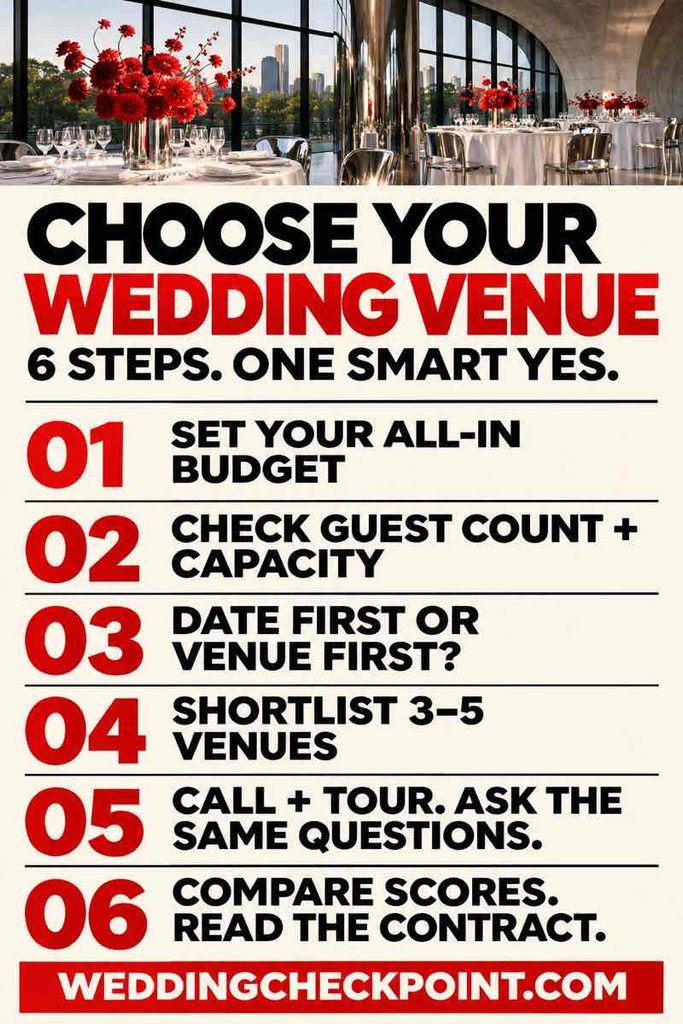
The Wedding Venue Scorecard
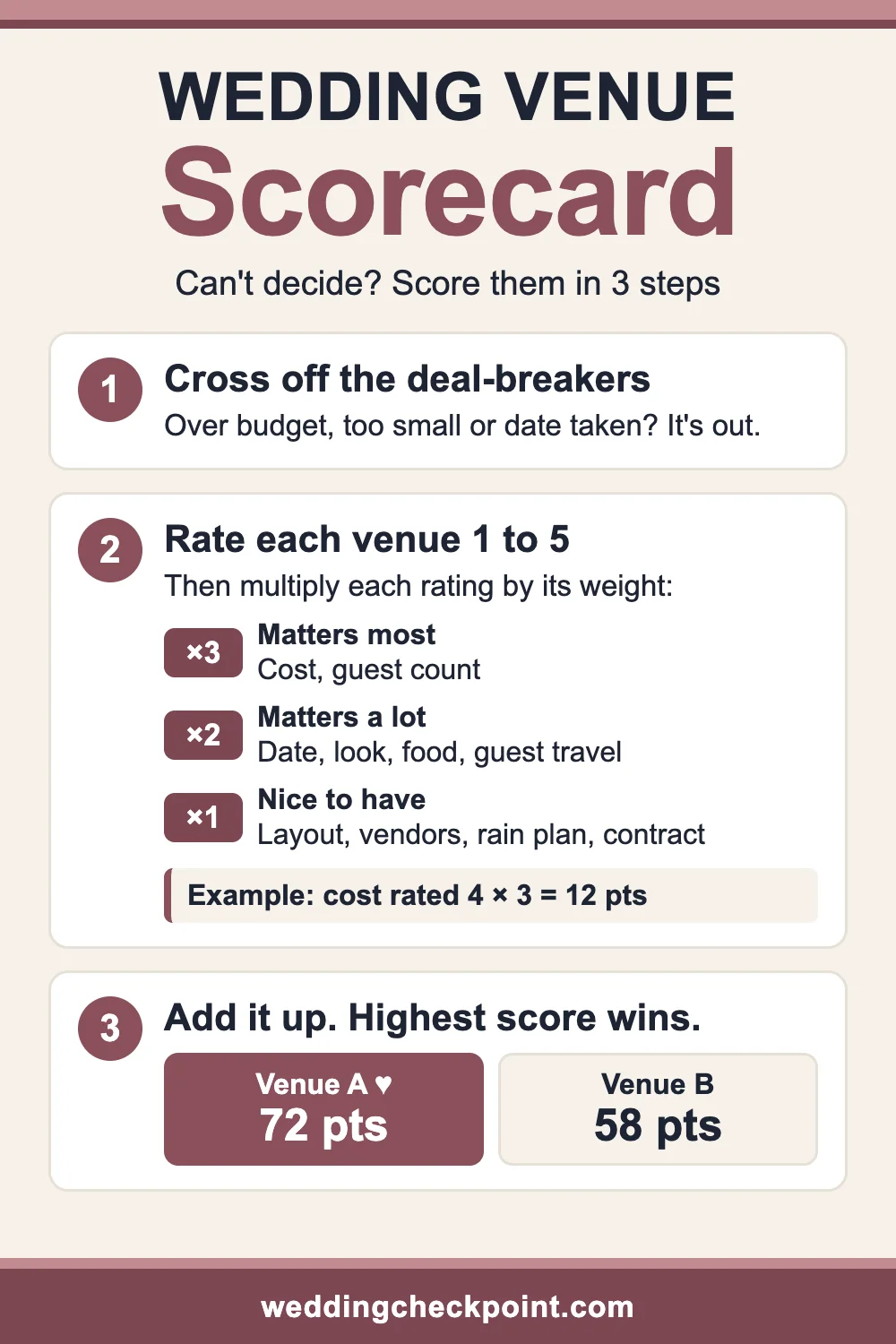
Want it on paper? Print the free scorecard and take it on every venue tour.
Make the weights yours first. The ones below are a starting point; if food matters more to you than layout, change the numbers before you score anything.
First, the pass or fail check
A venue that fails any of these doesn’t get scored:
- The all-in estimate fits your venue and catering allowance.
- It comfortably holds your guest count in your actual layout.
- Your date, or a date you’d accept, is available.
- Every non-negotiable on your own list is met.
Then, score what’s left
Rate each venue 1 to 5 on every factor, multiply by the weight, and add it up. For example, a cost rating of 4 with a weight of 3 earns 12 points. With these weights, the highest possible score is 90.
| Factor | Weight | 1 looks like | 3 looks like | 5 looks like |
|---|---|---|---|---|
| True total cost vs. budget | 3 | Over budget with no room to adjust | Fits, but uses up the cushion | Fits with a cushion left |
| Fits your guest count | 3 | Only fits at maximum capacity | Fits with some tradeoffs | Comfortable in your actual layout |
| Date availability | 2 | Only dates you’d settle for | A good alternative date | Your preferred date |
| Look and feel | 2 | Needs heavy decor to work | Needs some styling | Already feels like your wedding |
| Food and drink | 2 | Menu doesn’t fit your tastes | Solid, with a few compromises | Food you’re excited about, clear tasting terms |
| Guest convenience | 2 | Hard to reach, limited parking or access | Workable with planning | Easy travel, parking and access |
| Layout and flow | 1 | Long resets or awkward moves | Some transitions to manage | Everything flows easily |
| Vendor setup | 1 | Rules that conflict with your plans | Some restrictions | Fits your plan, bundled or flexible |
| Rain plan | 1 | No real backup | A backup you’d tolerate | A backup you’d be happy with |
| Contract terms | 1 | Unclear or one-sided terms | Standard terms | Clear, fair terms |
Copy the score sheet below into your notes, then fill in each venue’s rating multiplied by the weight. On a phone, the columns show as A, B and C for your three venues.
| Factor | Weight | Venue A | Venue B | Venue C |
|---|---|---|---|---|
| True total cost vs. budget | 3 | |||
| Fits your guest count | 3 | |||
| Date availability | 2 | |||
| Look and feel | 2 | |||
| Food and drink | 2 | |||
| Guest convenience | 2 | |||
| Layout and flow | 1 | |||
| Vendor setup | 1 | |||
| Rain plan | 1 | |||
| Contract terms | 1 | |||
| Total (out of 90) |
A venue scoring well above the others on cost, capacity and date is usually your answer, even if another one has prettier chandeliers.
Key Takeaway: A scorecard doesn’t replace your feelings. It just makes sure you fall in love with a venue that also works.
Before You Sign: Wedding Venue Contract Red Flags
The contract is where a dream venue becomes a good decision or an expensive lesson. Read the whole contract before you sign, and ask for changes in writing. Here’s what I’d look for from the sales side:
- Deposit and payment schedule. How much is due at signing, when each payment is due, and whether deposits are refundable.
- Cancellation and postponement. What happens if you cancel or need to move the date, and whether your deposit can roll to a new date.
- Force majeure. What happens if the venue can’t host your event because of something outside anyone’s control.
- Final guest count deadline. When you lock your number, and whether you can increase it after that.
- Overtime, curfew and noise. The hourly overtime rate and the hard end time.
- Vendor rules. Required vendors, outside vendor fees, load-in times and insurance requirements.
- Extra fees. Cake cutting, corkage, cleanup, security, coat check, and vendor meals (here’s our guide to wedding vendor meals).
- Event insurance. Many venues require liability coverage. Ask early so it doesn’t surprise you.
Expert Insight: If the sales manager promises something in conversation, like an extra hour, a free upgrade or a specific room, ask for it in the contract or in an email. Staff change, and only what’s written travels with your file.
Not sure how to ask for changes? Our guide on how to negotiate with wedding vendors covers what’s reasonable to request.
Wedding Venue FAQ
What should a wedding venue quote include?
A useful quote is written for your guest count and date, and lists the price per person, what the package includes, the food and beverage minimum, the service charge, the venue fee, tax, and any other fees such as ceremony, cake cutting, corkage or overtime. It should also say how long the prices are guaranteed.
Do you pick a wedding date or venue first?
It depends on what matters more to you. If a specific date is meaningful, choose it first and find venues open that day. If a specific venue is your dream, stay flexible on the date, since popular venues can book well ahead for peak dates.
Can we book a venue before our guest count is final?
Yes, most couples do. Book with a realistic estimate, and check the contract for the minimum guest count, the food and beverage minimum, and the deadline for your final number, so you know what happens if your count goes up or down.
What happens if we miss the food and beverage minimum?
It depends on the contract. Usually you either pay the difference as a fee or spend it on upgrades such as a better bar package or extra courses. Ask whether the service charge and tax also apply to the shortfall.
What should we confirm before paying a deposit?
Read the full contract first. Confirm the date, spaces and hours, the payment schedule, the cancellation and postponement terms, the final guest count deadline, any vendor rules, and every fee. Get any verbal promises added in writing.
How far in advance should you book a wedding venue?
It varies by market, season and venue. In busy areas, popular venues can book 12 to 18 months ahead for peak-season Saturdays, while off-peak dates often open up later. Ask each venue how far out your preferred dates usually book.
Why is picking a wedding venue so hard?
The venue affects your budget, guest list, date, style and logistics all at once, so it feels like every decision at the same time. Taking it in order and using a scorecard makes it much more manageable.
Choosing a wedding venue is a big decision, but it doesn’t have to be a stressful one. Know your real number, tour with a plan, score your favorites and read the fine print. Do that, and the venue you choose will be one you love on the wedding day and still feel good about when the final invoice arrives.
Now go book those tours. The rest of your planning is waiting on this one.